 Eurasia Press & News
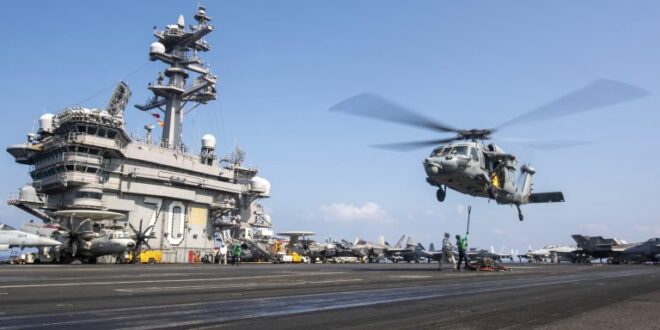
Over the weekend, Iran retaliated against U.S. strikes on its missile launchers on Larak Island by striking Jordan’s Muwaffaq Salti Air Base, which hosts a significant U.S. military presence.
The U.S. has been unable to achieve its strategic objectives despite the use of overwhelming airpower and economic pressure, but Iran’s ability to unsettle the global economy and energy markets has not, as Tehran anticipated, coerced the U.S. to end the campaign.
Recognizing the vulnerability of the Arab Gulf states to Iranian strikes, the U.S. military posture in the Persian Gulf is likely to return to its pre-1991 “over the horizon” presence, de-emphasizing forward positioning in large Gulf bases.
Iran’s “Axis of Resistance” allies have not been decisive “force multipliers” for Tehran’s war effort, calling into question Iran’s decades-long forward defense strategy.
The U.S.-Iran war reached the six-month mark on Friday, still unresolved. Although mediators from Pakistan, Qatar, and Oman have intensified their efforts to re-establish Washington’s and Tehran’s commitment to the collapsed but still viable June peace outline, the Memorandum of Understanding (MOU), Iran and the U.S. have continued to trade blows. Over the weekend, U.S. forces struck Iranian missile launchers on Larak Island, which the U.S. had assessed were preparing to launch rockets with sea mines into the Strait of Hormuz. The Iranian Revolutionary Guard Corps (IRGC) retaliated shortly after by striking Jordan’s Muwaffaq Salti Air Base, which hosts a significant U.S. military presence. Mediators have previously assessed President Trump as eager for an end to a conflict that has depleted the U.S. munitions arsenal, harmed the global economy, and diminished his domestic support in advance of November mid-term elections. Regional leaders also perceive that an acknowledged erosion of Iran’s control over traffic through the Strait of Hormuz, as well as severe economic conditions inside Iran, have expanded support within Iran’s regime to bring the conflict to a conclusion.
However, the recent strikes cast doubt on the mediation process, as leaders on both sides appear to believe they retain commanding strategic positions and will not accept a settlement on unfavorable terms, complicating mediation efforts. The threat of a return to major combat lingers, especially after the recent strikes, even as the two sides express interest in a resolution. President Trump had previously told journalists last week that he did not anticipate, but also did not rule out, ordering any additional kinetic strikes, asserting the U.S. will rely instead on Operation Economic Outcast. The initiative, announced last week, represents an effort to strangle Iran economically and soften its bargaining positions. Yet Iranian forces continue to attack ships transiting the Strait, and regime leaders are threatening military escalation to restore Iranian control of the Strait and compel Trump to end the U.S. naval blockade of Iranian ports.
The hurdles to a mediated settlement stem largely from both leadership teams’ refusal to abandon flawed strategic assumptions. Overruling the assessments of the U.S. intelligence community, President Trump assessed that a U.S.-Israeli “decapitation” strike that killed Iran’s Supreme Leader in the opening air strikes of the war would collapse Iran’s regime. The Trump team reportedly continues to believe economic pressure will cause the regime to collapse, even though it remains cohesive, in charge, and implementing a counter-strategy developed over decades. No popular uprising against the regime has materialized to date.
U.S. officials also assessed — again contrary to the advice of U.S. military and government professionals — that the application of overwhelming air power would, at the very least, be able to coerce the regime to accept U.S. demands for a settlement. The Trump team still asserts that crippling economic sanctions and maintenance of the naval blockade will eventually cause Iranian leaders to capitulate, including acceding to maximum U.S. demands to completely dismantle its nuclear program. However, Iran has not changed any of its core positions, affirming U.S. intelligence estimates that the regime is able to transfer almost all the economic pain to a population that can be cowed by Iran’s large security apparatus. Even if both sides return to the MOU, the accord defers the core U.S. goal of severely restricting Iran’s nuclear program to further negotiations, and there are no indications the regime will agree to dismantle the program outright.
Iran has followed a strategy developed over decades to counter a U.S. or Israeli assault. Tehran’s policy centers on using a large arsenal of ballistic and cruise missiles and attack drones to close the Strait of Hormuz, shatter the Gulf states’ sense of security, upend the global economy and energy markets, and force U.S. leaders to end the assault. Long ago, anticipating a U.S. or Israeli decapitation attack, the regime established several layers of military and political succession for every post, and delegated to local military units the authority to undertake kinetic action as it sees most effective, known as its mosaic defense strategy. However, IRGC expectations that it could drive oil prices to $200 per barrel or more, and indefinitely thwart U.S. Navy efforts to restore some commercial traffic through the Strait, have not been met. Oil prices reached more than $120 per barrel in April but have since fallen back, although they remain well above pre-war levels. Iran’s attacks caused widespread damage to Gulf state energy infrastructure and to bases that host U.S. forces. But Iran’s arsenal did not cause the Trump team to abandon the campaign, hamper the U.S. ability to operate over Iran or along its waters, or cause Trump to capitulate to Iran’s maximum demands.
Even as experts assess the results of the Iranian and U.S. strategies, the region’s longer-term architecture has been upended. Of paramount significance for the region’s future is the Arab Gulf states’ reliance on a U.S. security umbrella, which is in question. The Gulf states are not likely to downgrade their security partnership with the United States, largely thwarting Iran’s attempts to drive a wedge between the U.S. and the Gulf countries. But Gulf leaders will continue to diversify their strategic relationships, as exemplified by the August “Mecca Agreement” between Saudi Arabia, Pakistan, and Türkiye.
The Gulf states will furthermore re-evaluate whether hosting a large military presence enhances their security. Most Arab Gulf rulers will engage with Iran to avoid further backlash from Tehran, while remaining wary that Iran might try to close the Strait of Hormuz if any of Tehran’s red lines are crossed. Even if the war is settled in the near future, the Gulf states will still move forward at full speed with numerous projects to export energy via pipelines that bypass the Strait of Hormuz. Even if not all of the projects under study are completed, the developments are certain to reduce Iran’s strategic leverage over the Strait over the longer term.
The Gulf leaders’ shaken confidence in the U.S. is reflected within the U.S. strategy community itself, amid reports the Department of War is considering whether to rebuild the Gulf bases damaged by Iranian missiles and drones. In all likelihood, U.S. leaders will alter the U.S. military posture in the region from the forward-positioning U.S. forces assumed after the 1991 Iraq war, returning to an “over-the-horizon” presence. The destruction at the bases, although the facilities remain operational, has also fueled questions about a shortage and high cost of U.S. missile and drone defenses, particularly in comparison to the small amounts Iran spends to produce large volumes of attack munitions. More broadly, experts note that the rival great powers, Russia and China, view the war as a significant U.S. failure, undermining the U.S. global deterrence posture. In late August, CIA Director John Ratcliffe made a rare official visit to Moscow following reported U.S. intelligence findings that Russia might be planning to take advantage of observed U.S. weaknesses to attack NATO countries in northern Europe.
From the Iranian standpoint, the war effort, despite its strategic successes, has failed to reorder the regional balance of power and called into question Iran’s decades-long “forward defense strategy.” Before the war, and particularly before the October 7, 2023 Hamas attack, Iran counted on a wide range of regional allies — its “Axis of Resistance” — to deter U.S. or Israeli attacks on the Iranian mainland. The deterrence effect of the Axis was exposed as flawed by the June 2025 U.S. and Israeli strikes on Iran’s nuclear and missile facilities. And the Axis has not proved a decisive “force multiplier” for Iran in the current war. Hamas and Lebanese Hezbollah had been weakened by Israeli offensives after the October 7 attack, and were poorly positioned to provide decisive help to Tehran in the 2026 war, for example, by spreading thin U.S and Israeli forces, munitions, and missile and drone defenses.
Iran-aligned militias have conducted some effective attacks on behalf of Iran in the current war, particularly targeting energy facilities in Saudi Arabia and Kuwait. But the militias have been set back by U.S. counterstrikes against their headquarters, and their impact on the course of the war has been minimal. The Iraqi militants now face a Baghdad government intent on constraining their ability to embroil Iraq in a regional war on behalf of Tehran. The Houthi movement in Yemen began actively supporting Tehran’s war effort five months into the war, past the point where Houthi actions would decisively swing the balance of power in Tehran’s favor. And Houthi actions to block the strategic Bab el-Mandeb Strait were motivated as much by the Houthis’ pre-war intent to break a Saudi blockade of Houthi-controlled ports and territory as by the need to help Tehran. Houthi attacks on ships in the Red Sea since last month have not materially affected global energy prices.
Iranian leaders have also been surprised that the war has not, as they anticipated, divided Israel from the U.S. or the Arab world. Trump has sidelined Israel from wartime decision-making since the first month of the war, but continues to cooperate broadly on all regional issues. The two Gulf states that normalized relations with Israel under the Trump-brokered 2020 “Abraham Accords” — the United Arab Emirates (UAE) and Bahrain — have suffered significant Iranian attacks, but neither has downgraded relations with Israel or abrogated the accords. The UAE has expanded its defense relations with Israel to help defend against Iranian missile and drone strikes. And, as a potent blow against Iran, Israel and Lebanon are now working together on a plan to disarm Iran’s key regional ally, Hezbollah, and potentially eliminate Iranian influence from Lebanon.