 Eurasia Press & News
The announcement by Hamas of its agreement on the path of handing over its weapons is an exceptional event, which came in light of the announcement of the road map for the implementation of the second phase of the Gaza Strip and the approval of the movement. However, this paper discusses the obstacles to the movement’s delivery of its weapons in light of the requirements it imposes in return for the requirements imposed by Israel, so that “mutual disruption” becomes a term that explains the field and negotiating stalemate. This feature is no longer limited to describing the scene in the Gaza Strip, but also in southern Lebanon.
Hamas announced for the first time in its history its agreement to enter into a path that may end with the delivery of its weapons, in conjunction with the issuance of a detailed road map for the implementation of the second phase of US President Donald Trump’s comprehensive plan for peace in the Gaza Strip, and the map consists of 15 operational points, and constitutes an executive and practical framework for the implementation of the plan put forward by Trump on September 29, 2025, and this step comes after months of negotiating stalemate that followed the entry into force of the first phase of the agreement on October 10, 2025, where the transition to the second phase remained stalled, especially in light of the dispute over the disarmament of Hamas and the Israeli withdrawal from the Gaza Strip. Thus, the approval of the movement on the road map represents a remarkable shift in its previous position on the arms file, although the approval is linked to an executive track and mutual conditions, most notably the cessation of Israeli operations and withdrawal from the Gaza Strip.
Contents of the road map and context
The “Roadmap” consists of 15 points, based on the transfer of the civilian and security administration of the Gaza Strip from Hamas to the Gaza Management Committee, in parallel with the formation of an international stabilization force to support security and monitor the ceasefire, and then begin to dismantle heavy weapons, tunnels and the military structure of the armed factions and store them under the supervision of the National Committee. On the other hand, Israel is committed to a phased withdrawal that coincides with the achievement of disarmament steps, while the Gaza Management Committee is responsible for unifying the police and services and imposing the principle of “one authority, one law, and one weapon,” and the transition between stages is subject to an international investigation mechanism to measure the commitment to implementation, linking the transition of governance, disarmament and withdrawal in one gradual path, and in parallel reconstruction and financing arrangements begin.
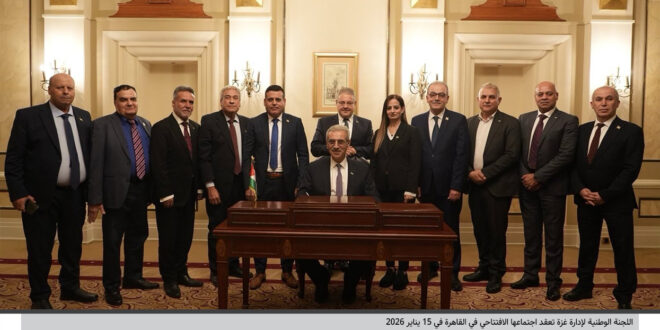
The “road map” came in the context of months of negotiations in Cairo between the movement and the Peace Council, which were centered on how to move to the second phase, specifically the transfer of the management of the sector and disarmament, the Israeli withdrawal, and the role of the International Stability Force, and in light of a series of developments, including the selection of 15 personalities from technocrats and independents as members of the Committee of Administration of Gaza, including the Chairman of the Committee Ali Shaath as Chairman in January 2026, which is supposed to assume its functions under the UN Security Council resolution in which it adopted the Trump Peace Plan on November 17, 2025, but the Israeli rejection of the road map on August 9, the transition to the stage of preparing timetables and executive mechanisms.
However, it was remarkable that Hamas announced for the first time its agreement to a path that ends with the gradual dismantling of its military infrastructure, although this announcement came in a formula that carries obstacles and challenges, but it is a development given its previous positions, as the movement has progressed from its absolute refusal to hand over its weapons, to the requirement to hand it over to an independent and sovereign Palestinian state, and then another formula emerged that speaks of a perception of concealing, storing or pledging not to use it, before turning into a discussion of the inventory of its heavy weapons, including rockets and anti-tank weapons, and placing them under Palestinian or international order and control.
Hamas’s Challenges in the Gaza Strip
According to UN data, 94% of the Gaza Strip’s population needs shelter, and more than 3,000 areas in the Gaza Strip are classified as high-risk according to the assessments of the pest control teams, and the population lacks the basic elements of fuel, energy and household items, and most of the population of the Gaza Strip is concentrated west of the Yellow Line, in less than half of the area of the Gaza Strip. In the midst of all this, the movement does not have the actual ability to provide services to the population or manage their affairs in the Gaza Strip, where it faces additional challenges in paying the salaries of 30,000 civil servants, and reports indicate that the movement pays about 20% of the salaries that were before the war, and in light of the escalation of inflation and crises of food and water shortage, the movement is facing a state of popular discontent, especially among its popular base. Accordingly, the scenario of the movement remaining in the administration of the Gaza Strip became an existential threat no less than the repercussions of the war itself or the handover of its weapons, and therefore one of its first decisions after the ceasefire was to declare its readiness to give up the management of the Gaza Strip in favor of the National Committee for the Administration of Gaza (NCAGIn January 2026, Hamas announced that the protocols, files and committees needed to hand over the administration were ready, and on July 6 the movement dissolved the government’s emergency committee and a number of its administrative officials submitted their resignations, including the head of the government apparatus.
At the military level, since October 7, the movement has lost its most prominent leaders and officials, including Saleh al-Aruri و, Ismail Haniyeh, Mohammed al-Deif and Yahya Sinwar. Israel also assassinated the leader of the military wing of the movement, Izz al-Din al-Haddad, and his successor, Mohammed Odeh, and the series of assassinations against its leaders from the second and third grades is still ongoing. On July 25, 2026, the Israeli army announced the assassination of three of the movement’s most prominent leaders, namely: Raed al-Omsi, commander of the air reconnaissance faction, Nabhan al-Amsi, head of the military intelligence service, and Hamoud Abu Ghazal, commander of one of the movement’s elite cells.
While the dynamic and organizational level faces complex challenges, the movement has been for more than a year and 10 months without the selection of a head of its political bureau, from the assassination of Sinwar on October 16, 2024, until the election of Khalil al-Haya on August 5, which indicates the decline of the movement’s structural capacity on the one hand, and the escalation of differences within its currents on the other hand, especially between the current close to Iran, which is currently led by al-Hayya, the current close to Turkey and the Muslim Brotherhood, led by Khaled Meshaal.
‘Mutual disruption’: between Israeli disarmament and withdrawal
The disarmament process seems to be separate and more complex than the administrative and institutional arrangements, as the agreement signed in July 2026 separates the stages of handing over weapons and dismantling the military structure from the handover of the administration, which of course requires a separate reading of Hamas’s announcement of its acceptance of the handover of its weapons in exchange for its initiative to accept the handover of the administration and even take steps to facilitate and accelerate this process. Therefore, the movement has long promoted even during the war its attempts to repeat Hezbollah’s model in Lebanon, or its experience in the Gaza Strip before 2007, by waiving the administration and remaining a parallel military force, and its willingness to give up its weapons does not indicate a real acceptance of this. In many cases, the movement has tended to respond to field pressures and the pressure of mediators to comply with the texts of the drafts of the agreement, but this does not necessarily mean the movement’s desire or ability to implement, for example, when the movement announced its approval of Trump’s peace plan, its statement published on October 3 of the same year, reversed a flexible trend that oscillates between conditional consensus and implicit reservation.
Similarly, the movement’s announcement can be read on a path that leads to the handover of its weapons; its approval is limited to its heavy weapons, and conditional on the full and not gradual Israeli withdrawal, and this “mutual disruption” where each party links its step to the full step of the other, has become a feature of the various fronts, and has become the last line of defense and the minimum tactical where the complex calculations of the parties to the “unity of the squares” meet, similar to Hamas; Hezbollah requires a full Israeli withdrawal from southern Lebanon before handing over its weapons, while the Iraqi factions , in return Israel adheres to the dismantling of the military structure of both Hamas and Hezbollah and their disarmament before the withdrawal, as it is estimated that the early withdrawal before achieving it loses the military pressure paper, and provides an environment that has always built the two parties and re-established its capabilities and its current continuity.
However, this tactical maneuver, especially by Hamas and the Lebanese Hezbollah, depends on the factor of time, and is linked to the ability of the local communities that host the parties to withstand, in the past, the two sides have had financial capabilities, continuous economic support and continuous Iranian supply of weapons, which made them guarantors of reconstruction and compensation for post-escalation periods and wars and preparation for the next rounds, but in the current scene they constitute an obstacle to the gradual return of the people to their normal lives, whether in the Gaza Strip or southern Lebanon, where the United States links the reconstruction file by handing over their weapons and dismantling their military structure, and in this case, in addition to the general public damage, the damage affects the social incubator of the two parties, which has disintegrated due to the war, where the social and geographical environment that provided them with social and military support networks have changed, for example, the brave one is one of the most important Hamas and its population is one of the most prominent, and the number of people is one of the most, the most numerous, the region of which is less than The same applies to Jabalia camp, which is one of the most important traditional environments of Hamas, and from which most of its leaders and cadres came out, its urban fabric was damaged and about 70% of its buildings and civilian structures were completely destroyed until May 2024, exceeding the damage in any other area of the Strip.
Israeli Rejection: The Thin Thread Between War and Negotiations
The Israeli government has rejected the roadmap, sticking to the withdrawal of arms before a gradual or full withdrawal. While Israel continues to prioritize security arrangements, at the same time it is looking for formulas to ease military burdens, especially with the multiplicity of fronts and the dangers of turning them into long-term attrition yards. In the Gaza Strip, Israel faces challenges in terms of the gap between its perceptions for the next day and the reality on the ground in the Strip, amid uncertainty in the governance and administration arrangements and the international forces in charge of maintaining security and disarmament, which keeps the Israeli army in a state of permanent deployment in the areas outside the yellow line, where two divisions operate inside Gaza, the “Gaza 143 Divisions” and the “99th Reserve Infantry Division”, with other units rotating. With the multiplicity of fronts in southern Lebanon and southern Syria, Israeli military commitments are expanding, according to the Stockholm International Peace Research Institute (SIPRIIsraeli military spending increased from 5.4% in 2022 to 8.8% in 2024. According to the Bank of Israel, public debt rose from 61.5% of GDP in late 2023 to 86.5% in late 2025, and as a result of the continuous call for about 360,000 reserve soldiers, the disruption of work per week leads to the loss of the equivalent of 6% of the weekly GDP.
On the other hand, the gap between the perceptions of the day after Israel and the American perceptions is increasing, as the US administration is pushing to push for the implementation of the road map, and according to the Israeli Broadcasting Corporation, Washington is pressing Israel for a two-week ceasefire in the Gaza Strip to start implementing the plan to disarm Hamas amid the opposition of the Israeli government, and the central dispute between the two countries is reflected in the disarmament mechanism, where Washington demands a gradual and verifiable disarmament mechanism in parallel with an Israeli phased withdrawal, while the Israeli government adheres to the complete disarmament of the movement before Israel withdraws. In addition, Washington is pushing for the start of “day after” arrangements such as the formation of a Palestinian technocratic government, the formulation of international security and reconstruction arrangements, and the formation of an international stabilization force to help with security, training and aid distribution, while Israel maintains its direct security control, while the Israeli army controlled about 64% of the Strip, the government in late May 2026 directed the army to expand control to about 70% of the area of Gaza.
In parallel, Israel seems to have three main considerations: first, to maintain its military deployment and to form buffer zones that have expanded as the war has expanded to a security depth, even temporarily, to ensure that the threat is not reconstituted before disarmament arrangements are completed; second, to maintain space for the independence of the security and military decision, without reaching a point where the United States is forced to impose a settlement or turn the dispute into direct strategic pressure; and thirdly, to formulate a path that ensures that the military deployment does not turn into a long-term war of attrition, as the presence of Israeli forces within “hostile environments” without a final decision can turn Israeli military superiority into cumulative depletion
Therefore, Israel follows a complex pattern, which integrates the negotiating and operational tracks, where it enjoys its operational freedom on the one hand and keeps both Hezbollah and Hamas within the negotiating track that they desperately need, and this also gives Israel a justification for its continued military deployment until the completion of security and political arrangements, and in this sense, Israel manages the scene within the high line between war and settlement, where it does not want to renew the war at its previous pace, nor in the success of negotiations in reaching arrangements and commitments that cannot be reversed, and this is why Israel offers changing complexes at every stage of the negotiation, the treatment of the disarmament complex may open a discussion about the mechanisms of verification, then about international force, then about police and security, and then about borders and areas of deployment, allowing for a long-term negotiation process, and this approach acquires its importance as it ensures the same time, the same thing, the same time, the same as the time that is kept, and within the most precise, short-term, the differences between them, which are preserved, in the same time, as the time is repeated, in the same time.
For her, the prolongation of the negotiation keeps its weapons and influence within the yellow line, gives it legitimacy to confront the armed factions against it, and transforms the local pressure imposed on it towards the Gaza Management Committee, and makes the transition to the next step based on the nature of the Israeli response, while Israel allows it to maintain the Palestinian geographical and administrative division and complicates international demands calling for the return of the Palestinian Authority to the rule of the Gaza Strip.
Finally, it is the scenario of the field stalemate and the inconsensual and long-term negotiations that govern the Gaza Strip scene, as Hamas benefits from this by maintaining its influence within the yellow line and directing its military focus on the armed factions and militias, while Israel remains from its military deployment outside the yellow line, and ensures that Hamas remains an internal Palestinian obstacle without demanding the international community to qualify the Palestinian Authority to unify the West Bank and the Gaza Strip administratively.