Eurasia Press & News
Key Takeaways:
A country can be militarily strong and still easy to interrupt. Limited attacks—such as drones on Saudi Arabia’s East-West Pipeline and earlier Houthi strikes—can force rerouting, shutdowns, and delays whose cost exceeds the physical damage, including UNCTAD’s estimate that avoiding Bab el-Mandeb can stretch a Yanbu-to-South Korea crude voyage from about 24 days to 54.
The author calls this “autoimmune war”: the defender’s own rational responses—interception, dispersal, alerts, closures—become a large share of the burden. Ukraine’s Operation Spiderweb and pressure on Navy logistics in Bahrain illustrate the pattern, but the concept applies most when self-protection, not just wreckage, drives the cost.
Expensive weapons still matter; the gap is endurance. Count interruption as well as interception, buy redundancy that is truly independent, and treat repair, spare capacity, and civil-military resilience as core defense—so a local attack cannot cascade into system-wide paralysis.
Small attacks no longer have to destroy powerful systems. They can win by triggering the defender’s own protective machinery until defense itself becomes the damage.
A country can be militarily superior and still be dangerously easy to interrupt.
On September 17, Reuters reported damage to three pumping stations on Saudi Arabia’s East-West Pipeline after a drone attack that Saudi officials said originated in Iraq. The pipeline had been carrying four million to five million barrels of oil a day. Repair estimates varied. Separately, earlier Houthi attacks had halted operations at some Saudi energy facilities.
The consequences extend beyond the damage. In a September 17 statement, UN Trade and Development explained that avoiding the disrupted Bab el-Mandeb route could extend a Saudi crude delivery from Yanbu to South Korea from about 24 days to roughly 54. The ship need not be sunk. Another month at sea ties up capacity and raises costs.
This is the asymmetry defense planners should put at the center of their budgets: a relatively limited attack can impose a much larger burden on the systems that keep a country functioning.
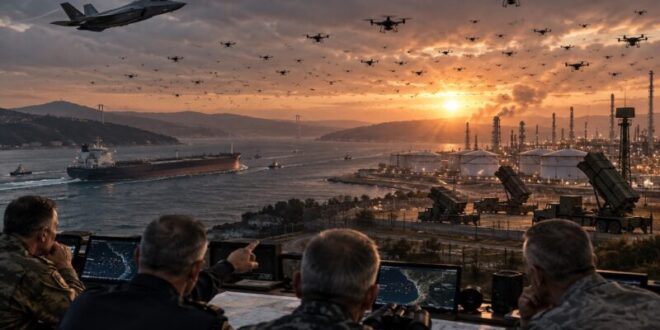
Call it autoimmune war. In an autoimmune disease, the body’s protective system begins damaging the body it exists to defend. Modern conflict is developing an analogous strategic vulnerability. A relatively small attack can trigger interceptions, shutdowns, dispersal, rerouting, precautionary closures and emergency restrictions whose accumulated cost exceeds the direct damage inflicted by the weapon itself. The attacker’s leverage comes not only from what it destroys, but from what the defender does to itself in order to remain safe.
This is not simply cost imposition, sabotage or provocation. The threat may be real, the defensive response may be rational, and every individual decision may be correct. The failure appears at system level when individually sensible protective actions accumulate into strategic paralysis.
The weapon is only part of the cost
Ukraine’s June 2025 Operation Spiderweb remains a striking illustration. Two U.S. officials told Reuters that the attacks hit as many as 20 Russian warplanes and destroyed around 10; Reuters could not independently verify either that assessment or Ukraine’s higher figures. Even the lower estimate points to a serious vulnerability in how valuable aircraft are protected.
Nor was the operation simply a purchase of inexpensive drones. Intelligence, preparation, access and coordination were part of the capability. Counting only the airframes understates the attacker’s investment, just as counting only destroyed aircraft leaves out the resources needed to protect surviving assets and replace losses.
The Iran conflict shows a different version of the same problem. Associated Press reporting on the Pentagon inspector general’s September assessment described Iranian drone and ballistic-missile attacks on the Navy’s logistics hub in Bahrain and the diversion of support to more distant locations, including Diego Garcia. The report described logistics cycles of 14 to 18 days. Damage to a support network can constrain a fleet without defeating its ships at sea.
Across these campaigns, drones operate alongside missiles, intelligence networks and substantial organizational effort. They are not interchangeable examples of autonomous swarms. What connects them is their ability to turn disruption at one point into costs and restrictions elsewhere.
Not every low-cost attack is an autoimmune-war case. Operation Spiderweb, for example, is primarily evidence of vulnerability to direct attack: the physical damage was the effect. The concept applies most strongly when the defender’s own response – interception expenditure, dispersal, shutdown, rerouting or precautionary restriction – becomes a major share of the total burden. The distinction matters because a useful theory should separate cases rather than absorb all of them.
Do not write the obituary for expensive weapons
The claim that advanced aircraft, missile defenses and strategic deterrents are now useless mistakes a change in vulnerability for the disappearance of military capability. Indeed, Saudi Arabia reported intercepting a Houthi ballistic missile aimed at Riyadh on September 19. Prevented damage belongs in the assessment alongside damage that occurred.
An expensive interceptor can be worth firing at a cheap threat when it protects people or an irreplaceable facility. Drones cannot replace every mission performed by aircraft, ships or strategic deterrents. But owning formidable weapons does not by itself supply a convincing answer to whether the bases, energy systems and transport networks supporting them can withstand repeated disruption.
Sabotage, raiding and attacks on logistics are not new. The urgent problem is their combination with repeatable, relatively inexpensive means of attack and societies whose essential services depend on tightly connected systems.
The question is therefore not whether to replace every expensive weapon with a cheap one. It is how to prevent an adversary from obtaining system-wide consequences at a price it can repeatedly afford.
Count interruption, not only interception
A cost comparison between an incoming drone and the missile used to destroy it captures only one transaction. Defense has a longer bill: surveillance, crews, alerts, protective shutdowns, diverted transport, replacement parts and the work required to restore confidence in a damaged service.
The relevant measure is the autoimmune share of the bill: how much of the total burden came from the defender’s own protective response rather than from direct physical damage. This is a planning lens, not a universal formula. Protecting lives cannot be reduced to a price ratio. But budgets should distinguish the number of threats defeated from the amount of essential activity preserved, and they should identify when the response itself has become a major source of lost capacity, diverted movement or defensive expenditure.
Consider a hypothetical port that remains physically intact but repeatedly suspends operations during alerts. Its defenses may perform well in each encounter while ships accumulate offshore. A hospital can possess backup generators yet remain exposed if fuel deliveries cannot reach them. The problem lies in the dependency between services, not necessarily in the performance of any single component.
This is why the first successful interception is an incomplete demonstration. Planners should ask what remains available after successive disruptions: which functions continue, which must stop for safety, how quickly substitutes work, and whether the defensive system can sustain the effort without exhausting scarce people or supplies.
An adversary need not win every exchange if the cumulative burden keeps narrowing the defender’s choices.
Buy a smaller consequence, not just a better shield
Active defense remains indispensable: detection and the ability to defeat credible threats. That investment should be integrated with physical protection, alternative service arrangements and repair capacity. A better interceptor and a less consequential failure solve different parts of the problem.
Current military adaptation already recognizes the need for integration. NATO’s communications agency described its August Baltic Trust 26 exercise as moving counter-drone systems from interoperability testing into a realistic operational environment. That is valuable. The next budget question should extend beyond the engagement: what essential activity does the combined defense preserve through repeated pressure?
This changes the status of assets that procurement culture can treat as secondary. Repair teams, interchangeable spares, protected operating sites, alternative communications and practiced service transitions should be evaluated for the military and civilian functions they preserve. Their value is not that they are cheaper than combat platforms. It is that they keep those platforms and the communities behind them usable.
Redundancy also needs an honest definition. Two facilities do not provide meaningful independence if both require the same damaged substation, unavailable supplier or inaccessible technical team. A backup should be credited as independent only when its dependencies and operating limits have been examined, not simply because another box appears on a diagram.
Automation can help coordinate a response, but it should not create a new common point of failure. Local operators need tested options when a shared network or central service is unavailable. Consequential automated actions should remain bounded by their purpose and operating conditions. A fast response that spreads one uncertain judgment across every connected service can enlarge the original disruption.
The defensive answer is tolerance in the engineering sense: the capacity to absorb a bounded attack without allowing protective actions to cascade into wider service loss. That means compartmentalized responses, local operating modes, reversibility and thresholds designed around mission consequences. Tolerance does not mean accepting attack. It means denying the attacker an oversized systemic payoff from the act of defending against it.
This is a design requirement, not a claim that any one architecture can deliver national protection. Hardware, trained people, lawful decision-making and independent testing still have to work together.
Make endurance a defense requirement
There is a timely policy opening. NATO’s 2026 resilience baseline requirements, published September 15, call for stronger repair and restoration capabilities, attention to cascading dependencies, and civilian planning that supports military operations while mitigating consequences for the population. The task is to turn that direction into funded, demonstrable capacity.
Governments should require major defense and infrastructure programs to state what essential service survives a defined disruption, what alternative is available, how long restoration takes and who supplies the people and parts. Exercises should involve the operators who actually own those dependencies. A successful demonstration with all support services available is not evidence of endurance when several are lost.
The costs must be assigned as clearly as the responsibilities. Private operators cannot be expected to reserve equipment, maintain spare capacity or support extraordinary demand indefinitely without agreements about payment and authority. Public protection should not become an unfunded instruction to someone else’s business.
The strategic logic is already part of NATO’s approach to civil preparedness: military forces depend on civilian energy, transport, communications and supplies. For countries outside NATO, the same practical question remains: can the systems supporting national life continue under pressure?
This does not replace deterrence, combat power or diplomacy with passive endurance. It makes them harder to undermine through disruption. A government with workable alternatives has more room to decide than one facing an immediate choice between escalation and the loss of essential services.
The lesson of small weapons is not that large powers have become powerless. It is that power must also be measured by whether a state can absorb repeated attack without its own protective response multiplying the disruption.
The next defense advantage will belong not simply to the country that can hit hardest, but to the one that is hardest to stop. In the age of autoimmune war, the decisive test is whether a defender can contain a local attack without turning its own protective machinery into a system-wide failure.