 Eurasia Press & News
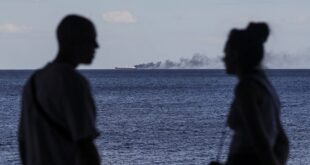
The Yemen-based Houthis’ naval blockade of Saudi Arabia and capture of additional territory near the Red Sea’s critical Bab el-Mandeb Strait adds a new dimension to the Iran war, with potentially major consequences for the region and the global economy.
The Yemen-based Houthis’ naval blockade of Saudi Arabia and capture of additional territory near the Red Sea’s critical Bab el-Mandeb Strait adds a new dimension to the Iran war, with potentially major consequences for the region and the global economy.
As the United States and Iran remain locked in a struggle for control over the Strait of Hormuz, concerns continue to mount about the security of another regional maritime chokepoint: the Red Sea. Since the start of the Iran war, the Iran-backed Houthi rebels have made a concerted effort to restrict oil and gas flows through the vital Mideast waterway. In September 2026, two months after the group declared a complete naval blockade on Saudi Arabia, which relies on the Red Sea to access global oil markets, the Houthis seized control of the strategic port city of Mokha and several islands near the Bab el-Mandeb Strait—expanding their control over Yemen’s Red Sea coastline. Since June, the Houthis have also banned all Israeli and Israeli-linked ships from transiting the Red Sea, calling them “legitimate military targets.”
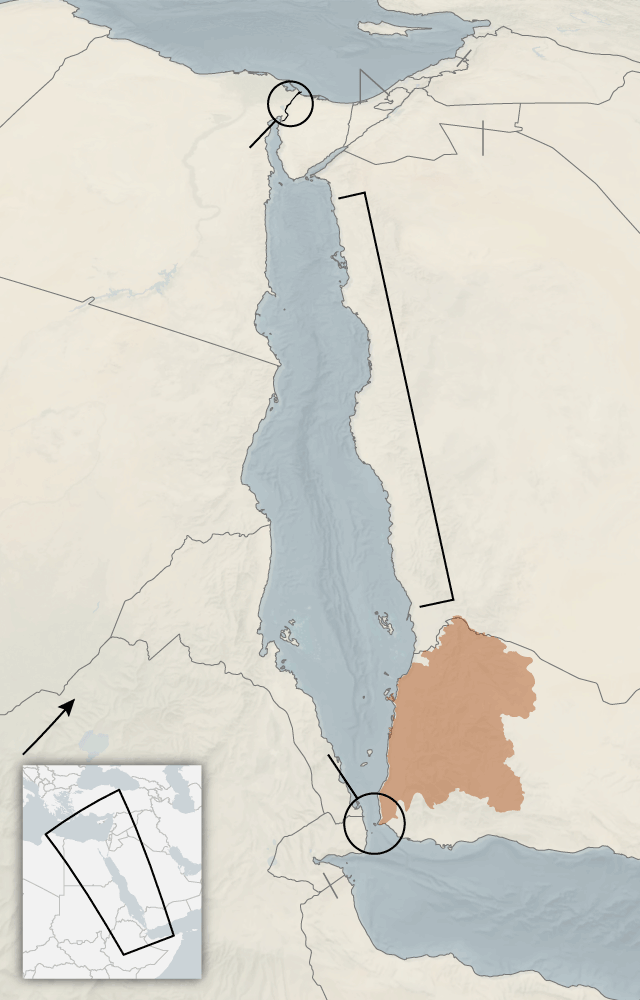
The Red Sea, a 1,400-mile-long inlet between northeastern Africa and the Arabian Peninsula, is one of the world’s most important arteries for global shipping. Each year, approximately 12 to 15 percent of global maritime trade worth more than $1 trillion transits the waterway, which extends from the Suez Canal in the north to the Bab el-Mandeb Strait in the south. Experts say sustained interference in the Red Sea, especially by the Houthis, would trigger severe supply-chain delays, drive up energy prices, and further destabilize the global economy.
“The issue is not just the sheer volume of oil that typically transits the Bab el-Mandeb Strait, but that the loss of a guarantee of safe passage through the Bab el-Mandeb Strait—much less the Red Sea at large—would represent a further contraction of viable oil and liquefied natural gas trade routes between the Middle East and other regions,” said CFR energy and climate expert Clara Gillispie. “This would place further strain on already fragile global energy markets.”
The Red Sea has been an active conflict zone since 2023, when the Yemen-based Houthis began attacking commercial and naval vessels in protest of Israel’s military campaign in Gaza, significantly disrupting international shipping. The group’s entry into the Iran war in March by firing missiles at southern Israel underscored the Red Sea’s potential to become a new front in broader regional tensions.
Why do the Red Sea and the Bab el-Mandeb Strait matter?
The UN International Maritime Organization describes the Red Sea as “one of the most critical maritime routes enabling global trade.” Between 12 and 15 percent of international seaborne commerce and 30 percent of global container traffic pass through the waterway annually, ferrying agricultural products such as grains and fertilizers, raw materials like ores and metals, industrial components like electronics, automotive parts, and energy resources.
About 4.9 million barrels per day (bpd) of crude oil and petroleum products transited the Suez Canal and the Suez-Mediterranean Pipeline—both on the Red Sea’s northern end—in the first half of 2025, according to the U.S. Energy Information Administration (EIA). Some 4.2 million bpd crossed through the Bab el-Mandeb Strait, at the Red Sea’s southern end. Together, oil shipments via these three routes accounted for approximately 6 percent of all seaborne-traded oil during that time. By comparison, oil flows through the Strait of Hormuz averaged almost 21 million bpd in the same period.
The Red Sea is also considered a digital chokepoint, as an estimated 90 percent of undersea fiber optic cables linking Europe and Asia pass through the waterway. These cables “represent critical sovereign underwater infrastructure that is no less significant than oil and trade routes,” Abdullah Jaber AlZaidi, senior advisor on defense and security studies at the Gulf Research Center, wrote in a CFR global perspectives roundup. Previous damage to these cables caused major disruptions to internet connectivity and cloud services across the region, as well as in Africa and Asia.
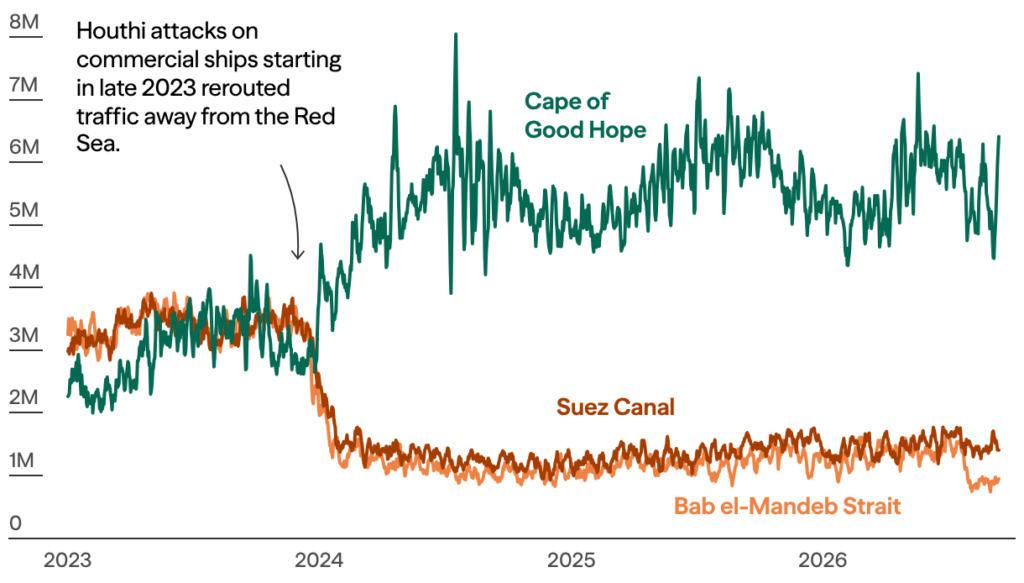
Red Sea Disruptions Are Ongoing
7-day average trade volume in metric tons through select chokepoints
At the same time, experts say the Houthis’ increased attacks are testing the new Mecca Joint Defense Agreement that was signed by Pakistan, Saudi Arabia, and Turkey in August 2026. The agreement includes a NATO Article 5-like clause, which declares that an attack on one member country would be considered an attack on all. Saudi Arabia has yet to invoke the agreement, but both Pakistan and Turkey have condemned the attacks.
How does the Red Sea fit into the broader Iran war?
As Iran’s disruption of the Strait of Hormuz continues, experts say the Red Sea could quickly become the war’s next chokepoint. “Historically, Washington’s protection of freedom of navigation went hand-in-hand with the core interest in ensuring the free flow of oil and gas from the Middle East,” said CFR expert Steven A. Cook. “The closure of the Strait of Hormuz and the potential closure of the Bab el-Mandeb [Strait] are a test for both.”
The twenty-mile-wide Bab el-Mandeb Strait is the only point of entry to the Red Sea from the Indian Ocean and runs alongside Houthi-controlled territory in Yemen. While it’s unclear whether Iran would deploy its own forces to attack shipping in the strait, years of Iranian support has boosted the Houthis’ military prowess, enabling them to project force into the Bab el-Mandeb Strait and the broader Red Sea.
Ali Akbar Velayati, senior advisor on international affairs to Iranian Supreme Leader Mojtaba Khamenei, wrote on social media in April that Iran’s “Resistance front”—referring to its coalition of Iran-aligned groups across the Middle East—“views Bab el-Mandeb as it does Hormuz.” He added that “if the White House dares to repeat its foolish mistakes, it will soon realize that the flow of global energy and trade can be disrupted with a single move.”
The current Houthi campaign marks a sharp departure from the group’s previous pullback since Israel and Hamas reached a ceasefire in Gaza in late 2025. The attacks have progressively escalated, from initial attacks on shipping infrastructure to Saudi reports of an attempted drone strike aimed at Mecca, the Muslim holy site, and Houthi claims of downing a Saudi F-15 fighter jet.
With a fraction of the ship traffic flowing through the Strait of Hormuz, the Houthis’ targeting of Saudi Arabia—one of the Middle East’s largest oil exporters—threatens to block another critical waterway for global energy markets. Saudi Arabia exports around four to five million bpd through a pipeline network connecting its oil fields to Red Sea ports, making access to the Bab el-Mandeb Strait critical, according to CFR expert Edward Fishman. “But the Houthis, who are Iranian allies, could theoretically shut off the Bab el-Mandeb and basically make it so that Saudi Arabia doesn’t have any way to export oil,” he said.
Previous Houthi attacks on the Red Sea have highlighted the economic stakes. The group’s response to the Israel-Hamas war disrupted maritime traffic in the Bab el-Mandeb Strait, causing oil shipments to fall by more than half, from 9.3 million bpd in 2023 to just 4.1 million bpd in 2024.
Who is involved in the Red Sea conflict?
Several major regional and external actors are involved in the Red Sea, including:
Houthis. The Yemen-based group, considered an independent partner of Iran, began targeting Israeli and international shipping in the Red Sea in late 2023 in response to Israel’s military campaign in Gaza. The group later announced a halt to attacks on non-Israeli vessels following the 2025 Gaza ceasefire. However, the July 2026 naval blockade declared by the Houthis on Saudi Arabia marked an expansion of its maritime campaign. Since then, the group has escalated its attacks on Saudi territory and infrastructure while expanding its territorial control along Yemen’s Red Sea coast; in September 2026, the Houthis seized the Yemeni port city of Mokha, as well as the islands of Perim and Greater and Lesser Hanish, near the Bab el-Mandeb Strait.
Iran. Tehran uses the Red Sea to project power, disrupt global trade, and challenge Western influence in the region. In retaliation for the United States’ naval blockade, which the Pentagon projected in May 2026 had cost Iran nearly $5 billion in lost oil revenue, Iranian officials had previously only threatened to use the Houthis to shut down the Bab el-Mandeb Strait. Iran is the group’s primary benefactor, providing them with security assistance including weapons transfers, training, and intelligence support. Some reporting indicates that Iran’s Islamic Revolutionary Guard Corps have advised the Houthis as they carry out their military campaign in the Red Sea.
Israel. The country has been a frequent target of Houthi attacks, which have significantly disrupted activity at the Port of Eilat, Israel’s only port on the Red Sea. Houthi aggression prompted Israel to launch retaliatory air strikes on Houthi-controlled ports and infrastructure in Yemen, though direct hostilities largely halted in late 2025. They have since resumed.
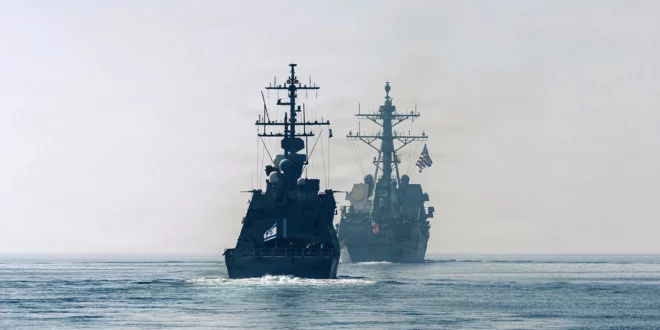
United States and allies. Washington and its allies have taken action to protect global shipping and restore freedom of navigation in the Red Sea. In response to the Houthis’ initial attacks in 2023, the Biden administration launched Operation Prosperity Guardian, a multinational security initiative that included forces from France, the United Kingdom, and other European countries. In March 2025, the Trump administration launched Operation Rough Rider, a more aggressive offensive targeting Houthi bases in Yemen. The operation ended in May 2025 after the United States reached a temporary ceasefire agreement with the Houthis. However, the agreement did not mandate the Houthis to stop attacking other countries’ ships—namely Israeli and Israeli-linked ones—and the ceasefire collapsed after two months. In September 2026, U.S. officials reportedly met with representatives from the group, during which the Houthis assured that they would not target U.S. ships in the Red Sea.
What are the ramifications beyond the Middle East?
In addition to disruptions to international shipping, experts warn that greater instability in the Red Sea could exacerbate existing crises in North and East Africa.
“There are already multiple, interconnected tensions in the region relating to the Nile waters, Ethiopia’s desire for port access, Sudan’s civil war, and Somalia’s political and security crises,” said CFR Africa expert Michelle Gavin. Many of these conflicts are being shaped by competition among Middle Eastern powers—including Qatar, Saudi Arabia, Turkey, and the United Arab Emirates—through strategic investments, military support, and security cooperation. “The more heated the competition gets, the more it is likely to result in conflict on African soil,” Gavin added.
Asian nations are also increasingly bearing the brunt of disruptions in the Red Sea, as Saudi Arabia’s East-West pipeline, which carries oil bound for Asia, temporarily closed following a drone attack by an Iran-backed militia. As of 2023, Asia is the primary export market for roughly 75 percent of Saudi Arabia’s total annual crude oil exports; other leading buyers include China, India, Japan, and South Korea.
What are the alternatives to the Red Sea?
For Iran and the Houthis, entirely blocking off the Bab el-Mandeb Strait would be difficult. Unlike the Strait of Hormuz, which is the only maritime outlet from the Persian Gulf to the open ocean, ships that enter the Red Sea via the Bab el-Mandeb Strait could exit through the Suez Canal in the north. Even so, a simultaneous and prolonged disruption of both straits could disrupt oil transit routes carrying about 24 percent of global oil supply, according to EIA data, leaving countries with even fewer options to transport oil in and out of the region.
CFR’s Fishman noted that while alternative routes exist, they are significantly less efficient. Oil shipped from Saudi Arabia’s Red Sea ports to Asia could travel north through the Suez Canal and the Mediterranean Sea before circumnavigating the entire African continent to get to the Indian Ocean. But “it’s a substantially longer trip,” Fishman said. “Not impossible—you can still get the product to market—but it’s nowhere near as convenient as using the Bab el-Mandeb.”
Routing vessels around South Africa’s Cape of Good Hope also presents challenges. “Southern African ports are not well positioned to take full advantage of the maritime traffic being rerouted around the Cape,” said Gavin, adding that “it takes time to invest in port infrastructure and efficiency.”
Some Gulf states have invested in overland trade and logistics corridors to reduce reliance on Red Sea shipping routes—such as the land bridge between the United Arab Emirates and Saudi Arabia—but these alternatives are highly costly.