Eurasia Press & News
Operation Dawn has opened a new chapter in Yemen’s long-running war, bringing the strategically vital Bab al-Mandeb Strait back to the centre of the conflict, as Iran, the United States, Pakistan and Türkiye are increasingly drawn into a wider struggle.
On 4th October, Yemeni President Rashad al-Alimi said in a televised address,
“Today, I announce the start of military operations to retake the remaining territory of the republic and extend the authority of the state and its institutions across the entire national territory.”This was the statement after which, on 5th October, the Saudi-led coalition and Yemen’s military forces launched an offensive against the Houthis, marking the beginning of Operation Dawn of Yemen. Saudi-led coalition spokesman Maj. Gen. Turki al-Maliki said 100 fighter jets were supporting Yemeni government forces. According to sources, the coalition had destroyed 324 targets since the beginning of the operation. The operation combines Saudi-led coalition air support with a ground offensive by Yemeni government-aligned forces, and they conducted a multi-domain military operation, including air strikes (100 jets), ground operations (in Dhubab and Mokha), and naval strikes in Hodeidah province, where they foiled the Houthis’ plan to attack ships in the southern Red Sea.
The question now is not whether Pakistan and Türkiye have entered the Yemen war, but how far the Makkah alliance will evolve if Houthi attacks on Saudi Arabia continue
Recent escalations have their roots in the 2011 Arab Spring protests, which eventually led to President Ali Abdullah Saleh transferring power to his deputy, Abdrabbuh Mansur Hadi, in 2012. Because of the instability during the Arab Spring and the subsequent weakening of the government, the Houthis were able to expand their territorial influence and eventually captured Sana’a, the capital of Yemen, in 2014. In March 2015, at the request of the Yemeni President, Saudi Arabia intervened to stop the Houthis from consolidating control over Yemen and to protect its own southern border. The UN-mediated truce began in April 2022, significantly reduced hostilities but failed to produce a lasting peace agreement. It also ended in October 2022 since the parties failed to agree to an extension. In November 2023, Houthis once again began to attack commercial ships in the Red Sea in support of Gaza.
On 11 September 2026, Houthi forces seized the strategic Yemeni island of Perim and the nearby coastal town of Dhubab, giving them a powerful position overlooking the Bab al-Mandeb Strait. To avoid the Houthis’ territorial expansion in Yemen, President Rashad al-Alimi announced plans to carry out a military operation against the Houthis. Operation Dawn of Yemen is not simply an attempt by the Yemeni government to regain lost territory. The geography of the current battlefield has transformed the military campaign into a wider geopolitical contest. If the Houthis establish a strong foothold along the Red Sea coast, their ability to threaten maritime traffic and exert pressure on Saudi Arabia could increase.
Significance of Bab-al-Mandeb
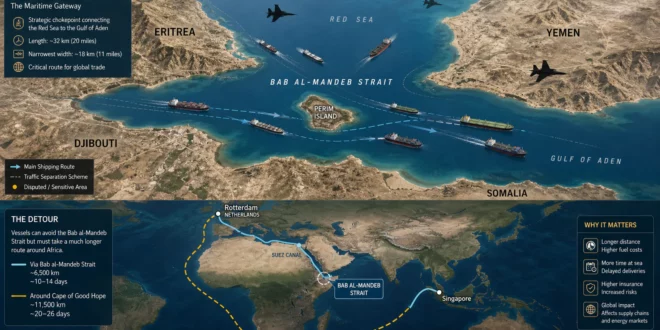
Bab-al-Mandeb is a major choke point connecting the world’s trading routes. The Bab al-Mandeb carries roughly 10% of global maritime trade and a significant share of global energy shipments. The strait is located at the southern end of the Red Sea, connecting the Gulf of Aden with the Arabian Sea. It links the Indian Ocean with the Mediterranean. It’s an important strait which links Asia, the Middle East, and Europe. Any disruptions in this region can cause huge losses in maritime trade.
The Houthi attacks in the Red Sea in October 2023 and their taking control of Bab al-Mandeb in September 2026 have caused havoc in the region. Many shipping companies have diverted vessels around the Cape of Good Hope, adding thousands of nautical miles to journeys between Asia and Europe and increasing fuel, insurance and freight costs. Before the latest counteroffensive on October 5, 2026, the Houthis had seized key positions along Yemen’s western coast, including Dhubab and the strategically important Perim Island, while advancing toward Mocha. Mocha is a geographically significant city because of its location close to the Bab al-Mandeb, while Perim Island sits directly within the strait and has historically possessed considerable military and maritime significance.
Alfred Thayer Mahan, a United States Navy officer, in his seminal book The Influence of Sea Power Upon History, wrote that “Whoever rules the waves rules the world.” An impactful sentence from the 19th century still echoes through the conflicts of the 21st century.
Saudi Arabia’s Interests in the Yemen War
Yemen shares a long border with Saudi Arabia. Any unusual activity in Yemen can cause a security dilemma in Saudi Arabia. In past, Saudi Arabia has played its role as a peacemaker in the Yemeni civil war, but this time Saudi Arabia has launched airstrikes against the Houthis to protect its borders and maritime routes leading to Western trade. For Saudi Arabia, pushing Houthi forces away from the choke point is an attempt to prevent the emergence of a permanent hostile military zone on its borders.
Saudi Arabia has security threats from the Houthis. The Houthis have an arsenal of ballistic and cruise missiles, which they have used in the Jazan, Najran and Abha, southwestern cities of Saudi Arabia. The combination of Houthi missile and drone capabilities and their temporary control of strategically important positions near the Bab al-Mandeb presents a direct security concern for Saudi Arabia. Interestingly, in September 2026, Anthropic reported that users in Houthi-controlled northern Yemen had attempted to use its Claude AI model to develop guidance and navigation software for advanced weapons. Although Anthropic blocked the accounts after detecting the activity, a test of a guided rocket had already been attempted and failed. This shows that they are trying to expand their military capabilities beyond the traditional weapons they were using, which should cause further alarm for Saudi Arabia.
Saudi Arabia does not want an Iranian-backed militia to operate near its border. This can provide access to Iran for creating its home in the backyard of Saudi Arabia. Therefore, Operation Dawn of Yemen can be read as an attempt to restore a security buffer around Saudi Arabia and the Red Sea while reducing the Houthis’ leverage.
Makkah Joint Defence Agreement in Action?
On 7th August 2026, Pakistan, Türkiye, and Saudi Arabia signed a collective defence agreement known as the “Makkah Joint Defence Agreement”. According to this agreement, any attack on one state is considered an attack on all. After the Houthis’ counterstrikes on Saudi Arabia’s major cities and its Aramco facilities, the three countries held an emergency meeting of the Strategic Political and Defence Committee in Riyadh. Their joint statement announced an immediate implementation of the defence agreement.
On September 18, Pakistan’s military spokesperson had said Islamabad would go to “any extent” to defend Saudi Arabia, while Defence Minister Khawaja Asif had earlier said Pakistan would stand by Saudi Arabia both practically and diplomatically if the situation escalated.
As of October 6th, the three countries have now agreed to the rapid deployment of agreed military forces and capabilities to Saudi Arabia. However, Pakistani and Turkish forces have not been confirmed as participating in combat operations inside Yemen; Defence Minister Khawaja Asif said Saudi forces were conducting the fighting in Yemen while Pakistan and Türkiye were providing support. The question now is not whether Pakistan and Türkiye have entered the Yemen war, but how far the Makkah alliance will evolve if Houthi attacks on Saudi Arabia continue.
Conclusion
Operation Dawn in Yemen is deepening the regional and international dimensions of Yemen’s long-running civil war. Houthi territorial expansion has increased Iran’s leverage. The United States is not directly conducting the current offensive, but it has provided intelligence and operational support to Saudi Arabia, reflecting Washington’s interest in protecting maritime security. Pakistan and Türkiye’s involvement through the Makkah Joint Defence Agreement signals an emerging regional security network. The outcome will determine whether Bab al-Mandeb becomes a source of strategic leverage or a trigger for prolonged regional escalation.