 Eurasia Press & News
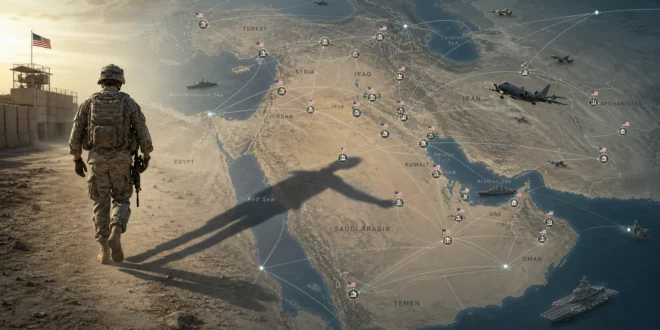
America’s last troops have left Iraq, but anyone looking for a US withdrawal from the Middle East is looking in the wrong place.
The end of the Iraq model
On September 30, the United States completed the withdrawal of its forces and equipment from Erbil Air Base, formally ending the mission of Operation Inherent Resolve in Iraq. More than two decades after the 2003 invasion, the American military presence that once reached roughly 170,000 troops at its peak has finally come to an end.
It is tempting to see the withdrawal as another milestone in America’s long-promised disengagement from the Middle East. Washington has spent more than a decade trying to shift strategic attention towards China and the Indo-Pacific. Barack Obama spoke of a “pivot” to Asia; Donald Trump repeatedly denounced America’s “endless wars”; Joe Biden withdrew from Afghanistan. Now Trump has completed the withdrawal from Iraq. But leaving Iraq is not the same as leaving the Middle East.
Washington wants to become less present without becoming less powerful
The clearest evidence comes from the US military itself. In August, the commander of US Central Command, Admiral Brad Cooper, toured Bahrain, Iraq, Israel, Jordan, Saudi Arabia and the United Arab Emirates, as well as an American aircraft carrier operating in the Arabian Sea. CENTCOM reported that more than 50,000 American service members were operating across the Middle East. Thousands of additional troops have very recently been deployed.
Nor has the mission conducted from Iraq simply disappeared. CENTCOM says the withdrawal represents a transition towards a bilateral US-Iraq defence relationship. The Combined Joint Task Force responsible for Operation Inherent Resolve remains operational, but its headquarters has moved to Jordan, from where the United States continues counter-ISIS operations in Syria alongside its partners.
Iraq therefore illustrates something more consequential than American retreat. What is disappearing is a particular model of American power: the post-9/11 reliance on prolonged ground deployments, counterinsurgency and direct responsibility for another country’s internal security. The emerging model seeks to achieve regional objectives without another Iraq.
From occupation to power projection
The new American posture is less about occupying territory than maintaining the ability to project military power across it. The infrastructure for doing so remains formidable. A 2024 Congressional Research Service assessment identified eight persistent American bases and another 11 military sites to which the Pentagon had access across the CENTCOM region. Bahrain hosts the US Navy’s Fifth Fleet; CENTCOM maintains its forward headquarters at Al Udeid Air Base in Qatar; and American forces have operated from facilities across Jordan, Kuwait, Saudi Arabia and elsewhere against Iran recently.
CENTCOM’s own 2026 posture statement makes the strategic logic explicit. Its priorities include deterring Iran and its proxies while preserving America’s strategic advantage relative to China. At the same time, it describes the United States increasingly as a security “integrator and enabler” whose regional partners assume greater responsibility for their own defence. American personnel are already embedded alongside partner forces in an increasingly integrated regional air-defence architecture. That represents a significant change in how Washington intends to exercise power.
Instead of hundreds of thousands of soldiers fighting insurgencies, the United States can increasingly rely on air and naval power, missile defence, intelligence, regional partners and rapidly deployable forces. Instead of concentrating troops in politically and militarily vulnerable locations, it can distribute them across a wider network.
Indeed, the war with Iran has exposed the vulnerability of the traditional American basing structure. Pentagon planners have consequently examined whether damaged Gulf installations should be rebuilt to their previous capacity and whether some forces should instead be relocated to locations farther west, including Jordan, Israel or Saudi Arabia’s Red Sea coast. This is retrenchment of a kind, but it is retrenchment from territorial exposure, not necessarily from regional power projection.
The contradiction is particularly visible today. Only days after American troops left Iraq, Washington is reinforcing other parts of its regional posture. The United States has reportedly sent two additional Patriot missile batteries to protect critical energy infrastructure in Saudi Arabia and Qatar. Meanwhile, reports indicate that Washington is preparing to deploy a third aircraft carrier and as many as 10,000 additional personnel to the region as tensions with Iran intensify.
A country simultaneously withdrawing from Iraq and potentially sending thousands of additional military personnel towards the Middle East is not straightforwardly disengaging. It is redistributing the geography and instruments of its power.
The paradox of American retrenchment
Iran explains much of why Washington finds genuine disengagement so difficult. Whatever America’s desire to devote greater strategic resources to China, developments since February have pulled the United States deeper into the region. The conflict with Iran has involved American air and naval strikes, missile defence, protection of Gulf partners and pressure on maritime routes. Tehran, meanwhile, has threatened a wider response if large-scale American attacks resume, potentially extending retaliation against US interests and states supporting American military operations.
Washington consequently faces a strategic contradiction. It wants fewer permanent liabilities in the Middle East while retaining the capacity to deter Iran, defend Israel and Gulf partners, and protect maritime routes through the Strait of Hormuz and Red Sea. That contradiction may define the next phase of American involvement.
There is also another reason why troop numbers provide an incomplete measure of American influence. Even after the military withdrawal, Washington retains considerable economic leverage over Iraq. Iraqi oil revenues continue to flow into an account held by the Central Bank of Iraq at the Federal Reserve Bank of New York. Because oil provides around 90 percent of Iraq’s state budget, the arrangement gives Washington substantial influence over Baghdad’s access to dollars and international financial transactions. Military withdrawal, in other words, does not necessarily mean strategic withdrawal.
But the new model carries risks of its own. Regional states are not passive participants in Washington’s attempt to redesign its presence. Gulf governments increasingly question whether American security guarantees are sufficient and are exploring additional regional arrangements and diversified partnerships. The more Washington asks its partners to shoulder their own security burdens, the greater their incentive to develop relationships and strategies that do not depend exclusively on the United States.
That could produce the central paradox of America’s emerging Middle East strategy. Washington wants to become less present without becoming less powerful. Iraq suggests how it intends to try: fewer soldiers controlling territory, greater reliance on networks, partners and military power projected from elsewhere.
Whether that formula works will matter far beyond Iraq. If Washington can reduce its physical exposure while preserving deterrence and influence, the withdrawal may herald a more sustainable form of American primacy. If regional states respond by constructing security arrangements increasingly independent of Washington, however, the lighter American footprint could accelerate the very multipolar regional order that the United States is trying to control.
The real question after Iraq, therefore, is not when America will leave the Middle East. It is whether America can change the way it stays without changing the balance of power that made staying necessary in the first place.