 Eurasia Press & News
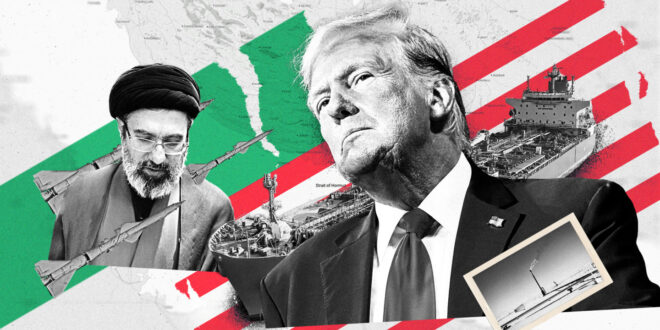
Analysis: Gulf states are shipping millions of barrels of oil through Hormuz, but that doesn’t change Iran’s ability to inflict pain on the global economy
As Iran and the US take tentative steps towards a deal to re-open the Strait of Hormuz, there may be signs that Tehran’s biggest source of leverage is being eroded.
Iran has long viewed its ability to paralyse the strategic chokepoint as its own version of a nuclear bomb, a Trump card which, if used, could trigger a global energy crisis of historic proportions.
Immediately after the US and Israel launched the war on 28 February, Iran’s Islamic Revolutionary Guard Corps (IRGC) did just that, moving decisively to block the strait and trapping a fifth of the world’s oil and liquefied natural gas inside the region.
But its ability to apply the thumbscrews to the global economy has been threatened in recent weeks as the US military facilitates covert oil shipments through the strait and Arab producers reconfigure export routes.
More oil is now leaving the region than at any point during the seven-month war, weakening Tehran’s hand as it tries to negotiate permanent control over the strait.
Arab oil exports are rebounding
Middle Eastern crude exports excluding Iran returned to pre-war levels in September despite Iran and its allies escalating attacks on tankers in the Strait of Hormuz and Saudi Arabia’s oil infrastructure.
Estimates by data tracking platform Kpler indicate that Arab countries shipped at least 16.5 million barrels of oil out of the region per day during the month.
Much of the rise was powered by Saudi Arabia, which responded to the attack on its Red Sea pipeline last month by surging exports through the strait.
Shipping data tracked by Bloomberg shows that the kingdom’s Hormuz shipments rose to more than three million barrels per day in the first three weeks of September, more than triple the amount in August.
Exports through Hormuz have slowly ticked up since June, when the Pentagon launched a coordinated effort to get energy supplies onto the global market. Backed by US air cover, Gulf states have snuck millions of barrels of oil through the narrow stretch of water by using shadow fleets to evade Iranian fire.
The US attempt to prise open the waterway has dovetailed with moves by Arab states to find new ways of getting their oil out of the region. Saudi Arabia has re-routed its crude to the Red Sea via its East-West Pipeline while the UAE has relied on its terminal at Fujairah on the other side of the strait. Iraq has trucked millions of barrels of oil across the Syrian desert to the Mediterranean.
“Iran appears to have lost significant leverage over the Strait of Hormuz,” said Ria Reddy, Iran team deputy lead at the American Enterprise Institute’s Critical Threats Project.
“If commercial vessels can continue to transit the strait at high rates despite Iranian threats, Iran has less ability to use the strait to compel the US and other states to accept its demands,” she told The New Arab.
The rise in Arab oil exports isn’t the only way in which Tehran’s control has slipped. The US blockade has turned the tables on Iran, trapping its oil in the region and depriving it of billions of dollars of vital revenues.
Dozens of its ships have been struck by US forces, in what the Trump administration has described as a “tanker for tanker” policy aimed at deterring IRGC attacks on maritime traffic.
Energy crunch continues
With no end in sight to the war, the millions of barrels of oil now making their way out of the region have had little impact on global prices, which continue to be influenced by heightened geopolitical risk and spiralling freight rates.
The unlocking of Hormuz has coincided with a 57% surge in the price of Brent, which peaked at $110 in mid-September following the Houthi takeover of Yemen’s Red Sea coast and the crucial Bab al-Mandeb strait.
Neither has it helped to curb shortages of fuels such as gasoline and diesel, whose prices have surged to record highs due to ongoing bottlenecks at refineries worldwide.
The US-led effort also appears not to have had the same success with raising gas shipments from Qatar, which remain far below pre-war levels. Last month, gas prices in Europe and Asia climbed to their highest levels since 2022 amid supply fears ahead of the winter.
All of this means that Iran continues to have a large say over the trajectory of the global economy, despite millions of barrels of crude now transiting the strait every day.
“Resumed oil exports in the Strait of Hormuz is not synonymous with stabilisation,” Burcu Ozcelik, a senior research fellow for Middle East security at the Royal United Services Institute (RUSI), told The New Arab.
“Iran still retains the capability to resume retaliatory drone and missile strikes on Gulf critical infrastructure and oil production sites,” she said.
Danny Citrinowicz, a senior researcher at Israel’s Institute for National Security Studies (INSS), said that although the US has weakened Iran’s control of the strait, it has so far failed to achieve its overarching goal of stabilising the global energy market.
“Iran retains the ability to target tankers, threaten commercial shipping, and make passage through the strait increasingly difficult and expensive,” he said.
“As a result, Washington’s operational achievements have yet to produce the economic outcome it ultimately needs. Oil prices remain elevated, in part because of higher insurance premiums, tanker shortages, and the continuing risk to commercial shipping.”
Tanker war
Iran’s sporadic attacks on ships have prevented a normalisation of maritime traffic in the strait, keeping freight rates at record highs, extending the freeze in the insurance market, and maintaining pressure on oil prices.
September saw a notable uptick in attacks on tankers, with 21 vessels confirmed hit by Iranian projectiles, up from 12 the month before, according to data collected by conflict monitor ACLED.
“September has seen the largest number of successful Iranian attacks on commercial ships since March, when the war was at its peak,” Valentin d’Hauthuille, ACLED’s Middle East regional team lead, told The New Arab.
Washington has for the moment gained the upper hand in the strait, but Iran’s continued ability to threaten ships raises questions about the long-term viability of its escort operation, he said.
That said, the US’s destruction of its coastal radars and surveillance systems is making it increasingly hard for it to use them. There are signs that the damage is forcing it to resort to cruder means of disrupting maritime traffic.
“Iran appears to have adopted less effective methods of tracking and attacking vessels, including the use of fast attack craft to visually identify targets and shore-based rocket launchers to deploy mines,” the Critical Threats Project’s Reddy said.
“These adaptations suggest that Iran faces greater difficulty identifying, targeting and consistently disrupting shipping at scale.”
Widening the battlefield
Iran’s say over the future of the strait extends beyond what happens in its immediate neighbourhood to other parts of the region, where its allies have been able to further tighten global energy markets.
Oil and gas prices spiked last month after Houthi forces and Iraqi paramilitaries mounted a one-two punch on Saudi Arabia’s Red Sea exports, in the same day taking over the Bab al-Mandeb strait and disabling Aramco’s East-West oil pipeline.
Since the ceasefire in Yemen collapsed in July, the group has struck several refineries on the kingdom’s Red Sea coast and closed the chokepoint to Saudi-linked ships.
However, horizontal escalation has had limited success for the Axis of Resistance, with Arab producers proving resilient to these multi-pronged attacks and swiftly finding new export routes when one is closed down.
Oil traders may have been spooked by September’s attack on the Saudi pipeline, but, in the end, it made little impact on the kingdom’s ability to export. Aramco was able to quickly divert flows to Hormuz and brought the pipeline back online in only two weeks.
It also involves a degree of risk which Iran has thus far not been willing to fully take on. Iran has refrained from targeting the UAE since signing the ill-fated peace deal in June, allowing shipments to Fujairah to continue. Neither has it tried to disrupt Iraq’s overland shipping route through Syria, a move which would only anger Baghdad and risk pushing it further into America’s orbit.
War of attrition
Despite the intense US bombing campaign, the IRGC is believed to still possess thousands of drones and a sizeable missile inventory. There are also signs that China is shipping components to Iran’s military to help it maintain production lines and replenish its stockpiles.
This means that, unless there is an end to the war or the US can accomplish the unlikely feat of fully destroying its offensive capabilities, Iran will likely be able to disrupt shipping for many months to come.
The sustainability of the US’s operation is less certain. It may be succeeding in getting more oil through the strait at the moment, but it remains an open question about how long it can keep this up.
Months of deployment are putting US forces under increasing strain, with commanders recently warning that continuing the war is unsustainable. Missile interceptor stockpiles are dangerously low, naval forces are fatigued, and the concentration of assets in the region is harming the military’s readiness elsewhere around the world.
Moreover, the cost of the operation is currently running at around $2 billion every month, according to the Congressional Budget Office. The Pentagon has put the total cost of the war at more than $45 billion up to the middle of September – and that’s without factoring in the costs of replenishing missile inventories and repairing the damage at US bases.
Despite this, the Pentagon appears to be preparing to resume the full-scale war following November’s midterm election, last week dispatching another carrier strike group and up to 10,000 additional troops to the region.
The Trump administration is hoping that economic pressure will push Tehran into accepting its conditions for an agreement and recently renewed its attempts to collapse Iran’s economy.
The new wave of sanctions dubbed Operation Economic Outcast, together with the naval blockade, has piled more pressure on Iran’s economy, sending inflation surging to 73% year-on-year in September and the Iranian rial plunging to a record low of 2.7 million to the dollar.
Meanwhile, the economy shrank more than 10% year-on-year between 21 March and 20 June, while the vital oil and gas sector contracted more than 26%.
RUSI’s Ozcelik said that, while large portions of the Iranian public appear to be backing the government’s twin calls for resilience and resistance, that may change in the coming months as the economic crisis continues to intensify.
“Tehran may find it harder to convince large segments of the public that they are winning the war and that resistance against the US is worth the heavy toll on the cost of living, hyperinflation, and shrinking economic opportunities,” she said.