 Eurasia Press & News
The Institute for the Study of War (ISW) and the Critical Threats Project (CTP) at the American Enterprise Institute are publishing two updates daily to provide analysis on the war with Iran. The morning update will focus on US and Israeli strikes on Iran and the Axis of Resistance’s response to the strikes. The evening update will be more comprehensive, covering events over the past 24-hour period and refining items discussed in the morning update.
Key Takeaways
The combined US-Israeli force killed Iranian Supreme Leader Ali Khamenei, and it is unclear who is currently ruling Iran. US President Donald Trump confirmed on February 28 that Khamenei was killed. The Iranian constitution stipulates that the President, the Judiciary Chief, and a member of the Guardian Council will take over the responsibilities of the Supreme Leader until Iran’s Assembly of Experts convenes to select a new leader. Khamenei was reportedly making plans prior to the current conflict for who he wanted to rule Iran in the event of his death, however.
The combined force conducted nearly 900 strikes on Iranian targets in the first 12 hours of its campaign, according to an unspecified US official speaking to Fox News. The Israel Defense Forces (IDF) stated that it struck 500 Iranian targets. The regime’s internet shutdown has almost certainly limited the amount of information about US and Israeli strikes coming out of Iran. ISW-CTP’s strike data, therefore, only reflects a portion of the total amount of US and Israeli strikes.
The United States and Israel are pursuing several lines of effort to achieve their stated campaign objectives: 1) suppressing Iranian air defenses, 2) degrading Iranian retaliatory capabilities, and 3) disrupting Iranian command-and-control.
US Central Command (CENTCOM) stated that Iran’s retaliation in response to the joint US-Israeli air campaign has not inflicted US casualties or caused meaningful damage to US military installations used to conduct offensive operations against Iran. CENTCOM said that US forces have successfully defended against hundreds of Iranian missile and drone attacks.
Iran has not attacked vessels in the Strait of Hormuz at the time of this writing, despite warning vessels against transiting through the strait. A European Union official told Reuters on February 28 that the IRGC warned vessels transiting through the strait that “no ship is allowed to pass the Strait of Hormuz.” ISW-CTP has not observed any reports of Iranian naval forces taking kinetic measures to harass or attack vessels in the Strait of Hormuz.
Several members of Iran’s Axis of Resistance, including Hezbollah and the Houthis, have condemned the US and Israeli strikes in Iran but have not conducted retaliatory attacks as of ISW-CTP’s 04:00 PM ET data cutoff. These Axis of Resistance members could decide at any time to attack the United States or Israel in response to the killing of Iranian Supreme Leader Ali Khamenei, however.
The Islamic Resistance of Iraq, which is a coalition of Iranian-backed Iraqi militias, claimed on February 24 that it conducted 16 unspecified “operations” with “dozens” of drones targeting “enemy” bases in Iraq and the region. The Iraqi Joint Operations Command also reported on February 28 that Iraqi air defenses intercepted nine drones that unspecified actors launched at Iraqi military sites in Dhi Qar and Basra provinces. No group has claimed responsibility for these attacks at the time of this writing.
Toplines
The combined US-Israeli force killed Iranian Supreme Leader Ali Khamenei, and it is unclear who is currently ruling Iran. US President Donald Trump confirmed on February 28 that Khamenei was killed.[1] Four Israeli security officials who were briefed on the matter told the Washington Post that Israeli airstrikes killed Khamenei in his Tehran compound on February 28.[2] A Fox News correspondent reported on February 28 that the combined force made the decision to take advantage of a meeting between Khamenei and multiple senior Iranian officials to strike Khamenei, according to US officials.[3] It is unclear at the time of this writing who is leading Iran. The Iranian constitution stipulates that the President, the Judiciary Chief, and a member of the Guardian Council will take over the responsibilities of the Supreme Leader until Iran’s Assembly of Experts convenes to select a new leader.[4] Iranian President Masoud Pezeshkian, Judiciary Chief Gholam Hossein Mohseni Ejei, and one of the six jurists on the Guardian Council are therefore constitutionally mandated to rule Iran. Khamenei was reportedly making plans prior to the current conflict for who he wanted to rule Iran in the event of his death, however. The New York Times reported on February 22 that Khamenei and top Iranian officials made plans for who would “manage the country” if Khamenei were killed.[5] The list of possible leaders included Supreme National Security Council (SNSC) Secretary Ali Larijani and Parliament Speaker Mohammad Bagher Ghalibaf.[6]
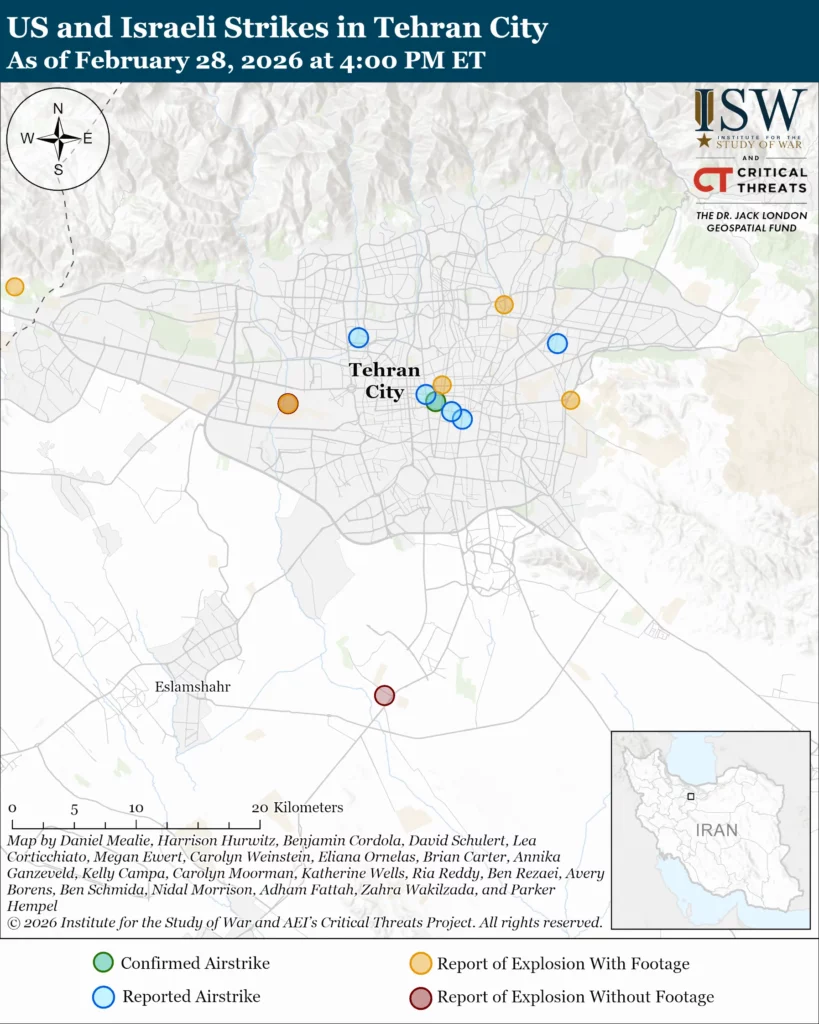
The combined force conducted nearly 900 strikes on Iranian targets in the first 12 hours of its campaign, according to an unspecified US official speaking to Fox News.[7] The Israel Defense Forces (IDF) stated that it struck 500 Iranian targets.[8] ISW-CTP has observed strikes across 17 provinces.[9] The regime’s internet shutdown (read more below) has almost certainly limited the amount of information about US and Israeli strikes coming out of Iran. ISW-CTP’s strike data, therefore, only reflects a portion of the total amount of US and Israeli strikes. A senior US official told Axios on February 28 that US strikes are focused on Iran’s missile program and missile launchers, while Israeli strikes are focused both on senior Iranian officials and the missile program.[10]
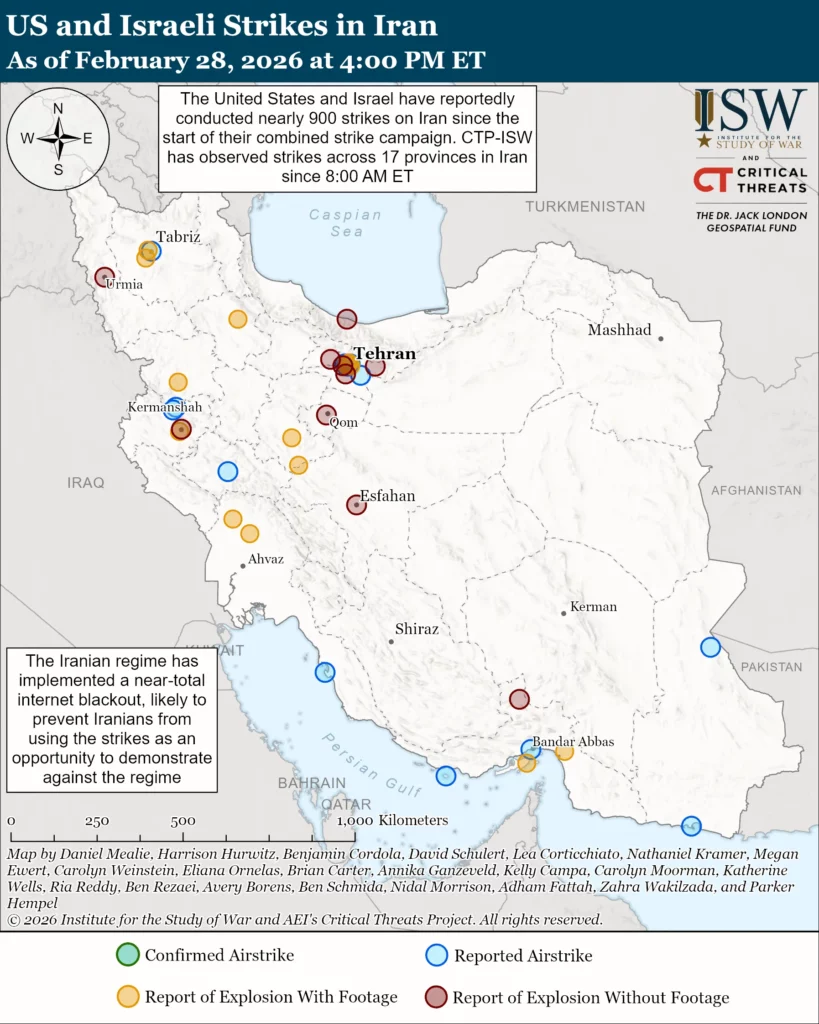
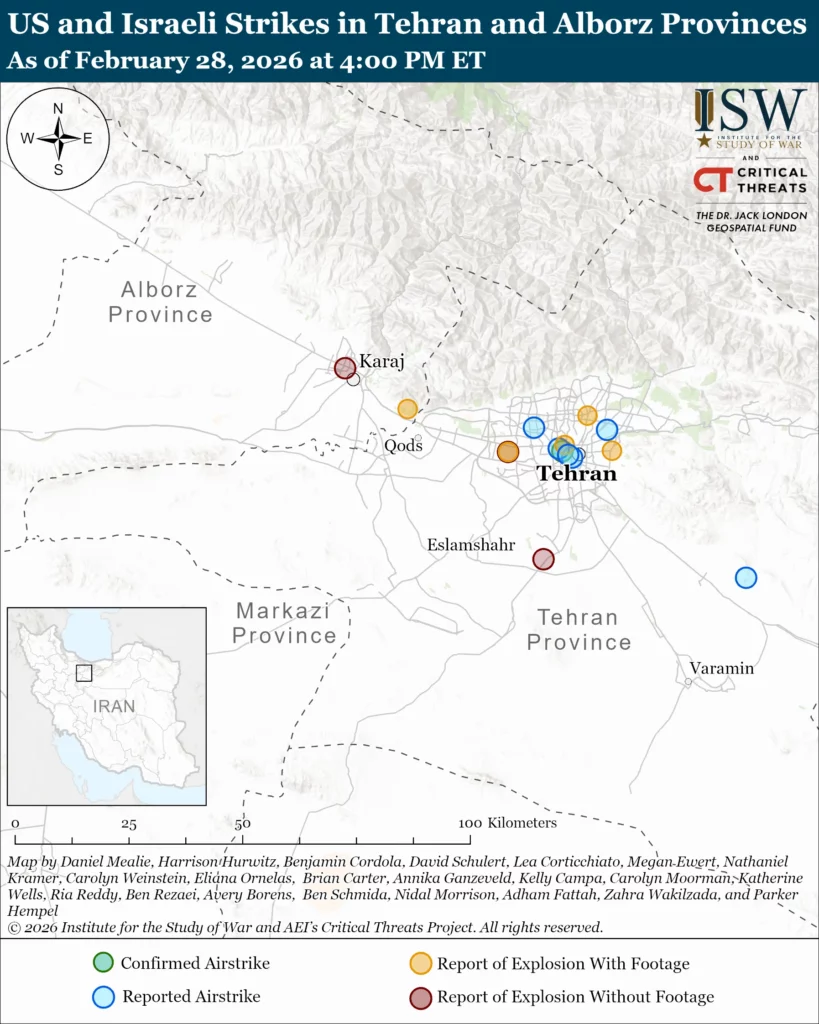
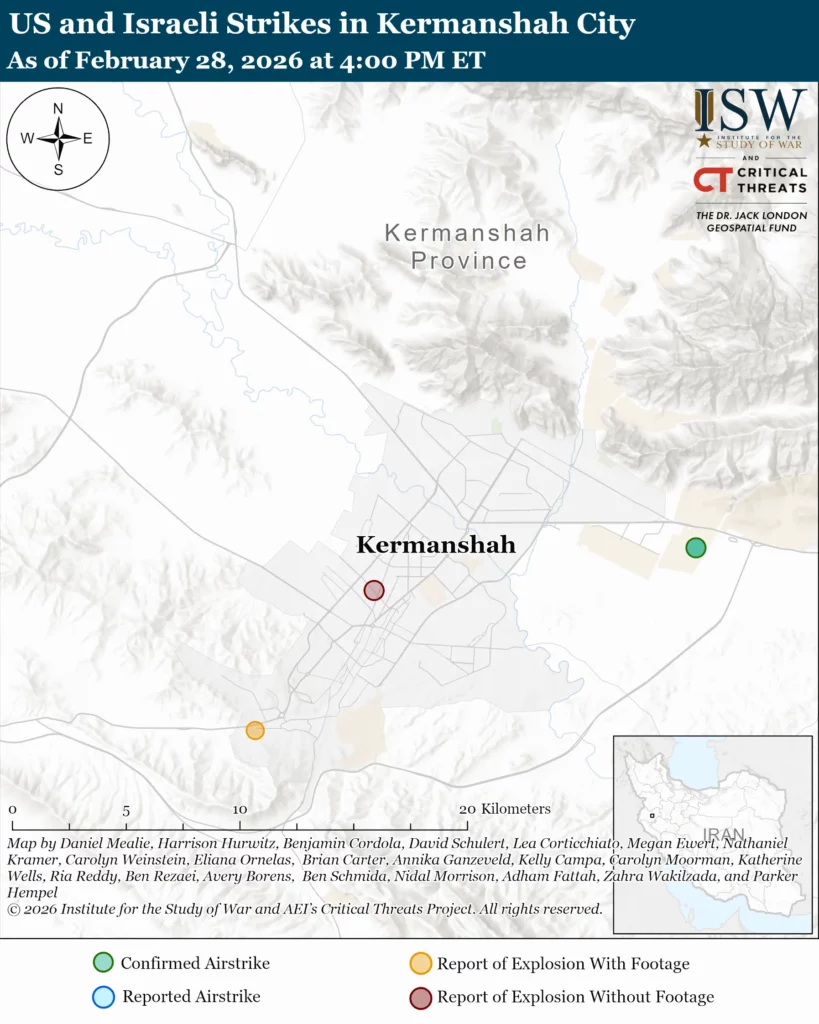
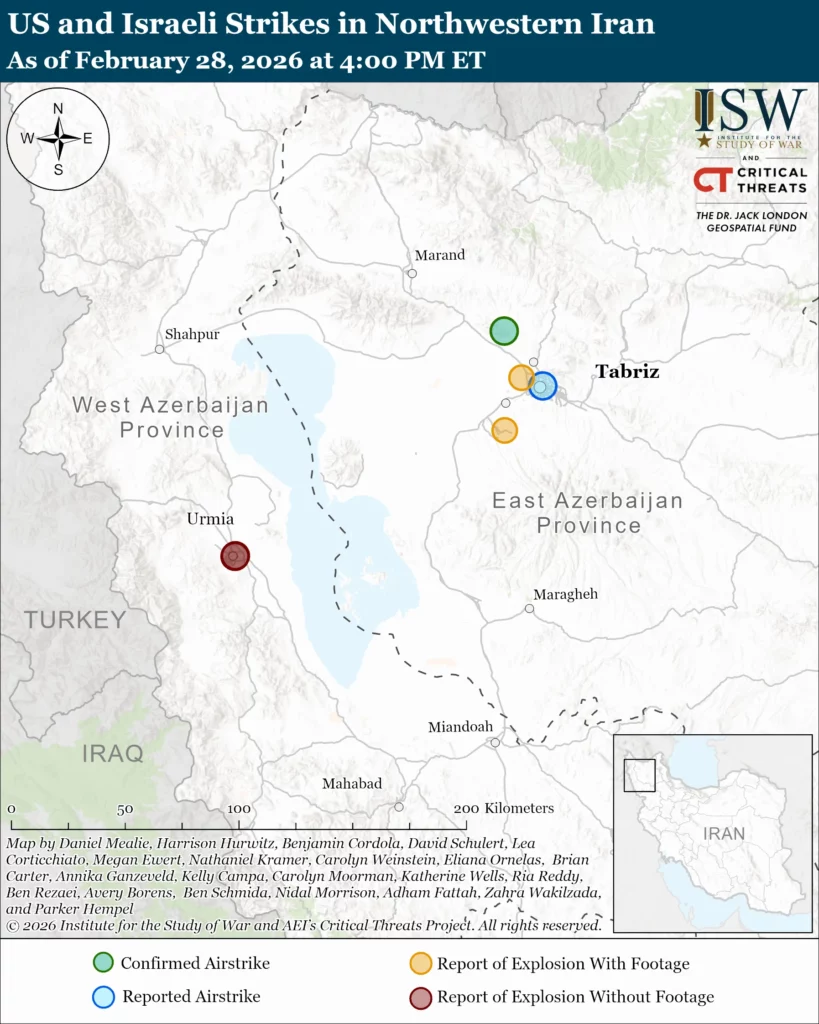
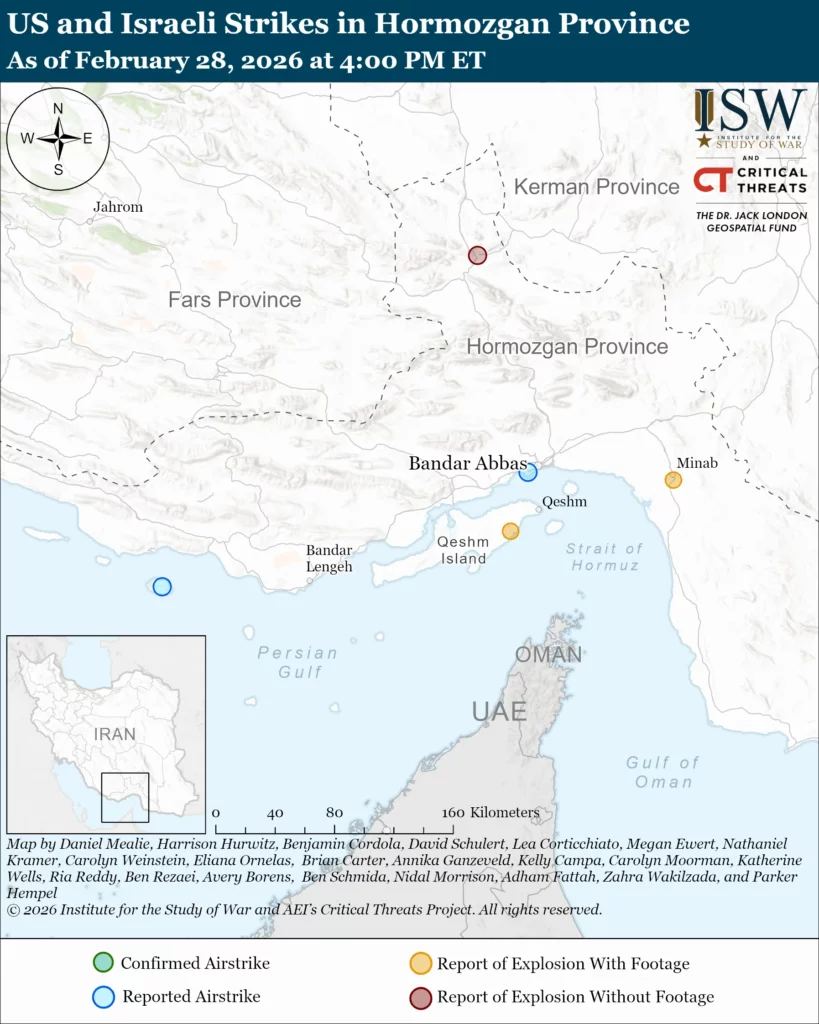
The regime is taking steps to maintain internal security. Internet monitor Netblocks reported on February 28 that the regime has implemented a near-total internet blackout.[11] The regime likely shut down the internet to prevent Iranians from coordinating efforts to organize demonstrations against the regime amid the US and Israeli strikes. Restoring access to the internet is crucial to achieving the United States’ stated objective of toppling the Iranian regime. The regime is also trying to intimidate Iranians from providing information to the United States or Israel. The SNSC released a statement on February 28 warning Iranians not to provide “targeting information to the enemy,” or else face harsh punishment from the judiciary.[12]
The United States and Israel are pursuing several lines of effort to achieve their stated campaign objectives. The United States and Israel seek to topple the Islamic Republic, among other objectives.[13] The United States also seeks to prevent Iran from obtaining a nuclear weapon, “raze” the Iranian missile program “to the ground,” “annihilate” Iranian naval forces, and prevent the Axis of Resistance from harming US forces in the Middle East.[14] The IDF has similarly stated that it seeks to “remove existential threats” to Israel, including the Iranian nuclear and missile programs and Axis of Resistance.[15] The United States and Israel have pursued the following three lines of effort thus far:
- Suppressing Iranian air defenses. The combined force has “effectively suppressed” Iranian air defenses, according to an unspecified US official speaking to a Fox News correspondent.[16] The IDF previously targeted Iranian air defenses at the outset of the 12-day war, which enabled the IDF to quickly establish and maintain air superiority over large parts of Iran.[17] The scale and intensity of the combined force’s air defense suppression efforts appear to be less than that of the IDF’s efforts in June 2025, possibly because Iranian air defenses have remained significantly degraded since the June 2025 Israel-Iran War. The IDF struck at least 11 air defense systems in western Iran, including an “advanced SA-65 air defense system” at the Islamic Revolutionary Guard Corps (IRGC) Ground Forces 29th Nabi Akram Operational Division base in Kermanshah Province.[18] The combined force also reportedly struck a radar on Kish Island in the Persian Gulf.[19] An Israeli X account also posted footage of a US Reaper drone flying over Shiraz, Fars Province.[20] The presence of a Reaper drone over a large Iranian city suggests that Iranian air defenses are badly degraded, given that the Reaper is susceptible to relatively rudimentary air defense systems.
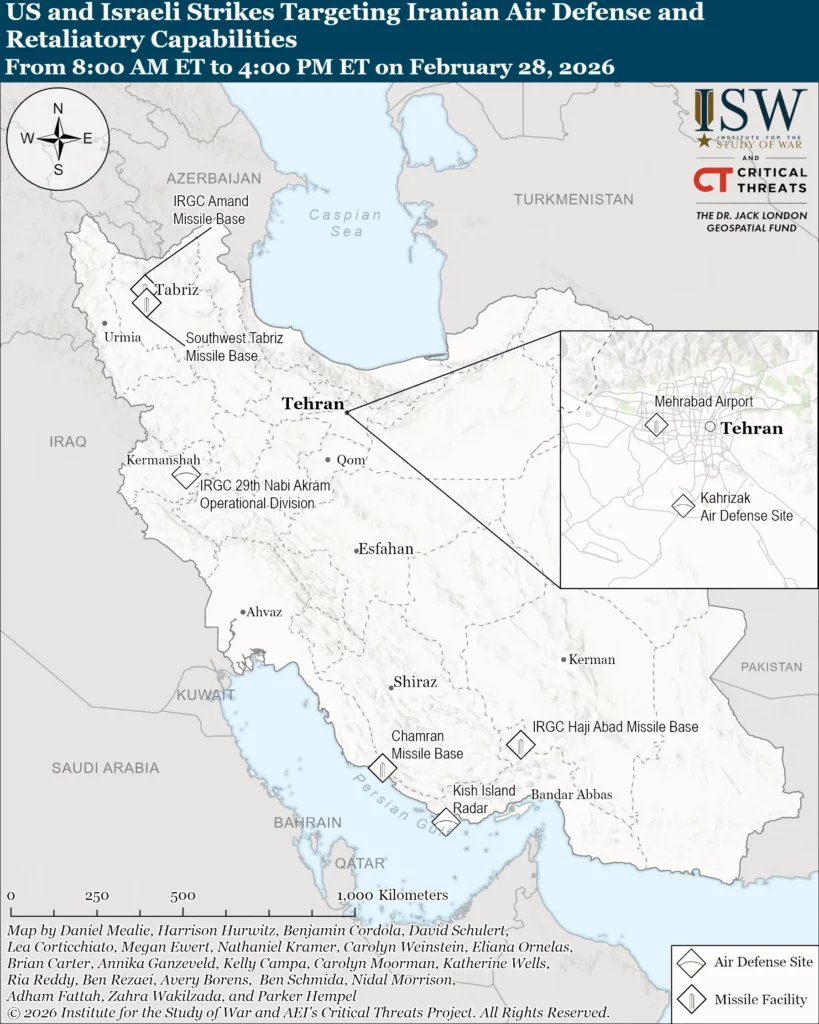
- Degrading Iranian retaliatory capabilities. The combined force appears to have limited the scope of Iranian retaliatory attacks targeting US bases, Israel, and other targets by striking Iranian missile launchers and missile bases. The combined force’s effort to limit Iran’s ability to immediately retaliate resembles Israel’s highly effective strategy in June 2025. The IDF limited Iran’s ability to respond to Israel at the start of its campaign and continued to destroy Iranian missile launchers and stockpiles throughout its air campaign.[21] The combined force’s efforts to limit Iran’s response appear to be effective, given Iran’s relatively ineffective response thus far (see below).
The IDF struck dozens of ballistic missile launchers at the IRGC Amand Missile Base, north of Tabriz, East Azerbaijan Province.[22] The IDF struck the Amand Base twice during the Israel-Iran War.[23] The base reportedly stores Ghadr medium-range ballistic missiles, which Iran previously used in its April and October 2024 attacks on Israel.[24] Iran has also reportedly used Ghadr missiles to attack Israel in the current conflict.[25] The IDF struck Iranian personnel as they attempted to load surface-to-surface missiles into a launcher at an unspecified location in western Iran.[26] The IDF also struck a missile launcher in Zanjan Province following launches from the site.[27]
The combined force also struck numerous Iranian missile bases across the country that likely store missile stockpiles.[28] Destroying Iran’s ballistic missile and drone stockpiles would degrade Iran’s retaliatory capabilities both in the immediate term and throughout the campaign. The IDF destroyed around 40 percent of Iran’s ballistic missiles during the 12-day war.[29] Iran prioritized reconstituting its ballistic missile program as an immediate strategic priority in the months following the war, and an Israeli journalist reported in December 2025 that Iran had reconstituted its “heavy” missile stockpile to around 2,000 missiles.[30] “Heavy” ballistic missiles presumably refer to medium-range ballistic missiles that can reach Israel. The combined force struck several missile bases that the IDF struck in June 2025, which suggests that Iran may have replenished some of its missile stockpile or repaired infrastructure at these facilities since the June war. Iranian media reported that the combined force struck the Khomein Missile Base in Markazi Province.[31] The IDF struck this base at least twice during the 12-Day War.[32]
Iranian media also reported that the combined force struck IRGC missile bases in Haji Abad, Hormozgan Province, and in Jam, Bushehr Province.[33] Iran recently positioned missile launchers along its southern coast in preparation for a conflict with the United States and Israel.[34] The combined force also reportedly struck an IRGC missile depot stored at Mehrabad Airport in Tehran.[35] The Artesh Air Force 1st Tactical Airbase is co-located at Mehrabad Airport.[36]
ISW-CTP has not observed reports that the combined force has targeted Iranian ballistic missile production capabilities as of this writing. The combined force has struck several defense industrial sites that may produce ballistic missile components or other materials, however (described in more detail below). The IDF struck Iranian missile production sites and equipment throughout the June 2025 war, including the Parchin Military Complex east of Tehran.[37] These strikes contributed to Israel’s degradation of Iran’s ballistic missile program.[38]
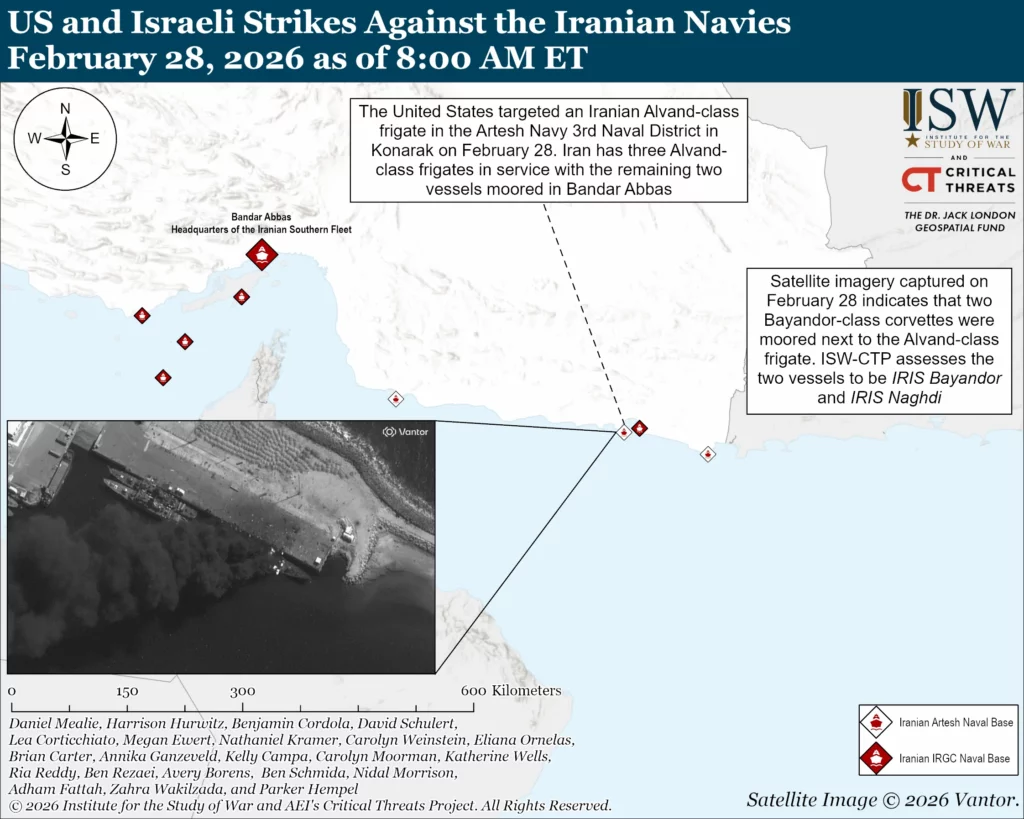
The combined strike force is disrupting the Iranian navies’ ability to attack international shipping and US Navy vessels as part of the effort to degrade Iran’s retaliatory capabilities. An Israeli OSINT account reported strikes on the IRGC Navy frigate Jamaran, as ISW-CTP reported in its February 28 Morning Update.[39] The Jamaran is a Moudge-class frigate.[40] The Jamaran previously seized two US unmanned surface vessels in September 2022 and operated around the Red Sea during at least parts of the Houthis’ campaign against international shipping during the October 7 war.[41] Vantor separately captured satellite imagery of what appears to be an Alvand-class frigate on fire in Konarak, Sistan and Baluchistan Province (see below). Alvand-class frigates are the largest surface combatants that Iran has.[42] Iran had three Alvand-class frigates prior to the current conflict.[43] The remaining two Alvand-class frigates are moored in Bandar Abbas, Hormozgan Province.[44] The imagery shows that two Bayandor-class corvettes were moored next to the Alvand-class frigate. ISW-CTP assesses that the two Bayandor-class corvettes are the IRIS Bayandor and IRIS Naghdi.
- Degrading Iranian retaliatory capabilities. The combined force appears to have limited the scope of Iranian retaliatory attacks targeting US bases, Israel, and other targets by striking Iranian missile launchers and missile bases. The combined force’s effort to limit Iran’s ability to immediately retaliate resembles Israel’s highly effective strategy in June 2025. The IDF limited Iran’s ability to respond to Israel at the start of its campaign and continued to destroy Iranian missile launchers and stockpiles throughout its air campaign.[21] The combined force’s efforts to limit Iran’s response appear to be effective, given Iran’s relatively ineffective response thus far (see below).
The IDF struck dozens of ballistic missile launchers at the IRGC Amand Missile Base, north of Tabriz, East Azerbaijan Province.[22] The IDF struck the Amand Base twice during the Israel-Iran War.[23] The base reportedly stores Ghadr medium-range ballistic missiles, which Iran previously used in its April and October 2024 attacks on Israel.[24] Iran has also reportedly used Ghadr missiles to attack Israel in the current conflict.[25] The IDF struck Iranian personnel as they attempted to load surface-to-surface missiles into a launcher at an unspecified location in western Iran.[26] The IDF also struck a missile launcher in Zanjan Province following launches from the site.[27]
The combined force also struck numerous Iranian missile bases across the country that likely store missile stockpiles.[28] Destroying Iran’s ballistic missile and drone stockpiles would degrade Iran’s retaliatory capabilities both in the immediate term and throughout the campaign. The IDF destroyed around 40 percent of Iran’s ballistic missiles during the 12-day war.[29] Iran prioritized reconstituting its ballistic missile program as an immediate strategic priority in the months following the war, and an Israeli journalist reported in December 2025 that Iran had reconstituted its “heavy” missile stockpile to around 2,000 missiles.[30] “Heavy” ballistic missiles presumably refer to medium-range ballistic missiles that can reach Israel. The combined force struck several missile bases that the IDF struck in June 2025, which suggests that Iran may have replenished some of its missile stockpile or repaired infrastructure at these facilities since the June war. Iranian media reported that the combined force struck the Khomein Missile Base in Markazi Province.[31] The IDF struck this base at least twice during the 12-Day War.[32]
Iranian media also reported that the combined force struck IRGC missile bases in Haji Abad, Hormozgan Province, and in Jam, Bushehr Province.[33] Iran recently positioned missile launchers along its southern coast in preparation for a conflict with the United States and Israel.[34] The combined force also reportedly struck an IRGC missile depot stored at Mehrabad Airport in Tehran.[35] The Artesh Air Force 1st Tactical Airbase is co-located at Mehrabad Airport.[36]
ISW-CTP has not observed reports that the combined force has targeted Iranian ballistic missile production capabilities as of this writing. The combined force has struck several defense industrial sites that may produce ballistic missile components or other materials, however (described in more detail below). The IDF struck Iranian missile production sites and equipment throughout the June 2025 war, including the Parchin Military Complex east of Tehran.[37] These strikes contributed to Israel’s degradation of Iran’s ballistic missile program.[38]
The combined strike force is disrupting the Iranian navies’ ability to attack international shipping and US Navy vessels as part of the effort to degrade Iran’s retaliatory capabilities. An Israeli OSINT account reported strikes on the IRGC Navy frigate Jamaran, as ISW-CTP reported in its February 28 Morning Update.[39] The Jamaran is a Moudge-class frigate.[40] The Jamaran previously seized two US unmanned surface vessels in September 2022 and operated around the Red Sea during at least parts of the Houthis’ campaign against international shipping during the October 7 war.[41] Vantor separately captured satellite imagery of what appears to be an Alvand-class frigate on fire in Konarak, Sistan and Baluchistan Province (see below). Alvand-class frigates are the largest surface combatants that Iran has.[42] Iran had three Alvand-class frigates prior to the current conflict.[43] The remaining two Alvand-class frigates are moored in Bandar Abbas, Hormozgan Province.[44] The imagery shows that two Bayandor-class corvettes were moored next to the Alvand-class frigate. ISW-CTP assesses that the two Bayandor-class corvettes are the IRIS Bayandor and IRIS Naghdi.
The New York Times separately verified a video of a strike on an IRGC Navy base in Minab, Hormozgan Province.[45] The base contains the 16th Assef Coastal Missile Group, which operates under the 1st Saheb ol Zaman IRGC Naval District.[46] The 16th Assef Coastal Missile Group is equipped with surface-to-sea missiles and is reportedly considered “the most important missile brigade” in the IRGC Navy.[47] An elementary school located close to the naval base was also reportedly struck.[48] Iranian officials and media have reported that the strike killed dozens of individuals.[49] CENTCOM said that it is investigating the reports of civilian casualties.[50] The combined force also struck the IRGC Navy Imam Ali Base in Chabahar, Sistan and Baluchistan Province, on February 28.[51]
- Disrupting Iranian command-and-control. The combined force has conducted a decapitation campaign targeting the Iranian military and political leadership.[52] An IDF official told Axios that the combined force struck three unspecified sites simultaneously, killing multiple senior Iranian officials “essential to the management of the campaign and the regime’s governance.”[53] CENTCOM reported that the combined force targeted IRGC command-and-control facilities.[54] Various sources have circulated footage of explosions at IRGC headquarters and bases in Tehran, East Azerbaijan, and Kurdistan provinces.[55] The combined force’s targeting of IRGC headquarters and bases could be part of an effort to disrupt Iranian command-and-control, but these strikes could also seek to achieve other effects, such as suppressing and degrading Iranian air defense and retaliatory capabilities.
Israeli officials told Axios on February 28 that Israel is targeting the entire “political and military” and “past, present, and future” Iranian leadership.[56] The combined force killed the following individuals:
Iranian Defense Council Secretary Ali Shamkhani[57]
Islamic Revolutionary Guards Corps (IRGC) Commander Major General Mohammad Pakpour[58]
Defense Minister Brigadier General Aziz Nasir Zadeh[59]
Khatam ol Anbia Intelligence Chief Saleh Asadi[60]
Supreme Leader Military Office Chief Mohammad Shirazi[61]
Organization of Defensive Innovation and Research (SPND) Chairman Hossein Jabal Amelian[62]
Former SPND Chairman Reza Mozafari Nia[63]
The combined force also targeted Khamenei’s son and potential successor, Mojtaba Khamenei, but his status is unknown.[64] CBS reported that US and Israeli strikes killed at least 40 Iranian leaders.[65]
The combined force struck several targets linked to Iran’s internal security apparatus. Multiple sources posted geolocated footage showing smoke coming from the Ministry of Intelligence and Security (MOIS) headquarters in Tehran.[66] Multiple sources also published geolocated footage of smoke near the Law Enforcement Command (LEC) headquarters in central Tehran.[67] ISW-CTP cannot confirm whether the LEC headquarters was struck, however. The LEC is the regime’s premier internal security service.[68] The LEC has many subordinate units, including the Prevention and Operations Police, which commands law enforcement stations across Iran, and Special Units, a highly trained, anti-riot force that deploys when regular police units cannot contain civil disorder.[69] Israel previously struck both the MOIS and the LEC headquarters during the 12-day war.[70] Multiple sources circulated footage of explosions at the Heydar Karar IRGC Base in Damavand, Tehran Province.[71] The Heydar Karar IRGC Base houses a training center for the Fatehin Battalions, according to Iranian media.[72] The Fatehin Battalions are special forces for the Basij Organization.[73] The Basij Organization is a paramilitary organization responsible for civil defense and social control.[74] The Fatehin have cracked down on Iranian protests, including in January 2026.[75] The Heydar Karar IRGC Base houses other assets, however, and it is not clear if the combined force targeted the Fatehin Battalions. The degradation of Iran’s internal security apparatus could reduce the regime’s ability to maintain internal security and social control.
The combined force targeted multiple industrial sites likely tied to Iran’s defense industrial base. The IDF issued an evacuation order for an industrial park near Esfahan City.[76] The IDF said that it planned to strike the site shortly thereafter.[77] Kimia Part Sivan Company, which is the drone production arm of the IRGC Quds Force, is located at the industrial park.[78] Kimia Part Sivan Company has reportedly worked with the Shahed Aviation Industries Research Center to produce engine and navigation components for Iranian drones.[79] The United States sanctioned Kimia Part Sivan Company in 2021 and also sanctioned several individuals and entities tied to the company in 2025.[80] Iranian media also reported that the combined force targeted an unspecified defense industrial site in Shiraz, Fars Province.[81] Israel previously struck the Iranian Defense Ministry-affiliated Shiraz Electronics Industries in Shiraz during the 12-day war.[82] The combined force also reportedly struck the Khairabad Industrial Town near Arak, Markazi Province.[83] The industrial town houses multiple metal manufacturing companies.[84]
The combined force struck several other sites on February 28. ISW-CTP is unable to confirm the targets or intended effects of these strikes. The combined force struck the Sahand University of Technology in Tabriz, East Azerbaijan Province.[85] The combined force also struck an unspecified IRGC base in Qasr-e Firouzeh, eastern Tehran City.[86] The Qasr-e Firouzeh neighborhood is located near many Iranian military and security sites, such as the Tehran Province Law Enforcement Command Special Units Headquarters.[87]
Iranian Retaliation
US Central Command (CENTCOM) stated that Iran’s retaliation in response to the joint US-Israeli air campaign has not inflicted US casualties or caused meaningful damage to US military installations used to conduct offensive operations against Iran.[88] CENTCOM said that US forces have successfully defended against hundreds of Iranian missile and drone attacks.[89] CENTCOM reported no US casualties or combat-related injuries and assessed that the minimal damage to US installations caused by Iranian retaliatory attacks has not affected US operations against Iran.[90] Iran launched ballistic missiles and drones at US bases in Bahrain, the United Arab Emirates (UAE), Kuwait, Qatar, and Jordan on February 28.[91] The IRGC announced that the strikes against US bases were part of Operation “True Promise 4,” which targeted the headquarters of the US Navy’s Fifth Fleet in Bahrain, US bases in Qatar and the UAE, and military and security sites in Israel.[92] An Iranian ballistic missile strike reportedly damaged a clinic at al Udeid Airbase in Qatar, the largest US military base in the Middle East.[93] Iranian ballistic missiles also struck the Ali al Salem Airbase in Kuwait and the Muwaffaq al Salti Airbase in Jordan, where US forces maintain a presence.[94] Iranian ballistic missile strikes caused “significant damage” to the runway at the Ali al Salem Airbase in Kuwait, according to the Italian foreign minister.[95] It remains unclear whether a ballistic missile interception, rather than a direct strike, caused the damage to the runway, however.[96] Iran also launched ballistic missiles and drones at the US Consulate in Erbil, a US base at the Erbil Airport, and the United States’ Harir Airbase in Erbil Province, but US air defense systems intercepted the munitions.[97] Iran previously launched 14 short- and medium-range ballistic missiles at al Udeid Airbase at the end of the 12-Day war.[98]
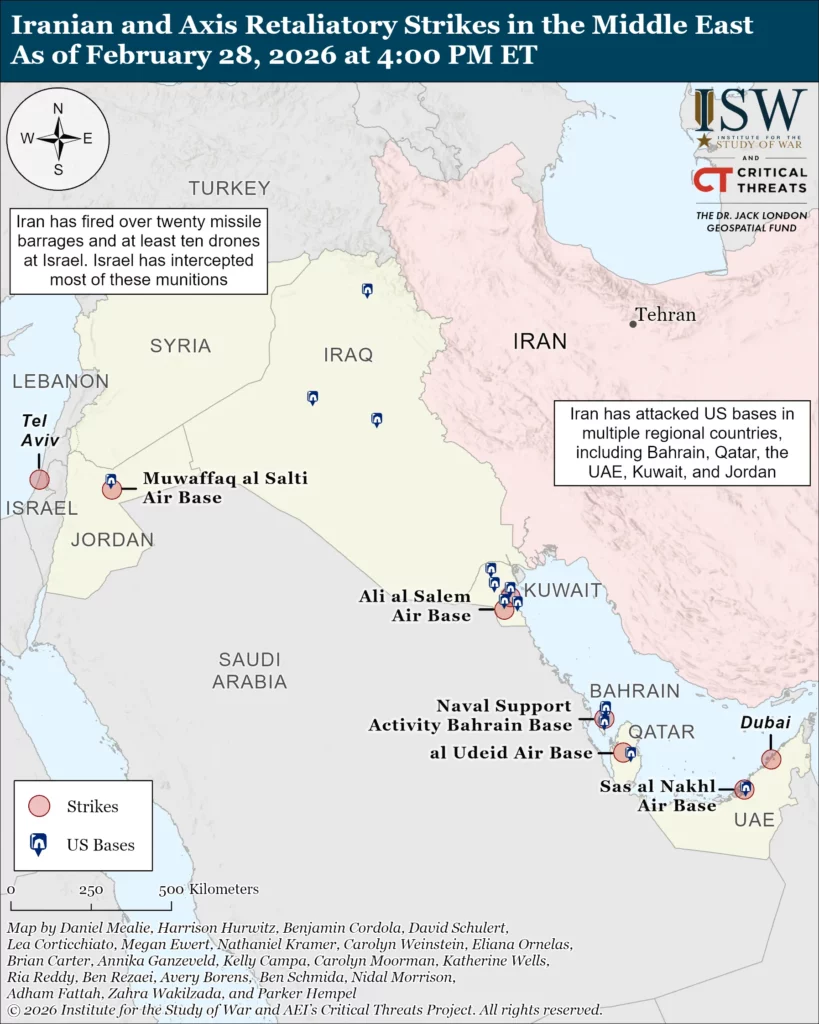
Iran has not attacked vessels in the Strait of Hormuz at the time of this writing, despite warning vessels against transiting through the strait.[99] A European Union official told Reuters on February 28 that the IRGC warned vessels transiting through the strait that “no ship is allowed to pass the Strait of Hormuz.”[100] ISW-CTP has not observed any reports of Iranian naval forces taking kinetic measures to harass or attack vessels in the Strait of Hormuz. An unspecified US official told the New York Times that there is “no evidence Iran was attempting a military blockade of the waterway.”[101] It is unlikely that Iranian naval forces could successfully impose a blockade on the Strait of Hormuz, given that such a blockade would require a continuous military presence, according to a risk and compliance analyst.[102] Commercial ship traffic dropped by 70 percent in the Strait of Hormuz in response to the United States and Israel’s combined strike campaign on Iran, according to ship tracking platform MarineTraffic.[103] Twenty percent of the global oil supply passes through the Strait of Hormuz.[104]
The rate and scale of Iranian ballistic missile strikes targeting Israel suggest that US and Israeli efforts to degrade Iran’s retaliatory capabilities are succeeding. Iran launched 20 separate ballistic missile barrages at Israel on February 28.[105] Iran reportedly launched 170 ballistic missiles at Israel and US military bases in the Middle East on February 28, according to an Israeli military correspondent.[106] Iran reportedly only launched between two and four ballistic missiles per barrage, according to an OSINT account based in Lebanon.[107] At least two Iranian ballistic missiles struck Israel, one in Bnei Brak and the other in Tel Aviv.[108] The strike in Tel Aviv reportedly killed one person and wounded 21 others, while the strike in Bnei Brak wounded several people, according to Israeli media.[109] The IDF said that it has shot down over 10 Iranian drones that targeted Israel.[110] The rate and scale of Iran’s retaliatory attacks on February 28 are significantly less than the rate and scale of Iranian retaliatory attacks during the 12-day war. The first two Iranian ballistic missile barrages during the 12-day war included fewer than 100 missiles but caused at least seven impacts on Israel.[111] The lower rate and scale of Iranian ballistic missile strikes targeting Israel may indicate that the United States and Israel are successfully disrupting Iran’s retaliatory capabilities.
Multiple Iranian drone strikes on civilian infrastructure in Gulf countries wounded civilians on February 28. Iranian drones struck civilian infrastructure in the United Arab Emirates (UAE), Kuwait, and Bahrain.[112] Iranian drones struck the Kuwait International Airport, reportedly causing minor injuries to several workers, the Fairmont Hotel in Dubai, the UAE, reportedly injuring four individuals, and residential buildings in Dubai and Bahrain.[113] The UAE, Kuwait, and Bahrain all condemned Iran for its attacks against their territory.[114]
Several members of Iran’s Axis of Resistance, including Hezbollah and the Houthis, have condemned the US and Israeli strikes in Iran but have not conducted retaliatory attacks as of ISW-CTP’s 04:00 PM ET data cutoff.[115] These Axis of Resistance members could decide at any time to attack the United States or Israel in response to the killing of Iranian Supreme Leader Ali Khamenei, however. The Houthis and Hezbollah both issued statements on February 28 confirming their solidarity with Iran. Neither group threatened to enter the conflict.[116]
ISW-CTP assesses that Hezbollah will likely intervene in the current war because the United States and Israel explicitly seek regime collapse and have thus crossed Hezbollah’s red lines.[117] Hezbollah officials, including the secretary general, have stated that an attack targeting Khamenei is Hezbollah’s “red line.”[118] Hezbollah remains deeply ideologically aligned with Iran, adheres to the principle of Velayat-e Faqih (the ruling principle of the Iranian regime that entrusts both spiritual and temporal power to the Iranian supreme leader), and took its orders from Khamenei.[119] Hezbollah could take one of many courses of action, such as conducting a symbolic attack against Israeli forces in Israel or Lebanon, launching large missile and drone salvoes targeting civilian areas in Israel, or conducting terrorist attacks against US and Israeli assets across the region and the world.[120]
The Islamic Resistance of Iraq, which is a coalition of Iranian-backed Iraqi militias, claimed on February 24 that it conducted 16 unspecified “operations” with “dozens” of drones targeting “enemy” bases in Iraq and the region.[121] The group’s announcement follows attacks by the combined force against Kataib Hezbollah in Jurf al Sakhar, south of Baghdad, on February 28.[122] Kataib Hezbollah posted photos on February 28 commemorating two of its members who were killed in the strikes.[123] Kataib Hezbollah is a member of the Islamic Resistance in Iraq.[124] Kataib Hezbollah had announced prior to the attack on Jurf al Sakhr that it would soon begin attacking US bases in response to the attack on Iran.[125] Harakat Hezbollah al Nujaba and Kataib Sayyid al Shuhada, which are both members of the Islamic Resistance in Iraq, also issued statements on February 28 calling for conflict.[126] A Harakat Hezbollah al Nujaba official called for its members to prepare for the “holy battle,” while Kataib Sayyid al Shuhada’s spokesperson told Iraqi media that the group had entered the war after the strikes in Jurf al Sakhr.[127] The Iraqi Joint Operations Command stated on February 28 that a second wave of airstrikes targeted Jurf al Sakhr, but no other news outlets have reported the strikes at the time of this writing.[128]
The Iraqi Joint Operations Command also reported on February 28 that Iraqi air defenses intercepted nine drones that unspecified actors launched at Iraqi military sites in Dhi Qar and Basra provinces.[129] No group has claimed responsibility for these attacks at the time of this writing. Unspecified actors launched four drones targeting the Imam Ali Airbase in Dhi Qar Province.[130] Unspecified actors also launched five drones at several unspecified military sites in Basra Province.[131] The Iraqi Security Media Cell separately reported on February 28 that unspecified actors fired drones at an unspecified military site in Basra City, wounding an Iraqi soldier.[132] An unspecified security source told Iraqi media on February 28 that unidentified actors launched a drone targeting a radar at the Basra Operations Command headquarters in Basra City.[133] The security source said that the drone did not cause any damage.[134] Unidentified actors similarly conducted drone attacks targeting the Imam Ali Airbase in Dhi Qar Province and Camp Taji in Baghdad Province in late June 2025. These attacks “severely damaged” Iraqi radars at those sites.[135] Those attacks came after Iranian-backed Iraqi figures repeatedly condemned Israel’s use of Iraqi airspace to attack Iran during the Israel-Iran War.[136]