 Eurasia Press & News
Key Takeaways
The Iranian regime, which ISW-CTP continues to assess is dominated by Islamic Revolutionary Guards Corps (IRGC) Commander Major General Ahmad Vahidi and his inner circle, suspended US-Iran negotiations on June 1. Vahidi and his inner circle likely calculate that the status quo, in which Iran has neither made concessions to the United States in a diplomatic agreement nor is engaged in a full-scale conflict with the United States, is a favorable situation that advances their objectives. IRGC-affiliated Tasnim News Agency announced on June 1 that the regime has suspended negotiations, ostensibly in response to Israeli operations against Hezbollah in Lebanon.
The Iranian regime’s decision to suspend negotiations and emphasize the Lebanon issue is almost certainly a response to US President Donald Trump’s recent amendments to the draft US-Iran memorandum of understanding (MoU).
The Iranian regime has likely focused on the Lebanon issue, as opposed to another key sticking point in negotiations, to try to curb Israeli operations against Hezbollah in Lebanon as part of the regime’s broader objective to preserve Hezbollah. The regime also likely seeks to drive a wedge between the United States and Israel by falsely blaming Israel and its operations in Lebanon for the collapse of the US-Iran talks. Vahidi and his inner circle also likely calculate that the status quo will help them advance several other objectives, such as solidifying Iranian control over the Strait of Hormuz and maintaining the Iranian nuclear program.
The suspension of negotiations further indicates that Vahidi and his inner circle are driving Iranian decision-making and have likely gained the upper hand over proponents of a deal, particularly Parliament Speaker Mohammad Bagher Ghalibaf.
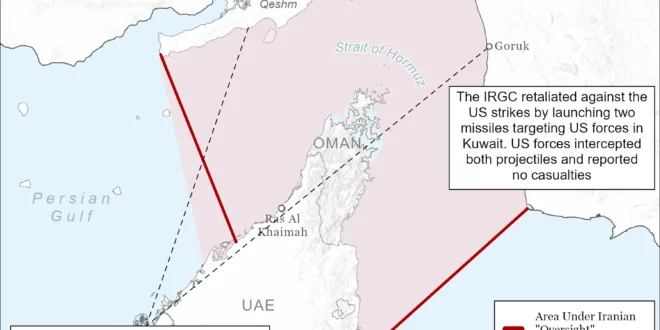
Iran and the United States have exchanged limited fire over the past 48 hours. Islamic Revolutionary Guards Corps (IRGC)-affiliated media announced on May 31 that Iranian air defenses shot down a US MQ-1 Predator drone over “Iranian territorial waters.” US Central Command (CENTCOM) responded by launching defensive strikes against Iranian targets on Qeshm Island and in Goruk, Hormozgan Province. The IRGC retaliated against the US strikes by launching two missiles at US forces in Kuwait on May 31.
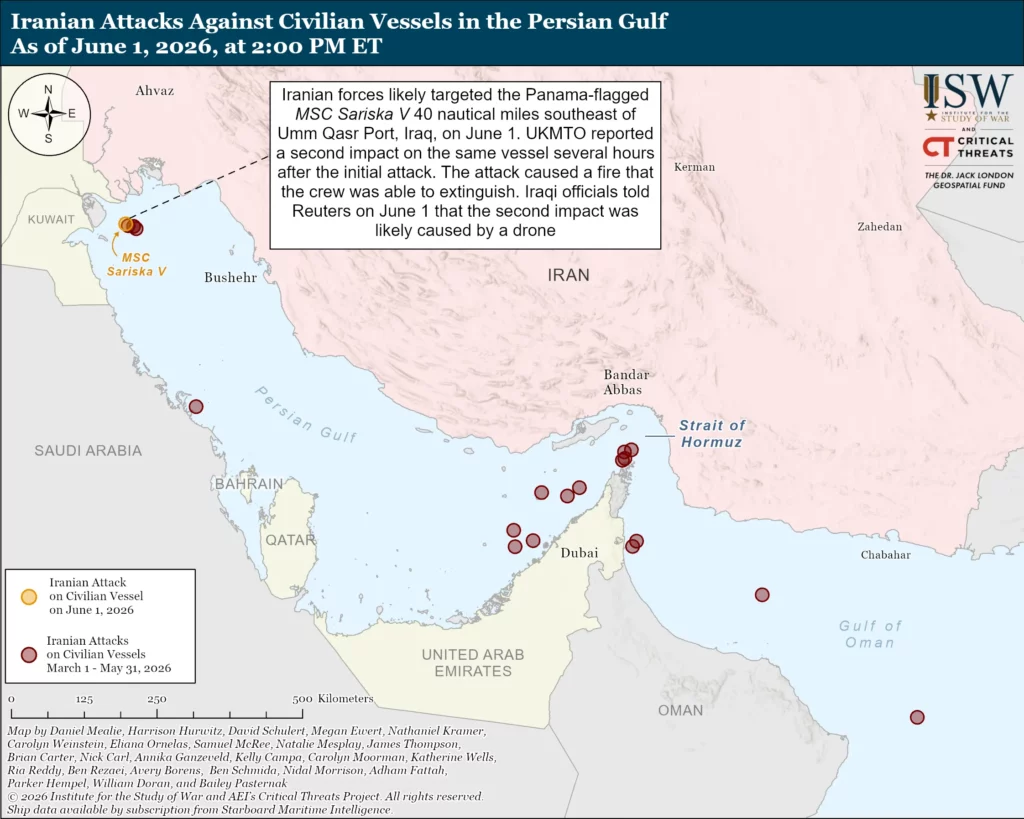
Iranian forces also likely attacked a civilian cargo vessel located off the coast of Iraq on June 1. United Kingdom Maritime Trade Operations reported on June 1 that an unspecified projectile struck a cargo vessel transiting the northern Persian Gulf approximately 40 nautical miles southeast of the Umm Qasr Port in Iraq.
Toplines
The Iranian regime, which ISW-CTP continues to assess is dominated by Islamic Revolutionary Guards Corps (IRGC) Commander Major General Ahmad Vahidi and his inner circle, suspended US-Iran negotiations on June 1.[1] Vahidi and his inner circle likely calculate that the status quo, in which Iran has neither made concessions to the United States in a diplomatic agreement nor is engaged in a full-scale conflict with the United States, is a favorable situation that advances their objectives. IRGC-affiliated Tasnim News Agency announced on June 1 that the regime has suspended negotiations, ostensibly in response to Israeli operations against Hezbollah in Lebanon.[2] The fact that IRGC-affiliated media announced the suspension of negotiations suggests that the decision to suspend negotiations was driven by the IRGC, and presumably by Vahidi. Iranian officials have consistently demanded throughout negotiations that the US-Iran ceasefire must include Hezbollah, but Iranian officials significantly increased their emphasis on this demand after Tasnim announced the suspension of negotiations.[3] Supreme Leader Adviser Mohammad Mokhber, for example, stated on June 1 during a meeting with Hezbollah’s representative to Tehran that any ceasefire that excludes Hezbollah is “irrelevant.”[4]
The Iranian regime’s decision to suspend negotiations and emphasize the Lebanon issue is almost certainly a response to US President Donald Trump’s recent amendments to the draft US-Iran memorandum of understanding (MoU). Trump requested several amendments, including changes to the draft’s text about Iran’s highly enriched uranium (HEU) and the Strait of Hormuz.[5] An Iranian official close to Iran’s negotiating team stated on June 1 that Iran has “concerns” about Trump’s amendments and reiterated that Iran will not transfer its HEU to the United States and that Iran must “manage” the Strait of Hormuz.[6] Iran likely responded to Trump’s amendments by reemphasizing its own maximalist demands, particularly its insistence that any ceasefire agreement between the United States and Iran must include Lebanon.
The Iranian regime has likely focused on the Lebanon issue, as opposed to another key sticking point in negotiations, to try to curb Israeli operations against Hezbollah in Lebanon as part of the regime’s broader objective to preserve Hezbollah. Khatam ol Anbia Central Headquarters Commander Major General Ali Abdollahi Ali Abadi issued an implicit threat on June 1 to attack civilians in northern Israel if the Israel Defense Forces (IDF) conducts airstrikes targeting Beirut.[7] Abadi’s warning comes after Israeli Prime Minister Benjamin Netanyahu ordered the IDF to conduct strikes against Hezbollah targets in Beirut and broaden the scope of IDF operations against Hezbollah in Lebanon.[8] Iran rarely issues public warnings before conducting attacks, which suggests that Abadi’s threat sought to achieve an informational effect. The regime likely intended to pressure the United States to push Israel to limit its operations against Hezbollah by threatening to attack Israel if Israel expanded its operations in Lebanon.
President Trump held a phone call with Israeli Prime Minister Benjamin Netanyahu on June 1 and stated that Israel will not attack Beirut.[9] Trump also noted that he had a “very good call” with Hezbollah via representatives, during which Hezbollah reportedly agreed to halt attacks against Israel. Axios, citing an adviser to Lebanese Parliament Speaker and longtime Hezbollah ally Nabih Berri, reported on June 1 that Berri informed the United States that Hezbollah is prepared to implement a “full and immediate ceasefire.”[10] Netanyahu stated that he told Trump that Israel would not cease attacks on Beirut if Hezbollah does not halt attacks on Israeli civilians and cities and added that Israeli operations in southern Lebanon will continue as planned.[11] Iran has long viewed Hezbollah as a central component of its deterrence strategy and therefore likely views an extension of the Israel-Lebanon ceasefire and halt of Israeli operations in Lebanon as necessary to prevent the further degradation of Hezbollah.
The regime also likely seeks to drive a wedge between the United States and Israel by falsely blaming Israel and its operations in Lebanon for the collapse of the US-Iran talks. The US-Iran negotiations have been at an impasse due to disagreements over other key sticking points for weeks, however. Senior Iranian officials and state media have framed Israeli operations in Lebanon as a ceasefire violation and cited the operations as the reason for suspending negotiations.[12] These statements seek to place blame for the collapse of the talks on Israel, and the regime likely calculates that portraying Israel as undermining US diplomatic efforts could create tensions between the United States and Israel. The US-Iran negotiations have been at an impasse for weeks, however, primarily due to disagreements over the Iranian nuclear program, the Strait of Hormuz, and Iranian demands for economic relief.[13] Iranian officials have previously tied the Lebanon issue to the negotiations, but it has not been the main sticking point preventing a deal up to this point.
Vahidi and his inner circle also likely calculate that the status quo will help them advance several other objectives, such as solidifying Iranian control over the Strait of Hormuz and maintaining the Iranian nuclear program. Iran continues to use coercive measures in and around the Strait of Hormuz to force vessels to transit through Iran’s illegal traffic separation scheme and comply with Iran’s protection racket.[14] Several countries have reached arrangements with Iran to facilitate their vessels’ safe passage through the strait.[15] Iran may calculate that protracting the status quo will force more countries to sign similar agreements with Iran, implicitly recognizing and legitimizing Iranian control over the strait.[16] Iran is also actively exploiting the US-Iran ceasefire to reconstitute elements of its ballistic missile and drone programs that Israel and the United States degraded during the June 2025 war and recent conflict.[17] Iran also continues to insist that it will not make any commitments regarding its enrichment capabilities or HEU stockpile.[18] The status quo, in which Iran has neither made concessions on its nuclear program nor faces US or Israeli strikes, enables Iran to maintain its nuclear program and prevent further degradation of this program. Vahidi and those around him may assess that focusing on the Lebanon issue will cause a protracted discussion about the Israel-Hezbollah ceasefire and thereby deflect attention from the above issues, which Vahidi refuses to make concessions on.
The suspension of negotiations further indicates that Vahidi and his inner circle are driving Iranian decision-making and have likely gained the upper hand over proponents of a deal, particularly Parliament Speaker Mohammad Bagher Ghalibaf. Vahidi and his inner circle have consistently opposed compromise and prioritized achieving the objectives outlined above.[19] Ghalibaf, on the other hand, has sought to reach an agreement and has appeared more willing to make concessions to the United States. The regime’s decision to suspend negotiations and insist on maximalist demands, such as Hezbollah’s inclusion in the ceasefire, therefore indicates that Vahidi and his inner circle continue to dominate decision-making.
US President Donald Trump told NBC News that Iran did not inform him that it had suspended negotiations.[20] He added that the United States would not necessarily resume military operations if talks collapsed but would instead maintain its naval blockade on Iranian ports because Iran is “losing a fortune.”[21]
Iran and the United States have exchanged limited fire over the past 48 hours. IRGC-affiliated media announced on May 31 that Iranian air defenses shot down a US MQ-1 Predator drone over “Iranian territorial waters.”[22] US Central Command (CENTCOM) confirmed on May 31 that Iranian air defenses shot down the drone but clarified that the drone was operating over international waters.[23] CENTCOM responded by launching defensive strikes targeting Iranian air defense systems, a ground control station, and two Iranian one-way attack drones on Qeshm Island and in Goruk, Hormozgan Province.[24] The IRGC retaliated against the US strikes by launching two missiles at US forces in Kuwait on May 31.[25] CENTCOM confirmed that US forces intercepted the two missiles and reported no damage or casualties.[26]
Iranian forces also likely attacked a civilian cargo vessel located off the coast of Iraq on June 1.[27] United Kingdom Maritime Trade Operations (UKMTO) reported on June 1 that an unspecified projectile struck a cargo vessel transiting the northern Persian Gulf approximately 40 nautical miles southeast of the Umm Qasr Port in Iraq.[28] Iraqi media and open-source intelligence (OSINT) accounts reported that the struck civilian vessel was the Panama-flagged MSC Sariska V.[29] UKMTO reported a second impact on the same vessel several hours after the initial attack.[30] The second impact caused a fire onboard, which the crew was able to extinguish.[31] Iraqi officials told Reuters on June 1 that the second impact was likely caused by a drone.[32] The IRGC Navy warned commercial vessels on June 1 that it will identify and “[deal] with” vessels that cooperate with “extra-regional hostile forces.”[33]
US-Iran Negotiations
See topline section.
Maritime Activity in the Strait of Hormuz and Persian Gulf
See topline section.
US and Israeli Air Campaign
See topline section.
Iranian Domestic Affairs
See topline section.
Iran’s Axis of Resistance
Lebanese Hezbollah and the Israeli Campaign in Lebanon
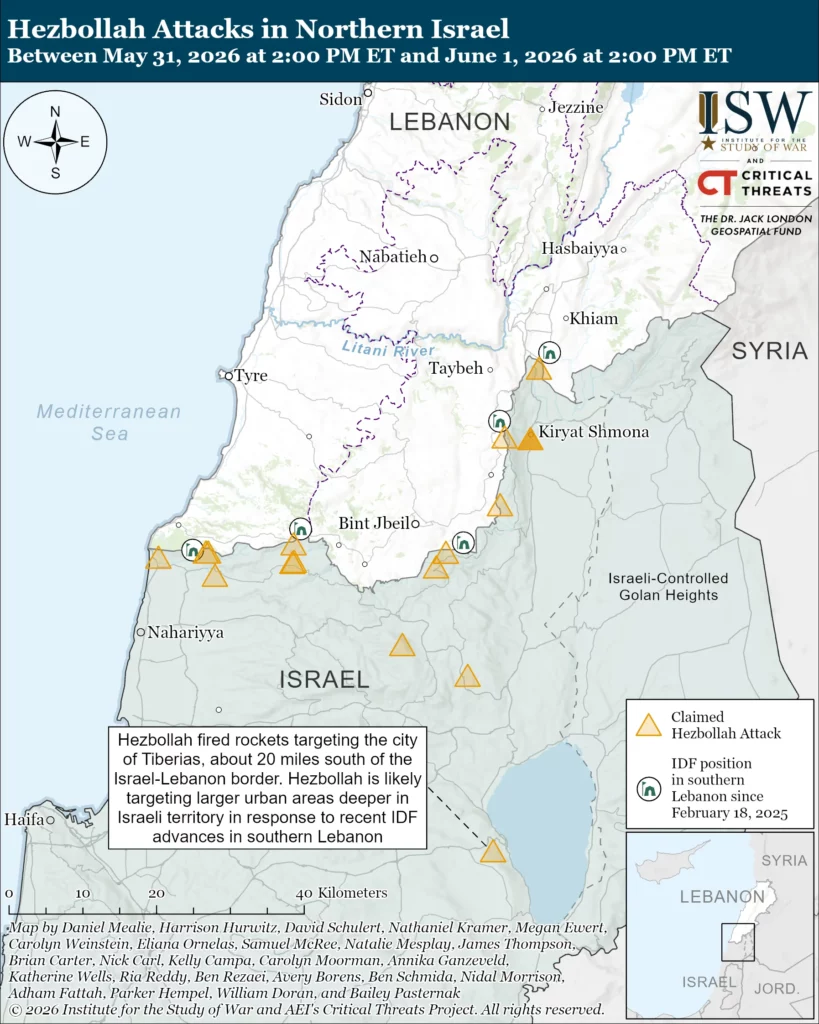
Hezbollah has continued to target larger urban areas deeper inside Israeli territory, likely in response to the Israel Defense Forces’ (IDF) recent advances in southern Lebanon.[34] Hezbollah claimed that it fired rockets targeting the northern Israeli city of Tiberias, which is located about 20 miles south of the Israel-Lebanon border, on May 31.[35] An Israeli military correspondent reported that the rockets did not strike their target and caused no casualties.[36] Hezbollah has targeted several urban areas in northern Israel and has progressively targeted cities deeper inside Israeli territory in recent days.[37]
US-Iran Negotiations
See topline section.
Maritime Activity in the Strait of Hormuz and Persian Gulf
See topline section.
US and Israeli Air Campaign
See topline section.
Iranian Domestic Affairs
See topline section.
Iran’s Axis of Resistance
Lebanese Hezbollah and the Israeli Campaign in Lebanon
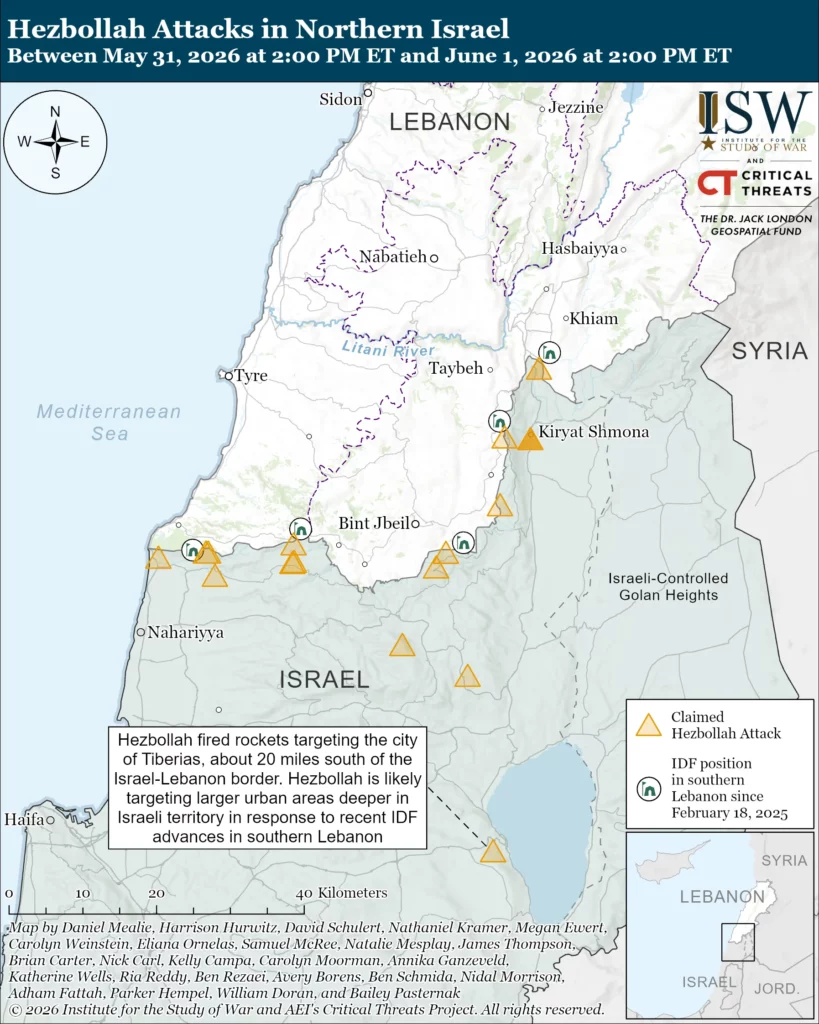
Hezbollah has continued to target larger urban areas deeper inside Israeli territory, likely in response to the Israel Defense Forces’ (IDF) recent advances in southern Lebanon.[34] Hezbollah claimed that it fired rockets targeting the northern Israeli city of Tiberias, which is located about 20 miles south of the Israel-Lebanon border, on May 31.[35] An Israeli military correspondent reported that the rockets did not strike their target and caused no casualties.[36] Hezbollah has targeted several urban areas in northern Israel and has progressively targeted cities deeper inside Israeli territory in recent days.[37]
The IDF 146th Armored Division withdrew from southern Lebanon on June 1.[38] Israeli military correspondents reported that two IDF divisions, the 36th Armored Division and the 91st Territorial Division, will remain in southern Lebanon.[39] The 146th Armored Division was responsible for the IDF’s ground operations in southwestern Lebanon and established a field headquarters in Biyyadah, Tyre District, prior to its withdrawal.[40] Hezbollah has frequently targeted 146th Division outposts, vehicles, and soldiers in Biyyadah with first-person view (FPV) drones during the recent conflict.[41]
Other Axis of Resistance Activity
Nothing significant to report.