 Eurasia Press & News
Key Takeaway: The Yemeni Houthis and Iran could target Emirati, Israeli, or US positions in the Horn of Africa and across the continent as part of the ongoing Iranian retaliatory campaign. The Iran war will likely have short-term effects on disputes in the Horn of Africa that are linked to Red Sea competition among Middle East actors, such as the Sudanese civil war and potential conflict in northern Ethiopia, although it is unclear whether the war will accelerate or dampen conflict in the short term. It is unclear how the Gulf states will prioritize countering any shared threat emanating from Iran versus their Red Sea competition in the long term, and Iran’s regional threat risk will heavily influence this decision.
add note
tweet
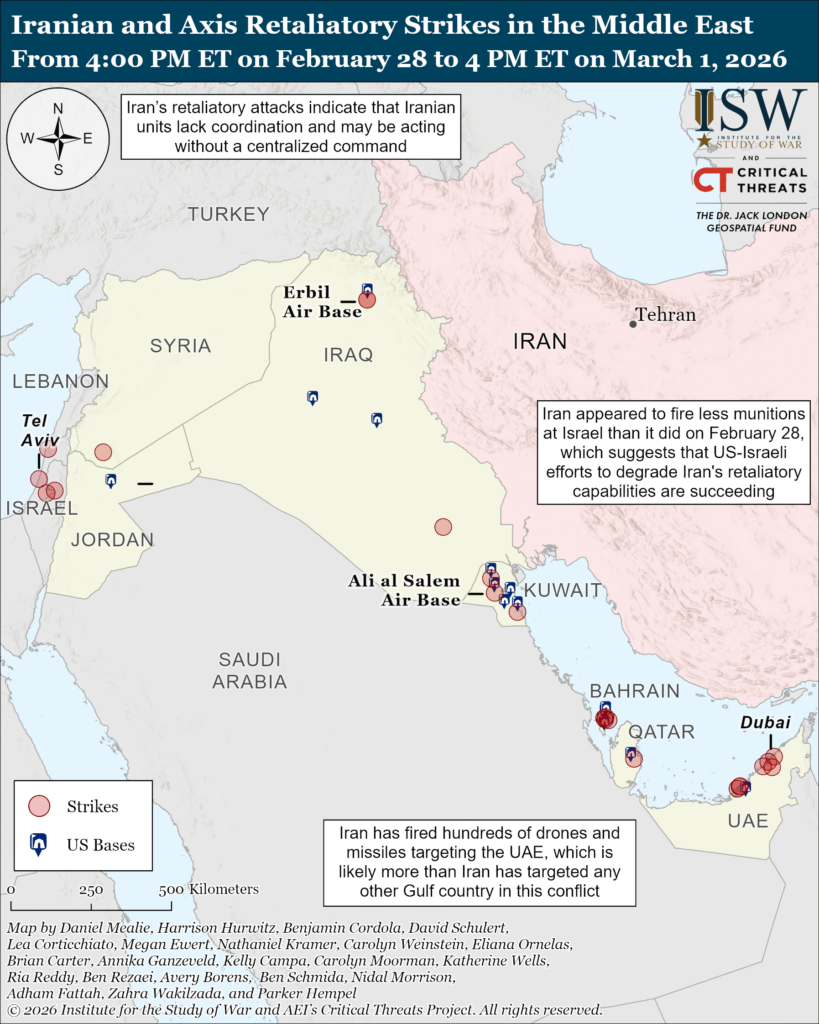
The Houthis could target Emirati, Israeli, or US military positions in the Horn of Africa if they join Iran’s regional retaliatory campaign. Iran has attacked Israel, US bases in the Middle East, and all six Gulf Cooperation Council (GCC) countries in response to the US-Israel strikes.[1] The United Arab Emirates (UAE), followed by Kuwait and Qatar, has predominantly borne the brunt of the hundreds of Iranian ballistic missiles and drones launched at the Arabian Peninsula. The campaign aims to exploit relatively soft GCC defenses compared with Israel and US bases in the Arabian Peninsula to force the GCC to pressure the United States to cease attacks on Iran and enter talks, despite the GCC countries refusing Israel and the United States permission to use their airspace to attack Iran.[2]
Figure 1. Iranian and Axis Retaliatory Strikes in the Middle East
The Houthis have not yet conducted any retaliatory attacks and only confirmed their solidarity with Iran, despite the Houthi spokesperson telling key Iranian officials in February that they would participate in any conflict targeting Iran.[3] Other members of Iran’s Axis of Resistance have conducted attacks, however. Lebanese Hezbollah fired rockets into northern Israel on March 2 for the first time since November 2024.[4] Several Iranian-backed Iraqi armed groups conducted drone, missile, rocket, and ground attacks against US bases.[5] Iranian sources have claimed that prewar coordination between the Islamic Revolutionary Guards Corps–Quds Force (IRGC-QF) outlined a “phased entry” and gradual activation of the Axis of Resistance.[6] CTP has noted that the Houthis can act at any time, and Armed Conflict Location & Event Data has assessed that the Houthis will likely pursue “controlled escalation” to avoid overwhelming retaliation.[7]
The Houthis would likely directly target Israel, and possibly the UAE if it joined the campaign. The Houthis regularly used drones and missiles to target energy infrastructure in Saudi Arabia and the UAE from 2015 to 2022, until a UN-mediated truce entered effect in April 2022.[8] The Houthis then shifted their focus to attacking Israel and Red Sea shipping in response to the Israel-Hamas war in October 2023. The Houthis conducted several major drone and missile attacks on Israel and in the Red Sea throughout mid-2025, including surrounding the June 2025 Israel-Iran war, before voluntarily slowing and eventually halting attacks in relation to the US-brokered ceasefire in Gaza.[9] Analysts have noted that the Houthis still maintain back channels to Saudi Arabia to manage escalation, whereas the UAE is viewed as closer to Israel and the United States and directly enabling the Israeli-US strikes on Iran.[10]
The Houthis could target Emirati or Israeli military positions in the de facto independent Somaliland region as part of a Red Sea attack campaign. The UAE has upgraded military facilities in the Somaliland port city of Berbera, which lies less than 200 miles from the southern entrance to the Red Sea at the Bab el Mandeb Strait, in recent years. Emirati facilities include a modern military port, a deepwater dock, and an airstrip with hangars and other facilities to support Emirati military operations in Yemen and the Horn of Africa.[11] The UAE helped facilitate Israeli recognition of Somaliland in December 2025, which CTP assessed as partially aimed to boost Israeli strategic depth to counter the Houthis.[12] Israeli and Somaliland officials had discussed base options as part of recognition talks, and Somaliland officials confirmed in January that basing talks were still ongoing.[13] Agence France-Presse reported on March 2 that “it is possible that Israeli forces are already present in the Berbera military base” and quoted a Western official who said that “there is a widespread assumption that there is an Israeli military or security presence that is already in the country.”[14] Houthi leader Abdul Malik al Houthi warned after the recognition that any Israeli assets in Somaliland would be legitimate military targets.[15]
Figure 2. Competition in the Greater Red Sea Area
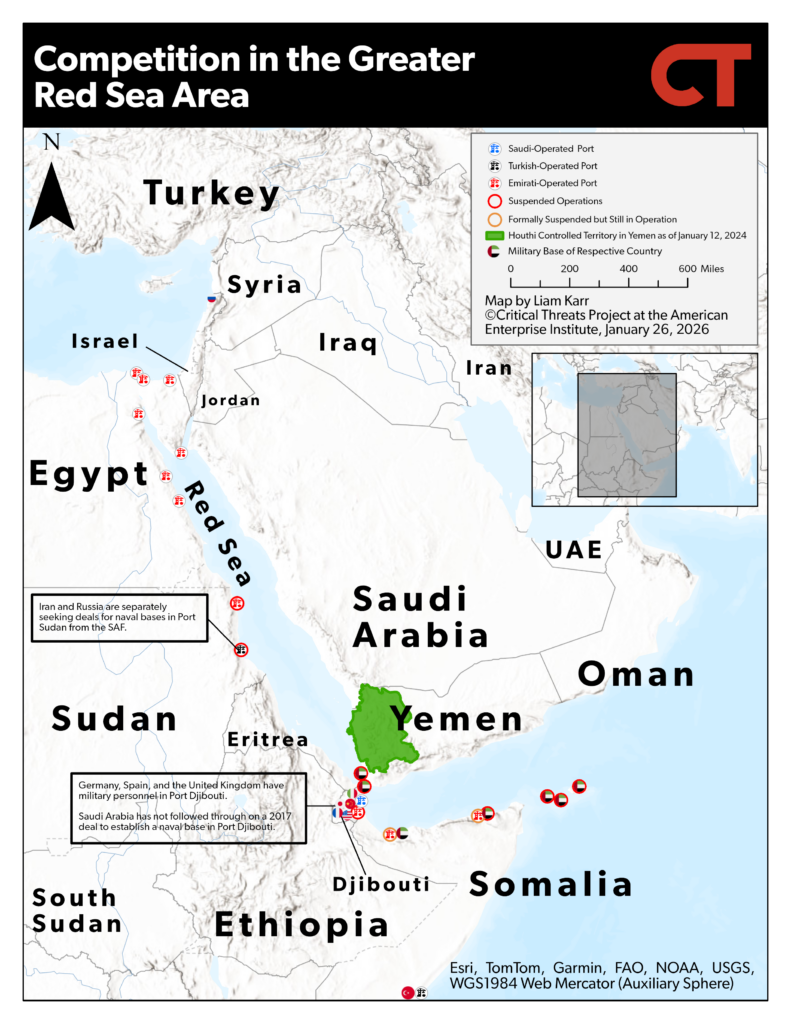
The Houthis could also target the US base in Djibouti—Camp Lemonnier—as part of a Red Sea attack campaign. Camp Lemonnier lies less than 100 miles from the Yemeni coast and hosts more than 4,000 US personnel who support counterterrorism and maritime security initiatives in the Red Sea and Horn of Africa. The multitude of foreign military bases in the area around Camp Lemonnier, which includes China, increases the risk of accidental collateral damage.[16] Analysts have previously noted that this risk, Djiboutian support for Palestine, and Djibouti’s non-confrontational approach to the Houthis have likely decreased Houthi incentives to target the base.[17]
The Houthis could also use their ties with al Qaeda’s Somali affiliate al Shabaab to increase disruptions to shipping in the greater Red Sea area. The Houthis have established ties with al Shabaab since 2024, cooperating on weapons smuggling, technical training, operational tactics, and logistic support.[18] Houthi support has included training on improvised explosive device and drone technology, and Somali security forces claimed that some Somali armed groups had acquired GPS satellite devices to better track commercial vessels.[19] The Houthis lack command and control over al Shabaab, but al Shabaab has previously offered to increase lucrative piracy operations in the Gulf of Aden in exchange for Houthi support.[20] These attacks would be highly lucrative for al Shabaab and bolster its propaganda if it decides to claim them. A piracy campaign in the Gulf of Aden would strain the bandwidth of maritime security forces focusing on countering Houthi attacks in the Red Sea.
Iran could also conduct terror attacks against Emirati, Israeli, and US targets across Africa. The Iranian regime is facing an existential threat, and its attacks on the GCC countries demonstrate a willingness to expand the conflict and attack US-allied targets softer than Israel or US bases in the region. Iran has attempted to use its covert apparatus to attack US and allied personnel across Africa as a form of horizontal escalation for US sanctions multiple times since 2013. Kenyan and Nigerian officials claimed to disrupt plots backed by the IRGC-QF and Lebanese Hezbollah in 2013 that aimed to attack British, Israeli, Saudi, and US targets in both African countries as the US tightened sanctions on the Iranian regime.[21]
Figure 3. Iranian-Backed Attack Plots in Africa
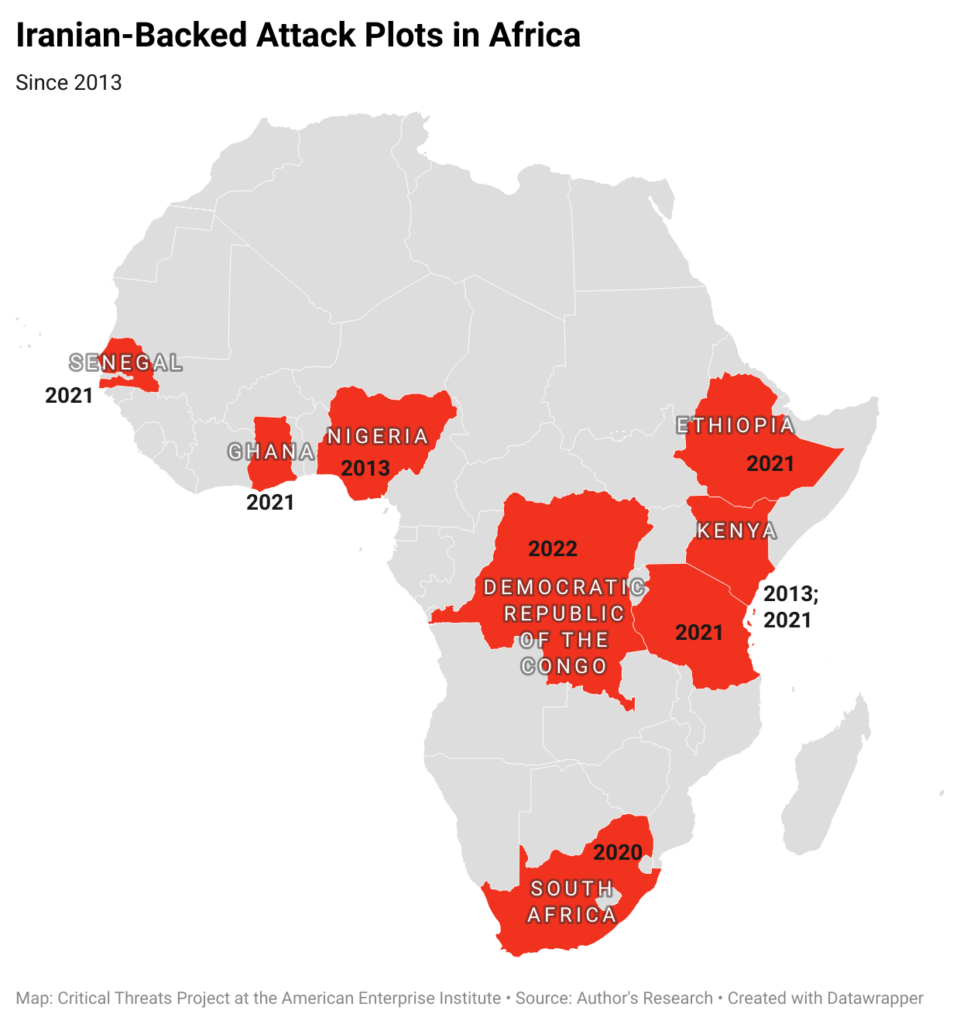
Iran surged attack plots between 2019 and 2022 in response to heightened US sanctions. Anonymous Western intelligence officials told The Telegraph in June 2019 that former IRGC-QF Major General Qassem Soleimani had organized attack cells in the Central African Republic, Chad, Gambia, Ghana, Niger, and Sudan to attack Western targets in response to new US sanctions.[22] US intelligence exposed a potential Iranian plot to assassinate the US ambassador to South Africa in 2020 in retaliation for the US assassination of Soleimani.[23] Security forces also thwarted IRGC-QF-backed plots against Israeli tourists and Jewish centers in Ethiopia, Ghana, Kenya, Senegal, and Tanzania in 2021 and US targets in the Democratic Republic of the Congo in 2022.[24]
Iranian attacks on Saudi Arabia and the UAE have thawed—at least temporarily—the previously escalating tensions between Saudi Arabia and the UAE in the Red Sea. Saudi Arabia, the UAE, and the other GCC members have rallied together in response to Iranian pressure and are considering counterattacks. Saudi Crown Prince Mohamed bin Salman (MBS) and Emirati President Mohamed bin Zayed spoke over the phone on February 28 for the first time since festering tensions between Saudi Arabia and the UAE around the Red Sea boiled over in December.[25] The GCC countries have all repeatedly emphasized their right to retaliate, and several reports claim that the Iranian attacks have only strengthened their collective will to fight back.[26]
Ties between Saudi Arabia and the UAE had been strained since November 2025. The UAE retaliated against Saudi Arabia on both sides of the Red Sea after MBS urged President Donald Trump to impose sanctions that would increase the cost of continued Emirati support for the Sudanese Rapid Support Forces (RSF) in November.[27] The UAE supported a power grab by its Yemeni proxies against the Saudi-backed Yemeni government and helped broker Israel’s recognition of Somaliland, both of which are Emirati allies, in December.[28] The UAE also continued a massive airlift to Ethiopia that had begun in October to open a new supply line for the RSF via Ethiopia, which enabled the group to open a new front against the Saudi-backed Sudanese Armed Forces (SAF) in eastern Sudan in January.[29]
Saudi Arabia responded forcefully to counter the UAE across the region. Saudi forces struck Emirati targets in Yemen and supported a counteroffensive that helped disband the Emirati-backed Southern Transitional Council.[30] Saudi diplomats helped rally widespread condemnation of Israel’s recognition of Somaliland and urged the Somali and Yemeni governments to expel Emirati forces.[31] Saudi Arabia also worked with Egypt to cut some Emirati supply lines to the RSF and reportedly was negotiating an arms sale between the SAF and Pakistan.[32]
Iranian attacks, any Gulf military response, and overall Emirati and Saudi rapprochement could help de-escalate several local conflicts in the Horn of Africa. The Iran war could reduce Saudi Arabia’s and the UAE’s capacity or willingness to continue fueling their proxy competition in the Red Sea and Horn of Africa. The UAE has flown hundreds of weapon shipments to countries surrounding Sudan to supply the RSF since the beginning of the Sudanese civil war in 2023, while Saudi Arabia was reportedly brokering a $1.5 billion arms deal in early 2026 between the SAF and Pakistan, which is also now preoccupied with a conflict with Afghanistan.[33] The UAE is a key military and financial supporter of Ethiopian Prime Minister Abiy Ahmed, who has repeatedly threatened to annex parts of neighboring Eritrea to secure sea access.[34] Saudi Arabia has grown closer to Eritrea to both counter increased Emirati influence in the Red Sea via Ethiopia and deter further regional instability. Emirati weapons shipments to Chad and Ethiopia, most of which are destined for the RSF, have continued as of the time of writing.[35]
Decreased external support could de-escalate conflicts in Africa by degrading key actors’ ability to pursue their goals by force. Emirati support has been indispensable for the RSF, as Emirati-provided weapons, drones, and mercenaries helped the group consolidate control of western Sudan and effectively partition the country in 2025.[36] The SAF has been preparing to launch a counteroffensive in central Sudan since late 2025, and CTP assessed that increased support from Egypt, Turkey, and possibly Saudi Arabia would fuel any counteroffensive.[37] The UAE has also increased weapons shipments since late 2025 to northern Ethiopia, where Ethiopian forces began a massive military buildup in February.[38] CTP assessed that the Ethiopian military buildup was likely in preparation for an imminent offensive to neutralize the rebelling Tigray People’s Liberation Front, which has partnered with Eritrea, and set conditions for a potential invasion of Eritrea.[39] An Emirati air bridge was critical during the last war in Tigray, and Emirati funding has helped Abiy stave off financial collapse amid Ethiopia’s debt crisis.[40]
The war does not change the local and regional drivers of competition among Saudi Arabia, the UAE, and their partners in the Red Sea, however, and could further escalate conflict by giving the rival coalitions greater freedom to act. The UAE has increasingly leveraged an aggressive foreign policy approach to pursue its strategic interests—eradicating Islamism and centering itself in regional trade—and views its partnerships with key African substate actors and Ethiopia as key to this regional framework. The UAE has taken this stance in part due to the belief it could no longer count on the United States and its regional coalition with Saudi Arabia and Egypt after Iranian-backed Yemeni Houthi strikes on Saudi Arabia and the UAE from 2019 through 2022.[41] The UAE has also allied with Israel, which shares a similar regional approach, to strengthen its regional military partnerships and gain economic benefits as part of this recalibration.[42] The UAE partnered with disruptive forces and substate actors with questionable international legitimacy, such as the RSF, Somaliland, and Abiy, that align with its overall regional objectives.
Saudi Arabia is trying to catch up to Emirati economic and geopolitical influence in the Red Sea, and views the Emirati approach as inherently destabilizing and as a threat to its regional interests beyond the zero-sum competition.[43] Saudi Arabia gives greater priority to regional stability than the UAE, as instability in the Horn of Africa threatens to cause influxes of refugees, arms trafficking, and other illicit activity along the Saudi Red Sea coast that would harm its Vision 2030 project.[44] Saudi Arabia promotes strong states as part of this regional outlook and blames weak states and nonstate actors for the conflicts in Gaza, Lebanon, Sudan, and Yemen. Egypt, Turkey and Qatar to varying extents, and several African states have aligned with Saudi Arabia’s outlook. A Saudi diplomat said that “the UAE’s approach creates non-state centers of influence, which could weaken Red Sea states and contribute to their fragmentation,” while an Emirati official accused the Saudi mentality of being counterproductive and “perpetuating crises in their chronic state.”[45]
Other actors within this regional competition have signaled that regional tensions remain. Most African actors in the Horn of Africa condemned Iran’s strikes on all the GCC countries and have been in touch with GCC officials to express their solidarity, but the SAF and FGS both explicitly excluded the UAE in their statements condemning Iranian retaliation.[46] Both the SAF and SFG are partnered with Saudi Arabia and are at odds with the UAE due to Emirati support for the RSF and opposition regions in Somalia, respectively. Turkey condemned both the Israel-US strikes and Iranian retaliation as destabilizing, further indicating that Turkey views Israel as a major threat to regional stability and its regional interests.[47] Israel and Turkey are competing for influence in Somalia, where Turkey backs Somalia, and Israel is partnered with Somaliland, as well as Syria and the eastern Mediterranean Sea.[48]
Figure 4. Emerging Coalitions in the Red Sea Arena
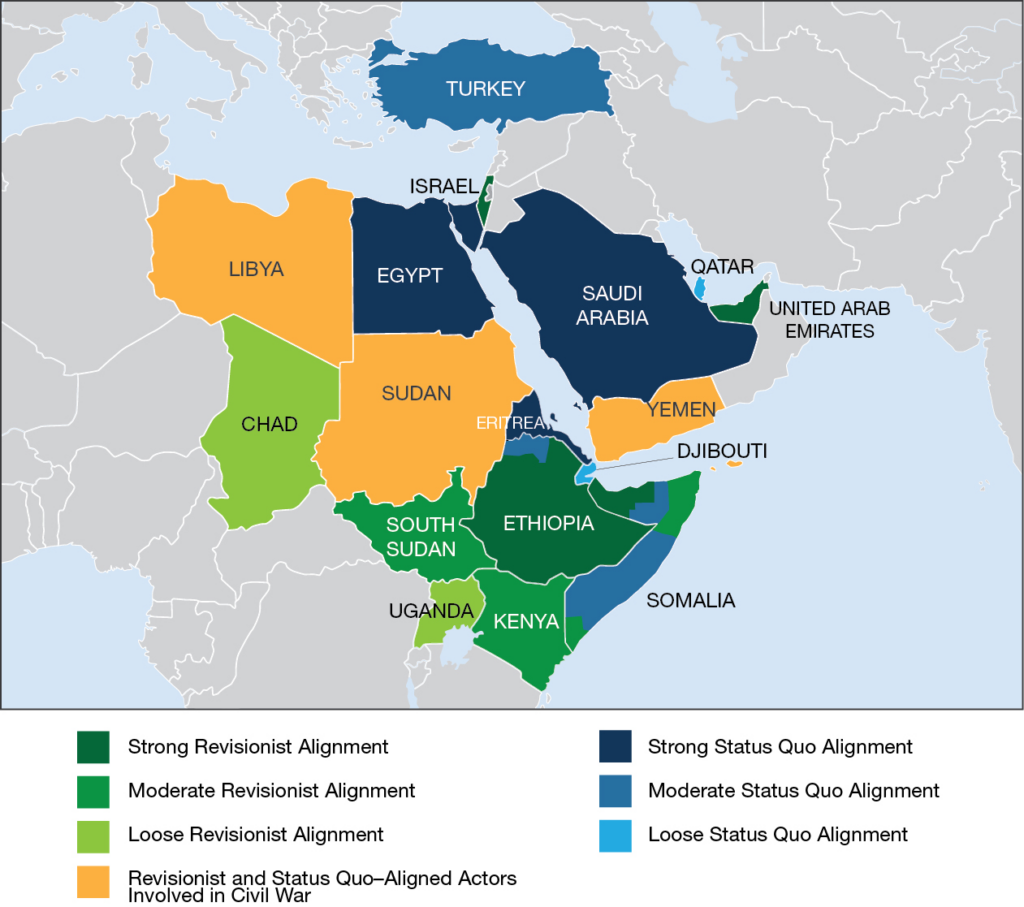
The Iranian strikes are likely further reinforcing each side’s opposing strategic outlooks in the region. Israel’s involvement in initiating the Iran war, despite Gulf and Turkish efforts to avoid conflict, risks further reinforcing Saudi Arabia’s and Turkey’s viewpoint that Israel, and the UAE by extension, are major sources of regional instability.[49] Iranian attacks on the UAE, and concerns with US defense assistance, risk reaffirming Emirati fears that the UAE cannot rely on the United States or the current regional system and must aggressively strengthen its strategic depth to protect itself.[50] The UAE has partially supported the RSF due to the SAF’s links to Islamist groups and Iran, which the RSF’s political coalition highlighted when condemning Iran’s attacks in the region.[51] Israel and the UAE’s partnership with Somaliland also provides strategic depth to help the two partners counter any impending Houthi activity in the Red Sea.
add note
tweet
The Iran war also does not change the local African drivers of these conflicts. The competition among Saudi Arabia, the UAE, and other Middle Eastern powers has layered over preexisting African disputes.[52] The Sudanese civil war, potential conflict in northern Ethiopia, and federal tensions in Somalia are all domestic power-sharing disputes between rival state and substate actors. Ethiopia and Eritrea have had an acrimonious relationship for decades, and Abiy has pushed for sea access for years as part of his vision to make Ethiopia a regional hegemon.[53] Egypt has partnered with several surrounding states to contain Ethiopia, and various African actors have meddled in these conflicts to protect their regional interests, independent of any non-African actors.[54]
US and regional preoccupation with the Iran war could give African actors and their partners greater freedom to act without repercussions. US mediation and private pressure have made progress toward reaching a ceasefire in Sudan over the last year, and the United States, Turkey, and Saudi Arabia have also been pressuring Ethiopian Prime Minister Abiy Ahmed against military action in northern Ethiopia or Eritrea in recent weeks.[55] The new war will at least temporarily distract from and deprioritize these peace efforts. Decreased external pressure would create opportunities for African actors or their sponsors to act with impunity. The United States had repeatedly refused to increase pressure on the UAE to cut its support for the RSF due to fears that it could jeopardize Emirati-US cooperation in the Middle East, which is now critical in the Iran war.[56]
It is unclear how the Gulf states will prioritize countering any shared threat emanating from Iran versus their Red Sea competition in the long term, and Iran’s regional threat risk will heavily influence this decision. The Iranian attacks on GCC energy infrastructure will likely cause a fundamental shift in the GCC’s approach to Iran and increase GCC countries’ willingness to confront Iran if it poses a threat. Saudi Arabia, and the UAE to a lesser extent, pursued a more conflict-averse approach to Iran and its partners across the region for several years, explicitly to avoid costly economic disruptions.[57] Iranian attacks on Gulf energy infrastructure in response to the Israeli and US strikes undermine a core assumption, however, that Iran would not target the GCC as long as the GCC did not directly aid offensive actions against Iran. An adviser to the Emirati president signaled that the Iranian attacks on the GCC would elevate Iran’s long-term importance “regardless of whoever is actually in power” and reinforces that Iran is the Gulf’s “number one threat.”[58] Regional analysts noted that the GCC would view any Iranian attacks on energy infrastructure as a “red line,” and numerous reports emerged on March 2 that the GCC countries were considering “active defense measures,” after Iran struck Saudi and Qatari energy infrastructure earlier in the day.[59] Israeli media reported on March 3 that Qatar launched strikes in Iran in response to an Iranian attack on the Hamad International Airport in Doha.[60]
Figure 5. Iranian Strikes Targeting Gulf Oil and Gas Facilities
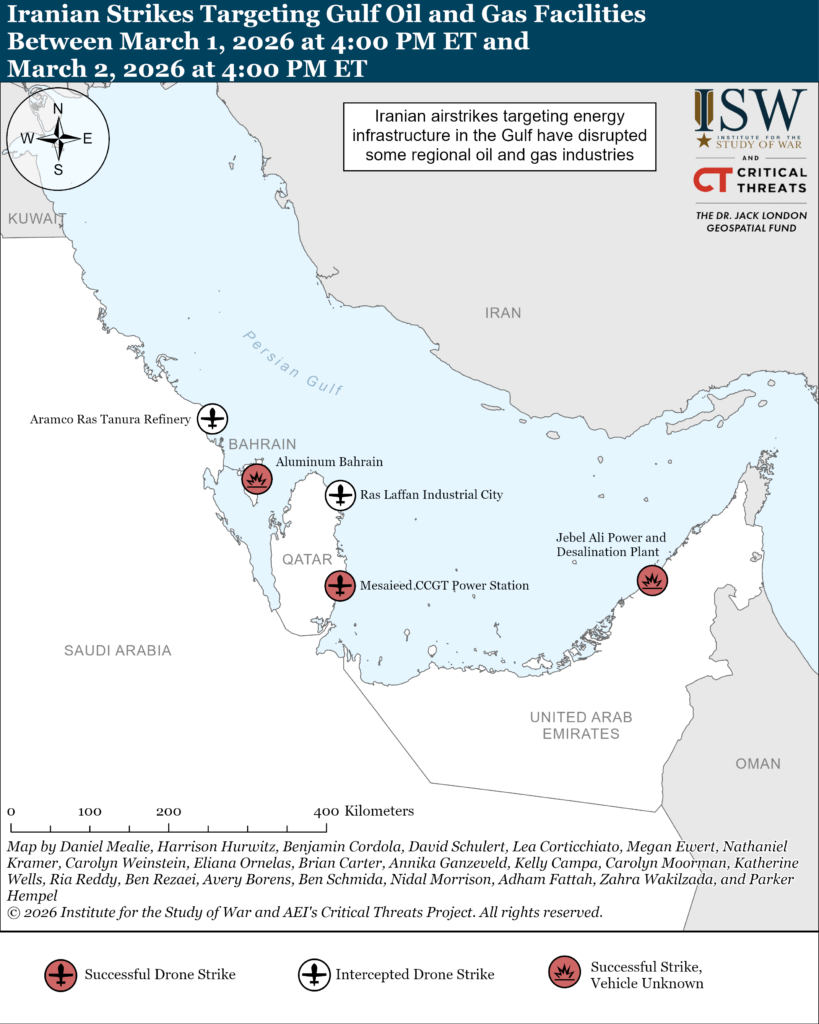
The Gulf states and their partners could alternatively seek to de-escalate the conflict with Iran and manage ties with new Iranian leadership, however, which would also enable them to give more priority to competition in the Red Sea. The Iranian attack campaign seeks to impose unbearable economic costs on the GCC countries, so that they will pressure the United States to halt strikes on Iran. Saudi Arabia became more assertive in the Red Sea in late 2025 but was still trying to manage escalation with Iran through early 2026.[61] Middle East Eye reported on March 1 that Saudi Arabia was frustrated with the Israeli-US strikes and seeking to manage and avoid further escalation, while Bloomberg reported on March 2 reports that Qatar and the UAE are rallying allies to push for de-escalation. [62] These reports came before Iran crossed the GCC’s “red line,” however, and Qatar and the UAE denied parts of the Bloomberg report that they were running out of interceptor missiles.[63] Turkey has pursued a similar approach with Iran for more than a decade, and its condemnation of all sides in the current war indicates that it continues to view de-escalation and management as the best path forward.[64]
Iran remaining a major regional source of instability would likely encourage Saudi Arabia and the UAE to prioritize the shared threat in Iran over points of contention in the Red Sea. The US Central Intelligence Agency warned that hardline elements of the IRGC could take power if the Iranian regime is not dismantled.[65] Regime collapse risks fragmenting Iran, which would create a vacuum for radical Islamists and cause a destabilizing refugee crisis. The Saudi-UAE partnership has been at its strongest in the past when responding to shared threats, such as during the 2010s, when the pair supported counterrevolutionary partners across the Middle East to contain Sunni and Shia Islamist movements that they viewed as threats to their regional interests and monarchical regimes.[66]
An Iran that is friendly or weak but stable would likely encourage the two rivals and their partners to prioritize economic and geopolitical competition in the Red Sea in the absence of a major shared threat. All sides would have more resources available to support their activities in the Red Sea without worrying about the threat from Iran. A greater regional emphasis on economic competition over Islamist politics in recent years had already contributed to the heightened competition in the Red Sea, especially since Israel began degrading Iran’s regional influence after October 2023.[67] Saudi Arabia, Egypt, and Turkey would presumably view the UAE-Israel-Ethiopia axis as the new greatest threat to regional stability with Iran neutralized. The more assertive stance from these partners against the UAE and Israel in the Red Sea in late 2025 indicated that they already viewed the axis as an equal if not greater threat to the weakened Iranian regime prior to the current war.[68]