 Eurasia Press & News
The Institute for the Study of War (ISW) and the Critical Threats Project (CTP) at the American Enterprise Institute are publishing two updates daily to provide analysis on the war with Iran. The morning update will focus on US and Israeli strikes on Iran and Iran and the Axis of Resistance’s response to the strikes. The evening update will be more comprehensive, covering events over the past 24-hour period and refining items discussed in the morning update.
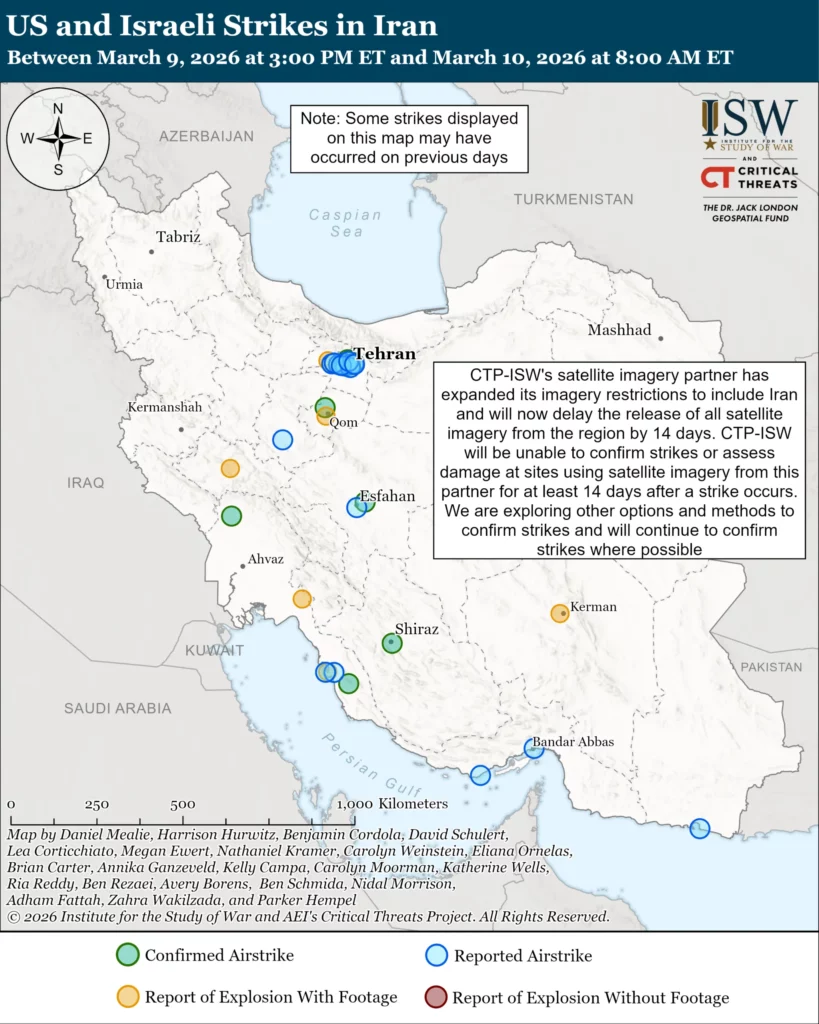
ISW-CTP’s satellite imagery partner has expanded its imagery restrictions to include Iran and will now delay the release of all satellite imagery from the region by 14 days. ISW-CTP will be unable to confirm strikes or assess damage at sites using satellite imagery from this partner for at least 14 days after a strike occurs. We are exploring other options and methods to confirm strikes and will continue to confirm strikes where possible.
Key Takeaways
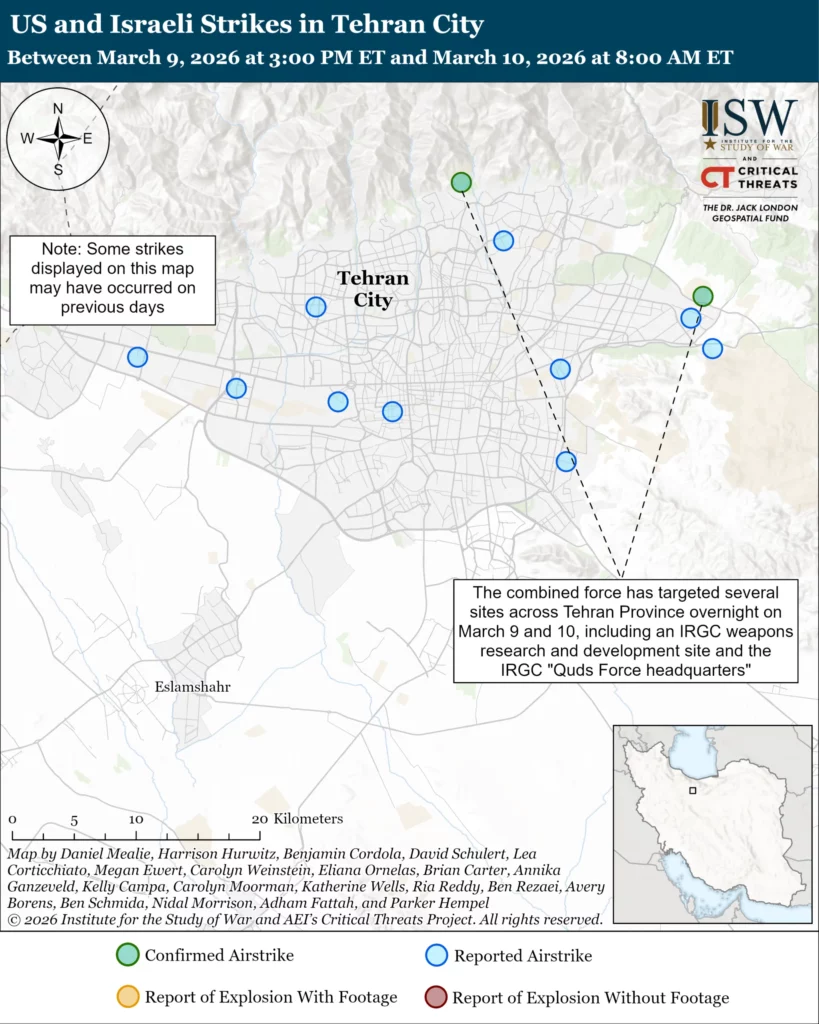
The combined force struck several targets in Tehran overnight on March 9 and 10, including the IRGC “Quds Force headquarters” and an IRGC weapons research and development facility.
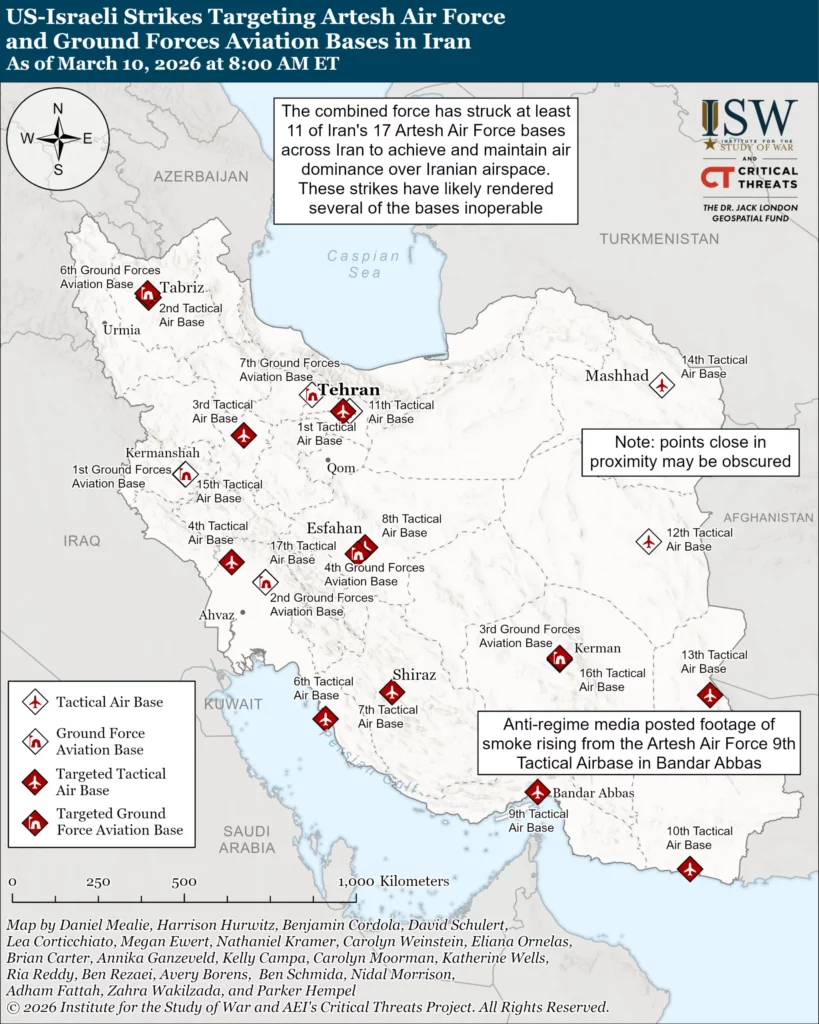
The combined force struck multiple sites in Bandar Abbas, Hormozgan Province, on March 10, which may have included the Artesh Air Force 9th Tactical Airbase. ISW-CTP has recorded combined force airstrikes targeting 11 out of Iran’s 17 Artesh Air Force tactical airbases since February 28.
Iran launched three missile barrages at Israel between 3:00 PM ET on March 9 and 8:00 AM ET on March 10. US Defense Secretary Pete Hegseth noted during a Pentagon briefing on March 10 that Iran had fired its lowest number of missiles since the war began over the last 24 hours. The IDF said on March 10 that Iranian missile barrages in recent days have included only a few missiles at a time, but that around 50 percent of Iranian ballistic missiles fired at Israel have contained cluster warheads.
Hezbollah has claimed 18 attacks targeting IDF positions and forces in northern Israel and southern Lebanon since ISW-CTP’s last data cutoff at 3:00 PM ET on March 9. The IDF confirmed that Hezbollah is using long-range projectiles to attack Israel, after Hezbollah claimed that it launched “high-quality missiles” targeting the IDF Rehavam Camp in Ramla, Central Israel, on March 9.
The IDF has continued to conduct airstrikes targeting Hezbollah across Lebanon to degrade Hezbollah’s ability to launch attacks targeting Israeli forces and positions in northern Israel and southern Lebanon. The IDF has reportedly continued to advance into southern Lebanon on three separate axes since ISW-CTP’s last data cutoff on March 9.
Toplines
The combined force struck several targets in Tehran overnight on March 9 and 10. Reuters reported that US-Israeli strikes in Tehran overnight were the most intense since the start of the war on February 28.[1] There were reported airstrikes in at least eight districts across Tehran Province.[2]
The IDF reported on March 9 that it struck the Islamic Revolutionary Guards Corps (IRGC) Quds Force Headquarters in Tehran.[3] The Quds Force is the extraterritorial arm of the IRGC and Iran’s primary means of controlling and supporting the Axis of Resistance.[4] The Quds Force provides leadership, materiel, intelligence, training, and funds to Iranian proxy and partner militias across the Middle East, including Hezbollah in Lebanon, Hamas in the Gaza Strip, the Houthis in Yemen, and militias in Iraq. The IDF previously reported that it struck the IRGC Quds Force Headquarters on March 4.[5] It is unclear if the IDF struck the same facility again or targeted another Quds Force facility in Tehran. The Southern Quds Force Unit Headquarters is also located in Tehran, for example. The exact role and responsibility of the Southern Quds Force Unit is unclear.
The IDF also struck an underground weapons research and development facility at Imam Hossein University.[6] The IDF stated that it targeted an underground tunnel where the IRGC conducts ballistic missile production research and testing. The US-Israeli combined force has targeted Iran’s ballistic missile infrastructure since February 28 in order to degrade Iranian missile capabilities and Iran’s ability to retaliate.[7]
The combined force struck multiple sites in Bandar Abbas, Hormozgan Province, on March 10, which may have included the Artesh Air Force 9th Tactical Airbase.[8] Anti-regime media posted footage of smoke rising from the 9th Tactical Airbase in Bandar Abbas.[9] ISW-CTP has recorded combined force airstrikes targeting 11 out of Iran’s 17 Artesh Air Force tactical airbases since February 28.[10]
US Central Command (CENTCOM) reported on March 9 that the United States has damaged or destroyed at least 50 Iranian vessels since February 28.[11] Anti-regime media posted footage on March 10 of plumes of black smoke rising from an unidentified Iranian vessel in Chabahar, Sistan and Baluchistan Province.[12]
Iranian Retaliation
Iran launched three missile barrages at Israel between 3:00 PM ET on March 9 and 8:00 AM ET on March 10.[13] US Defense Secretary Pete Hegseth noted during a Pentagon briefing on March 10 that Iran had fired its lowest number of missiles since the war began over the last 24 hours.[14] The IDF said on March 10 that Iranian missile barrages in recent days have included only a few missiles at a time, but that around 50 percent of Iranian ballistic missiles fired at Israel have contained cluster warheads.[15] The reduction in Iranian missile attacks demonstrates the success of the combined force’s efforts to degrade Iran’s ability to launch retaliatory attacks. An unspecified senior Israeli official told Israeli media on March 9 that the combined force has destroyed 80 percent of Iran’s missile launchers.[16]
An Iranian drone struck the Millennium tower in Manama, Bahrain, on March 9, killing one person and injuring eight others.[17] An Iranian drone also started a fire at the Ruwais Oil Refinery in Abu Dhabi, UAE, on March 10.[18] ISW-CTP assessed on March 2 that Iran is likely targeting energy infrastructure in Gulf countries to compel the United States and its partners to pursue a ceasefire before achieving their objective of toppling the regime.[19] Iranian attacks have killed at least 12 civilians in the United Arab Emirates (UAE), Kuwait, Qatar, Oman, and Bahrain, according to the New York Times’ tally of official sources.[20]
Axis of Resistance Response
Hezbollah has claimed 18 attacks targeting IDF positions and forces in northern Israel and southern Lebanon since ISW-CTP’s last data cutoff at 3:00 PM ET on March 9.[21] Hezbollah claimed that it attacked Israeli forces and disabled three Israeli Merkava tanks in Khiam, Marjaayoun District.[22] Hezbollah did not offer any proof of their claim. An Israeli defense journalist separately reported that Hezbollah hit a Merkava tank loaded on a transport truck with an unspecified projectile in the Upper Galilee, which is on the Israel-Lebanon border and just south of Khiam.[23] Hezbollah also claimed that it fired rockets and artillery targeting Israeli forces in Markaba and Tal al Hamamis, Marjaayoun District, and Aitaroun, Jabal al Bat, Maroun al Ras, all in Bint Jbeil District.[24] One of Israel’s five permanent positions in southern Lebanon that it has occupied since February 2025 is located at Tal al Hamamis.[25] Hezbollah also claimed that it targeted Israeli positions in northern Israel on the Israel-Lebanon border, including three separate attacks targeting an artillery position at al Abbad near Margaliot, northern Israel.[26] Hezbollah previously targeted some of these IDF positions in northern Israel during the October 7 War.[27] Hezbollah also claimed that it targeted multiple IDF bases and an unspecified military factory with drones and rockets on March 10.[28] Hezbollah claimed one drone attack targeting an IDF base in central Israel on March 9.[29] The IDF confirmed on March 9 that Hezbollah is using long-range projectiles to attack Israel, after Hezbollah claimed that it launched “high-quality missiles” targeting the IDF Rehavam Camp in Ramla, Central Israel, on March 9.[30]

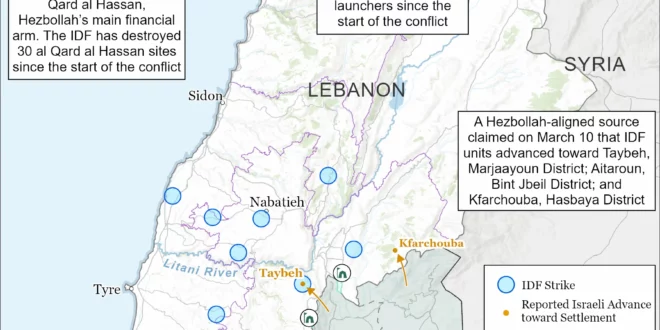
The IDF has reportedly continued to advance into southern Lebanon on three separate axes since ISW-CTP’s last data cutoff on March 9.[31] A Hezbollah-aligned source claimed on March 10 that IDF tanks advanced from Aadaysit Marjaayoun and Rab El Thalathine toward Taybeh, all in the Marjaayoun District.[32] The source also claimed that IDF units also advanced on March 10 from Maroun al Ras toward the Kanouq neighborhood in Aitaroun, Bint Jbeil District.[33] The source additionally claimed that Israeli tanks and bulldozers advanced towards the Azrael area on the outskirts of Kfarchouba, Hasbaya District.[34]
The IDF has continued to conduct airstrikes targeting Hezbollah across Lebanon to degrade Hezbollah’s ability to launch attacks targeting Israeli forces and positions in northern Israel and southern Lebanon. The IDF reported that it has destroyed 70 Hezbollah missile launchers since the start of the conflict.[35] The IDF also targeted at least three locations linked to al Qard al Hassan, Hezbollah’s main financial arm, on March 10.[36] Hezbollah uses funds transferred via al Qard al Hassan to finance its military operations, pay its fighters, and purchase weapons.[37] The IDF has destroyed 30 al Qard al Hassan sites since the start of the conflict.[38] The IDF also targeted a Hezbollah headquarters in Insar, Nabatieh District.[39] The IDF stated that Hezbollah fired rockets from the village targeting Israel on March 9.[40] Israel issued additional evacuations on March 10 for Lebanese residents in Tyre and Sidon in southern Lebanon, as well as in Beirut’s southern suburbs.[41] Israel has issued multiple evacuation notices in southern Lebanon and Beirut’s southern suburbs since the start of the conflict.[42]