 Eurasia Press & News
President Trump recently commented on the turmoil within Iran’s leadership, emphasizing the ongoing power struggle following the late Supreme Leader Khamenei’s death.
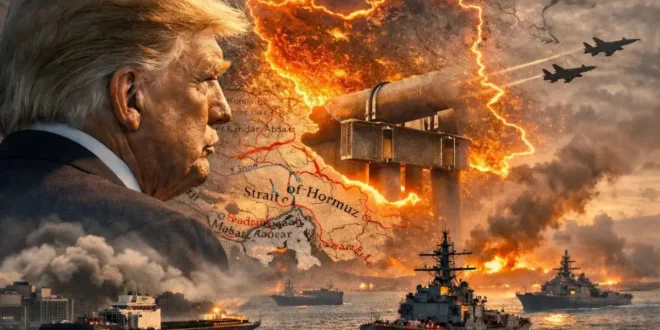
President Donald J. Trump took to Truth Social on Thursday to highlight what he sees as deep confusion and infighting inside Iran’s fractured leadership, while boasting that the United States Navy has the strategic Strait of Hormuz completely locked down until Tehran agrees to a deal.
In the post, Trump wrote:
“Iran is having a very hard time figuring out who their leader is! They just don’t know! The infighting is between the “Hardliners,” who have been losing BADLY on the battlefield, and the “Moderates,” who are not very moderate at all (but gaining respect!), is CRAZY! We have total control over the Strait of Hormuz. No ship can enter or leave without the approval of the United States Navy. It is “Sealed up Tight,” until such time as Iran is able to make a DEAL!!! Thank you for your attention to this matter. President DONALD J. TRUMP”
The message comes amid ongoing reports of a power struggle in Tehran following the death of longtime Supreme Leader Ayatollah Ali Khamenei earlier in the conflict. His son, Mojtaba Khamenei, was named the new supreme leader in March but has remained largely invisible — injured in the initial strikes, communicating only through written statements, and reportedly sidelined as senior commanders from the Islamic Revolutionary Guards Corps (IRGC) take charge of key security and diplomatic decisions.
Recent reporting describes a collective, military-dominated setup where battle-hardened IRGC generals hold real influence over strategy, including the closure of the Strait of Hormuz and negotiations with the US Elected officials like President Masoud Pezeshkian and Foreign Minister Abbas Araghchi have been pushed toward domestic matters, while figures such as Parliament Speaker Mohammad Bagher Ghalibaf (a former Guards commander) have led talks.
Trump’s post frames the situation as messy internal fighting between hardliners suffering battlefield setbacks and so-called moderates who are “not very moderate at all” but appear to be earning some US respect for their willingness to negotiate. He portrays the chaos as an opportunity for American leverage.
US Naval Blockade Remains Firm
Central to Trump’s message is the US Navy’s control of the Strait of Hormuz — the narrow chokepoint through which roughly 20% of global oil passes. The waterway has been a flashpoint since the early days of the conflict, with Iran using its closure to disrupt global energy markets and the US responding with a naval blockade.
Trump emphasized that “no ship can enter or leave without the approval of the United States Navy,” calling the strait “Sealed up Tight” until Iran makes a deal. This aligns with earlier US actions, including seizing vessels and maintaining pressure even during fragile cease-fires. The blockade has inflicted economic pain on Iran while giving Washington a powerful bargaining chip.
Echoes of a Blunt Approach
The president’s post also resonates with comments circulating in conservative circles. Conservative commentator Marc Thiessen recently captured a similar hard-edged sentiment in a widely shared remark: “If there are two factions in Iran, one that wants a deal and one that doesn’t, let’s kill the ones who don’t want a deal.”While Trump’s Truth Social message stops short of that level of directness, it underscores his strategy of maximum pressure: exploit Iran’s internal divisions, maintain military dominance over key assets like the strait, and force Tehran to the table on US terms.
As of now, the cease-fire remains extended but shaky. Talks in Islamabad involving US Vice President JD Vance and Iranian representatives have stalled, with disagreements over sanctions relief, nuclear concessions (including enrichment limits and highly enriched uranium stockpiles), and control of the strait. Trump’s latest message sends a clear signal: Washington sees opportunity in Iran’s disarray and has no intention of easing the economic and naval squeeze until a comprehensive deal materializes.
Iran Hits Back
Iran’s response, as reflected in reporting by Fars News Agency and statements linked to the Islamic Revolutionary Guard Corps Intelligence Organization, focuses on turning criticism back toward the United States. Instead of directly engaging with claims about divisions inside Iran, the narrative highlights what it describes as political instability in America. It points to a reported drop in the U.S. president’s approval rating to around 35 percent and mentions the resignation of several senior political, security, and military officials during a recent period of conflict. By doing this, Iran argues that a country dealing with internal disagreements and leadership challenges lacks the credibility to comment on Iran’s internal affairs.
This response is also meant to shape perception. It presents Iran as stable and resistant under pressure while portraying the United States as divided and weakened from within. The message works on two levels: domestically, it reassures the public that Iran remains steady despite external pressure, and internationally, it questions the authority of the U.S. to influence or criticize other nations. Overall, the response is less about direct defense and more about shifting the focus to the perceived shortcomings of its rival.
Whether the hardliners or the more pragmatic voices inside Iran ultimately prevail — and whether they can present a unified proposal — remains uncertain. For now, the US holds the strait, and President Trump is keeping the pressure on.