 Eurasia Press & News
Cities and towns in northeastern Syria, particularly al-Hasakah and al-Qamishli, have seen a notable security escalation in recent days. It has included renewed security deployments on the streets, the spread of temporary checkpoints, tighter inspection procedures, field movements, and politically charged activities, with no official explanation from the Syrian Democratic Forces, SDF, for these measures.
Enab Baladi observed several checkpoints inside neighborhoods and at their entrances, especially in Ghuwayran neighborhood and at the entrance to al-Zuhour neighborhood, where SDF members were stopping cars and passersby, checking identity cards, and, in some cases, searching mobile phones.
Checkpoints Inside Neighborhoods and Phone Searches
Local residents said the checkpoints are not limited to main roads, but extend into residential neighborhoods, in what they described as a sudden move. They added that the inspections include searches of mobile phones, raising growing fears among civilians over privacy and personal safety.
One resident of Ghuwayran neighborhood, who asked not to be named for security reasons, said, “The deployed members are closely checking IDs, and sometimes searching phones without explaining why, creating a state of anxiety among residents.”
This comes amid a clear security alert, with reinforced military presence at several vital points inside the cities, without official statements explaining the background to these movements.
Civilian Arrested After Protest
In a related development, local sources said the SDF arrested civilian Majd al-Zoubaa in the Villas area of al-Nashwa neighborhood in al-Hasakah city after he protested the raising of the Democratic Union Party flag above his home, according to the sources.
The SDF had not issued any official comment on the incident by the time this report was prepared, and the charges against the detainee and the conditions of his detention remained unclear.
Raising Political Flags and Images in Cities
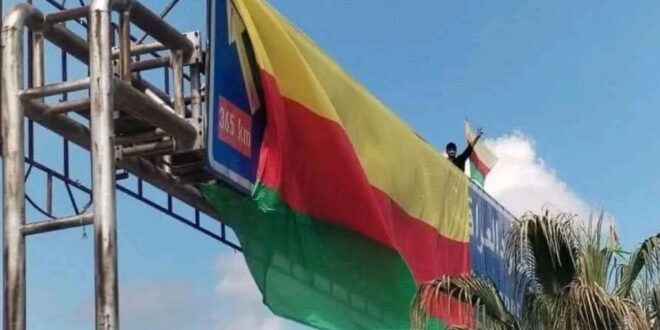
Alongside the security measures, cities across the region saw a wide display of SDF flags on main streets, atop high buildings, and around public institutions and city centers.
According to field observations by Enab Baladi’s correspondent, two large flags were installed in al-Hasakah city, one in front of the Palace of Justice and the other above the grain silos, along with the reappearance of images of Abdullah Ocalan, the leader of the Kurdistan Workers’ Party, PKK, at several locations.
These steps come amid existing tensions with the Syrian government and coincide with public mobilization activities organized by the SDF.
Shops Forced to Close and Protest Marches
In al-Mabada (Karki Laki), local sources said the Revolutionary Youth, affiliated with the SDF, forced a number of shop owners to close their stores and take part in protest vigils calling for the release of SDF fighters held by the Syrian government.
The SDF also organized a march in al-Malikiyah (Derik, al-Hasakah governorate), involving employees, teachers, and students, protesting what participants described as “changing school names,” in a move that reflects growing public mobilization linked to political and administrative issues in the region.
Sharp Polarization on Social Media
These developments were accompanied by sharp polarization on social media platforms.
Supporters of the SDF and the Syrian government exchanged accusations amid escalating political and media rhetoric between the two sides, reflecting the depth of division over the future of governance in the region.
Tension Over the Judicial File
These developments come in the context of rising tension between the Syrian government and the SDF over stalled implementation of the January agreement, which stipulates the handover of government institutions, including judicial ones, to Damascus.
Ahmed al-Hilali, spokesperson for the presidential team following up on implementation of the agreement, previously told Enab Baladi that a Ministry of Justice delegation, headed by Deputy Attorney General Judge Hassan al-Turba, held meetings with officials and judges in al-Hasakah and al-Qamishli to discuss the mechanism for taking over courthouses and integrating employees into state institutions.
According to al-Hilali, the ministry has not received the required lists from the SDF containing the names of judges and employees, which has obstructed the integration plan. He added that the courthouse in al-Qamishli was not handed over and that judges and employees of the courthouse in al-Hasakah were prevented from entering, describing it as an “unjustified escalation.”
Impact on Residents on the Ground
The return of security displays and the spread of checkpoints, alongside arrests and political movements, reflect a state of tension on the ground linked to the political and administrative disputes between the two sides.
These measures are also directly affecting residents’ lives by restricting movement, increasing security scrutiny, and deepening anxiety, especially in the absence of official explanations about the nature of the next phase.