 Eurasia Press & News
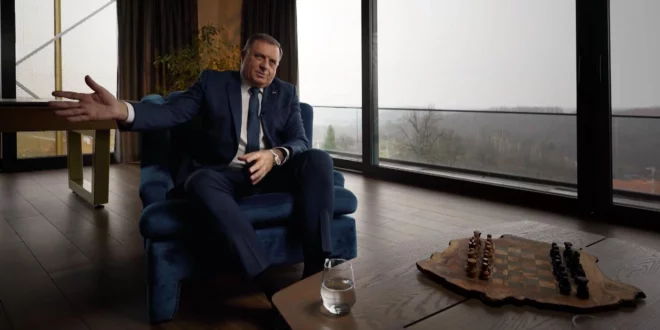
After the unexpected resignation of the international administrator in Bosnia and Herzegovina Christian Schmidt and the intensification of contacts between Bosnian Serb leader Milorad Dodik and the Kremlin and at the same time the entourage of US President Donald Trump, the situation in Bosnia from the postwar begins to resemble the pre-war one. At least Washington’s transition to conditionally “pragmatic politics” plays into the hands of only the separatist bloc. Dodik as his head, despite the dismissal of the Republika Srpska, remains the real leader of the Bosnian Serbs. Having achieved the lifting of US sanctions, they launched a campaign to abolish external surveillance, frankly seeking the independence of the Republika Srpska, although the Dayton Agreements do not provide for such an opportunity.
The leader of the main party of Bosnian Serbs – the Union of Independent Social Democrats (SNSD) – Milorad Dodik visited Moscow with the second visit in the month. After participating in the Parade on May 9, he received an invitation to the International Security Forum, at which delegations from 120 countries discuss “security issues, protection of traditional values, confrontation with neocolonialism and neo-Nazism.” Among the guests are national security advisers of heads of state, heads of law enforcement agencies and special services, ambassadors, representatives of international organizations and the scientific community.
Dodica is difficult to attribute to any of these categories. But he retains the image of the Kremlin’s main ally in the Balkans primarily thanks to the unconditional support of all Kremlin ideas and decisions. And although Dodik does not have foreign policy powers (and now formal state – it is often accepted in the Kremlin and the Ministry of Foreign Affairs.
Dodik has the image of the main ally of the Kremlin in the Balkans thanks to the unconditional support of all Kremlin ideas and solutionsThis time, he arrived to meet with Deputy Minister Alexander Grushko, armed with the declaration of the Republika Srpska Parliament (FS in Bosnia and Herzegovina) calling on the UN Security Council to completely abolish the post of High Representative in Bosnia. So officially is the international administrator, who became the highest authority in the interpretation of the Dayton Peace Agreement, which was the basis for ending the war in Bosnia.
Now in the Balkans are arguing about the unexpected resignation of the current High Representative Christian Schmidt. German diplomat Schmidt announced his departure on May 11 after five years in office. And although Schmidt refers to “personal motives,” many believe that it was “removed” by the US administration, which was not satisfied with the German’s style of work and his acute conflict with Dodik. The State Department did not formally confirm this, but called Schmidt’s resignation a timely decision, promising to actively work on de-escalation.
Dodik, Russia and the United States against Europe
It was Schmidt’s disputes with Dodik, as well as the position of Russia and China, which did not even recognize his appointments, that resulted in the acute crisis from the civil war. As a result, Dodik was dismissed from the post of President of the RS for failure to comply with the decisions of the High Representative. The court sentenced him to the year of prison (which was quickly replaced by a monetary fine) and banned from holding public office for another six years. However, Dodik did not lose the influence.
In the November 2025 elections, he secured the election of his associate Sinisha Karan as president of the RS. And in addition, he has achieved the lifting of American financial sanctions from himself, his children and the immediate entourage. It is Dodik that experts call the main beneficiary of the conflict with the international administration. And today it is much easier for him to demand the abolition of external supervision, playing on the contradictions of the main guarantors of the world – the United States, Europe and Russia.
As Vuk Vuk Vukznovic, lecturer at the Department of Military Studies at King’s College London in London, told The Insider, opinions on the Institute of the High Representative in Bosnia and Herzegovina.
The authorities in Sarajevo and most Western countries considered this institution necessary to implement the Dayton Agreement and maintain stability in the country. On the other hand, many Bosnian Serbs, some Croatian politicians, some Western experts, and Russia, argue that the institution of the High Representative has led to international officials having too much influence compared to democratically elected local leaders.
“Reality is certainly more difficult than any of these positions, but politically the greatest winner in this situation is Dodik, whose main goal is to maintain political influence and stay in power, formally or informally,” says Vuksanovic.
It is interesting that in this case, although for various reasons, the United States and Russia were in a similar situation, the expert notes. Russia has for years criticized the institution of the High Representative, and especially Schmidt, seeing this as an opportunity for obstruction of the West and promoting its own influence in the region.
On the other hand, Vuksanovic notes, Trump administration policy is showing a trend towards more pragmatic and “deal-built” relations with local political elites. Dodik managed to improve his position in Washington thanks to lobbying in the United States, ties with Israel and willingness to cooperate with the Trump administration.
“In a sense, Dodik achieved what he hoped for, but did not get Serbian President Aleksandar Vucic – the ability to maintain relations with both Washington and Moscow, while weakening European influence,” the expert says.
Why Dodik lifted sanctions
Observers are arguing how much Washington’s policy in the Balkans under Trump can change and whether this will eventually break the entire settlement model in which Washington initially acted as the main financial donor and guarantor of security.
The Trump administration said that “the United States remains committed to the Dayton Agreement, as well as the sovereignty and territorial integrity of BiH.” Strong U.S. diplomacy, according to a recent report to Congress, helped end the most acute crisis since the 1992-1995 conflict, “while maintaining the country’s legal cohesion and constitutional order.”
But the details of last year’s Washington’s agreements with Dodik remained unknown. One of the main questions is why all the sanctions were lifted from him after years of accusations of corruption, obstruction of a peaceful settlement and attempts to collapse BIG?
The U.S. began imposing sanctions on Dodik back in 2017 and then expanded them several times, extending to his son Igor and daughter Goritsa, heads of family-related companies and political associates. If you read the previous argument, then Dodik looks almost the idea of hell, who robbed the people and almost ruined the country.
If you read into the previous argument, then Dodik looks almost a source of hell, robbing the people and almost ruined the countrySo, in June 2024, the US Treasury reported that “will continue to expose fraudulent schemes that allow Dodik and his family to exploit their own people for personal purposes.” Dodik, the document said, not only robs citizens with their corruption behavior, but also undermines security by constant threats to the Republika Srpska branch.
The Ministry of Finance explained that Dodik used the official position to transfer state contracts to private companies that control him and his son Igor through nominee owners and directors. These companies include Prointer, Kaldera, Infinity Media, K-2, Una, Sirius, which receive profitable state contracts in the field of information technology and the engineering sector.
Against all logic
Back in November 2024, the US Treasury announced the “exposure” of the obvious attempts of the Dodik network to circumvent the bans imposed on him. But still, on October 29, 2025, sanctions were lifted – a total of almost 70 individuals and legal entities. In such a seemingly favorable situation, one could expect a softening of rhetoric, but Dodik’s team continued to harshly criticize the international administration and opponents in Sarajevo, using any controversial issues – financial issues, state ownership – to remind about the main desire of the Republika Srpska – to go free.
“Dodik has always found unexpected directions of action to survive in the political arena, and even when it seemed that he was going into the past, he rebelled against all political logic,” says Hesaniya Cumberovic, professor at the Faculty of Philosophy of Sarajevo University.
According to the expert, Dodik has not changed his rhetoric for a long time, but only strengthens it, and Schmidt’s resignation encourages him to be even more active. Despite the fact that Dodik was removed from the post of President of the RS, he is still the central political figure and a key link of power in the RS, says Kamberovich. In fact, this position is now best suited to him: he retained full power, while shifting responsibility to others.
Schmidt's resignation prompts Dodik to be even more activeDodik will impose his new declarations and will try to push others to adventure with the cancellation of previous decisions of the High Representative, the interlocutor believes.
During the entire post-war period, the Office of the High Representative made hundreds of decisions on a variety of issues on which local authorities could not agree. They concerned property and the return of refugees, the state symbols of BiH, citizenship laws, elections, etc. In addition, about 140 officials were dismissed, including judges, ministers, civil servants and members of parliament. Among the latter are the decision to suspend funding from the budget funds of the Dodik (SNSD) party and the abolition of a number of decisions of the RS parliament.
“Americanization” of Republika Srpska
In recent months, delegations of the Bosnian Serb leadership have been frequented in America, and American congressmen-republicans and other interesting associates of Donald Trump have visited Banja Luca. The other day, гостилformer Trump National Security Advisor, General Michael Flynn, visited here, whom Dodik called a friend of the US president.
The Gold Institute for International Strategy, led by him, held an international forum on economic and security in Banja Luca on May 27-28. Politicians and “opinion leaders” from Europe, the United States and allied countries were invited to the event. Particular attention is reportedly paid to the role of Republika Srpska in Bosnia and Herzegovina and its neighbors, “as Europe faces changing alliances, the resumption of competition between the great powers and the evolution of the institutional framework.”
Flynn is known for having worked as a national security adviser for only 24 days – this is the shortest period in the history of this position. He left the post in February 2017 after the scandal because of hidden contacts with Russian Ambassador to the United States Sergey Kislyak.
He pleaded guilty to making false testimony to the FBI in the case of alleged Russian interference in the US elections, but later tried to revoke his guilt. In 2020, Trump took advantage of the constitutional right and issued a pardon to Flynn.
In the Balkans, it is called one of the main lobbyists of the Republika Srpska with a reward of $100 thousand per month. Flynn provides “strategic advice and analysis and helps to establish contacts with decision makers in Washington.”
Flynn, who is called a “Christian nationalist”, had already come to Banja Luka a few months ago, and his lecture was broadcast live on the pro-government TV channel RTRS. He, among other things, accused the European Union of “high-mercy” and indirectly supported the idea of the independence of the RS.
Answering Dodik’s question about the threat of Islamization of Europe and the authorities of European countries, Flynn said that “Islam is not a religion, but a political philosophy.” Many took this as a stone in the garden of Bosnian Muslims, who make up half of the population of BiH.
In the footsteps of Gorbachev, Bush and Blair
In early April, Milorad Dodik and his son Igor, who is the organizing secretary of the SNSD party, warmly received in Bath Luka the son of the American president, Donald Trump, the youngest. Although he does not occupy public office, but is considered one of the key advisers to his father.
Donald Jr. is the executive vice president of The Trump Organization. At the same time, he acts as a “grander” of the MAGA (Make America Great Again” movement, participates in election campaigns and the formation of the president’s team, helping to promote conservative personnel and ideas. The press discusses his possible participation in future presidential elections.
In the Republika Srpska, he was already received with special honors as the future head of state. The Banja Luki Center was completely closed, armored vehicles and a large number of local policemen were involved. Igor Dodik said that Trump Jr. arrived in Banja Luka at his invitation, citing the result of many years of work with people who are in favor of a “policy of common sense”. At the same time, the Dodik Sr. was among the key persons accompanying Trump Jr.
Three weeks later, the Bosnian Serb leader was honored at the Christian Judson University. Dodik was given the “Leadership and Protection of Democracy” Award in recognition of its commitment to national sovereignty, democratic principles and courage in the face of difficult political and global challenges. This university gained fame thanks to the Forum of World Leaders, which in different years was visited by Mikhail Gorbachev, Tony Blair, George W. Bush and Condoleezza Rice.
Answering journalists’ questions, Dodik criticized previous U.S. administrations for making mistakes in the implementation of the Dayton Agreement, calling Bosnia an unsustainable country without sovereignty and even compared himself to Trump, also allegedly affected by the courts for dissent. Dodik called Russia, the United States and China as their partners.
What about partners and sovereignty?
In the near future, the main participants of the Balkan settlement will have to agree on the candidacy of a new High Representative instead of Schmidt. Observers are confident that he will no longer have such freedom as his predecessors. For three decades, Washington has been one of the main supporters of the interventionist approach, and, receiving the green light from the United States, international administrators have been wary of dismissal of undesirable officials and introduced the necessary laws.
However, at a meeting of the UN Security Council on May 12, US Ambassador Tammy Bruce said that the future High Representative should have “a meaningfully more limited mandate.” Britain and France expressed support for the High Representative’s office, and Russia has traditionally called for its closure.
As Khusniya Kamberović said in an interview with The Insider, it is now quite difficult to find political forces both in Bosnia and Herzegovina and in the world that would help resolve the crisis. “I would like the international community to do more in the last 30 years to stabilize internal institutions in BiH. But we see that these institutions, undermined by corruption, turned out to be not responsible enough, and politicians are not able to cope with the challenges faced by the country,” says a professor at the University of Sarajevo. In his opinion, “it is necessary to find a compromise, otherwise there is a real threat of a new conflict, perhaps more bloody than in the 1990-ies.”
Many observers in the Balkans fear that today’s debates in world players could turn into a serious security problem, especially if the separatist bloc led by Dodik goes on the path of escalation. However, Vuk Vuksanovic believes that “to talk about the collapse of Bosnia and Herzegovina would be an exaggeration.”
“Even Dodik understands that such a scenario is extremely risky and difficult to achieve. In addition, despite changes in American politics, neither the Trump administration nor even Russia want such a scenario,” said The Insider interlocutor of King’s College in London.