 Eurasia Press & News
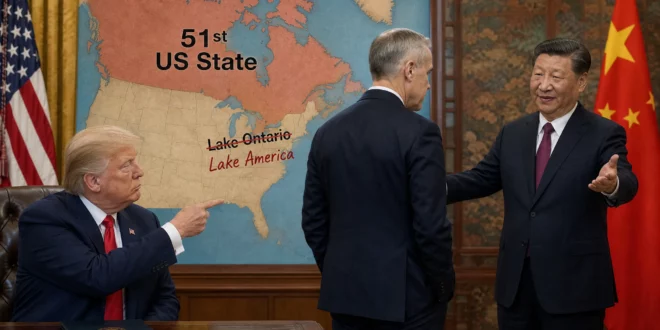
The U.S.-Canada relationship is entering a period of strategic change as economic tensions, U.S. pressure and Canada’s push for diversification challenge the foundations of their traditional partnership.
From Closest Partners to Strategic Friction
The Trump administration imposed 50% tariffs on Canadian goods, in response to which Ottawa has imposed retaliatory 15%- 50% tariffs on the U.S., which PM Mark Carney has said is a “dollar-for-dollar” approach. This countermeasure has created a dilemma for Ottawa, as Canada cannot easily replace the US market, but at the same time, overdependence on a single market leaves Canada exposed whenever Washington wants to use that dependence.
Before this trade war, the two states were close partners, having signed pacts and treaties like the 1965 Auto Pact, the 1958 NORAD agreement, and the USMCA free trade agreement. The recent rupture in US-Canada relations is a result of a dispute that has gradually moved beyond the tariff war. President Trump frequently addresses, in his speeches, Canada as the 51st state of the US, and recently President Trump announced the renaming of Lake Ontario to Lake America, questioning the sovereignty of Ottawa. Now the question is not about whether the tariff war can be negotiated; rather, it is about whether US-Canada relations can continue under a more transactional approach by Washington.
The shift could reshape North American geopolitics and create a more autonomous role for Canada within the wider Western order
What Is the US Trying to Achieve?
The confrontation with Canada cannot be solely understood through the trade war. The question is what Washington wants to achieve by imposing economic pressure on Canada.
Economic Leverage
Canada’s complete dependence on the US market gives Washington considerable leverage. The two countries are connected through the United States-Mexico-Canada (USMCA) free trade agreement. It was designed to support fair trade and economic growth, but the tariff policy of Washington is now changing the value of USMCA that it once had. Washington is deeply concerned that China is using Mexico and Canada as a backdoor to bypass the US tariffs. It believes that China is importing low-quality materials to Canada with low taxes, making Canada free from depending wholly on the US. Changes to US policies under the USMCA trade agreement have raised serious concerns in Ottawa about whether access to its most important market will continue. For this reason, Ottawa is seeking other roads to reduce its dependence on a single market. Control of North America In addition to being a trading partner, Canada is important for the U.S. due to its strategic position in the Arctic. About 40% of the Arctic region is under Canadian control. The U.S. Geological Survey states that the Arctic may contain 22% of the world’s oil and also has valuable rare earth minerals. The Arctic also offers shipping routes, like the Northern Sea Route and the Northwest Passage, that can cut shipping distances between Asia and Europe by nearly 3,000 nautical miles. These routes could save up to two weeks in travel time. For this reason, the U.S. wants Canada to function as the 51st state, giving Washington access to the Arctic’s resources and strategic advantages.
Wider Hemisphere Strategy
Washington is not only trying to put Canada under its umbrella, but it is also trying to put the South American states under its shadow. The recent visit of US Secretary of State Marco Rubio to Latin America proves that Washington is trying to activate its Monroe Doctrine, or can be said to be Trumpism, which focuses on an “America-first” agenda. Seen from this perspective, Canada is not an isolated case. It forms part of a broader debate over how the United States intends to impose power across the Western Hemisphere and how neighbouring states respond when Washington demands greater alignment with its priorities.
Canada’s Strategic Response: From Dependence to Diversification
Canada is opting for the following strategies to achieve strategic autonomy:
Economic Autonomy
US remains Canada’s main trade partner, so complete economic separation is not possible. To manage this, Ottawa is expanding trade with the EU, Indo-Pacific and ASEAN states. New trade agreements are intended to make the domestic economy much stronger. Now Canada will have to balance between the US and the expanded ties.
Energy Autonomy
Canada is a major energy provider to the US. New pipelines and ports from Canada to the EU and the Indo-Pacific can give Canada greater access to Asian and European Markets. Also, Canada has access to the Arctic; it can export critical minerals to other markets and can become a global supplier of minerals. This will boost Canada’s economy and will reduce its total dependence on the US.
Defense Autonomy
Despite having North American Aerospace Defence Command (NORAD) and Five Eyes Intelligence, Canada has launched its first Defence Industrial Strategy to increase defence exports and reduce dependence on the US military and equipment. Along with this, it has joined the EU’s SAFE defence procurement framework and has applied to join the UK-led Joint Expeditionary Force (JEF).
What Happens Next?
The Canada-US confrontation may have the following outcomes:
The Rise of Armed Autonomy Among Allies
To reduce its total dependence on the US, Canada can create its own cyber and space agencies, causing the rise of armed autonomy. States build their own weapons for their defence, in case their primary ally refuses to provide military aid to them. Ottawa is not withdrawing from NORAD or NATO; instead, it is reducing its dependence on the United States and establishing its own resources.
Europe Could Become a Second Strategic Pillar
Canada is expanding its ties with Europe. In this case, Europe could become a second strategic pillar. This would create a three-layered Western system: North America for continental defence, Europe for manufacturing defence and military equipment, and the Indo-Pacific for economy and strategic diversification.
Canada May Become a Test Case for Middle-Power Strategy
Canada is effectively testing whether a middle power can rise on its own without abandoning existing great powers. If Canada becomes successful in this experiment, then other US partners, the NATO members, can do the same and can become independent. This would dissolve the decentralised Western-led system of power.
Beyond the Old North American Order
The US-Canada bilateral relations are unlikely to collapse, but its old assumptions are being challenged. Now Canada will not be totally dependent on the United States; instead, it is making its own defence plans and expanding its ties to the world islands. A new North American order is emerging, which will benefit Canada in rising as a middle power. Now the question is about how much autonomy Canada can build without having the US as its primary partner.