 Eurasia Press & News
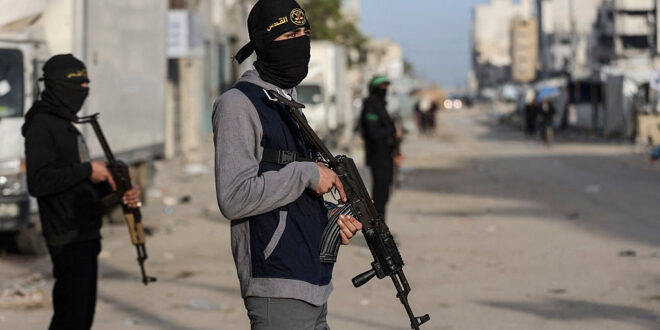
The ceasefire plan in Gaza has hit a roadblock in the shape of Hamas’s continuing refusal to disarm.
The Iran-backed terrorist group conveyed that exact message to representatives of President Donald Trump’s Board of Peace — the international coalition tasked with overseeing the ceasefire — on April 14, after the deadline for its disarmament expired last weekend.
Simultaneously, Hamas has continued to violate the first phase of the ceasefire in recent weeks, launching attacks against Israeli forces. Its continued rejection of future phases of the ceasefire, combined with its attacks on IDF troops in Gaza, leaves the ceasefire’s stability in a fragile position.
Hamas Insisting on Statehood First, Then Disarmament
After meeting with officials from the Board of Peace, Hamas formally refused the Board’s eight-month phased disarmament plan as presented by High Representative Nickolay Mladenov.
Hamas distinguishes between “disarmament” and “handing over weapons,” insisting that any transfer of materiel be handled by a neutral party, with additional guarantees to preserve the weaponry against future Israeli attacks. A senior Hamas official accused Mladenov of bias, asserting that his framework aligns with Israel’s position by conditioning reconstruction on disarmament.
Reports indicate that Hamas is demanding a full IDF withdrawal from Gaza as a precondition for any disarmament talks. However, the “Yellow Line” — which separates IDF- and Hamas-controlled areas in Gaza — has served as the ceasefire’s agreed-upon boundary during Phase One, suggesting that Hamas may be attempting to renegotiate or abandon stipulations of the agreement.
Hamas has proposed an alternative three-year timeline, beginning with the collection of heavy weapons while retaining light arms for self-defense during a transitional period.
IDF Increases Strikes Against Terrorists
Hamas’s actions on the ground are consistent with its rhetoric. According to IDF announcements, there have been at least nine instances since April 1 in which Israel struck Hamas or other terrorists either planning or aiding attacks on IDF troops in Gaza.
On April 8, the IDF announced the elimination of Hamas operative Muhammad Dawwad, described by Israel as “an expert in engineering and explosives production.” Dawwad was targeted after being assessed as posing an imminent threat to IDF forces. Four days earlier, the IDF eliminated Ali Ahmed Ali Amrain, a known weapons smuggler who had continued to supply arms to Hamas, advancing its military activities.
On April 9, the IDF eliminated Ahmed Muhammad Saleh, a terrorist in Hamas’s elite Nukhba forces who had “advanced” multiple attacks against IDF forces.
Additional strikes followed in the days after. On April 12 and 13, the IDF struck Hamas cells assessed to be threatening troops in central Gaza. Also on April 13, the IDF announced that it had eliminated armed Hamas terrorists posing “an immediate threat” to Israeli forces.
These instances underscore that while Hamas is no longer the force it was before the war in Gaza, it continues to exploit the ceasefire to conduct military activity against IDF forces.
Board of Peace Cannot Bend to Hamas Demands
Hamas cannot be allowed to unilaterally revise the ceasefire’s previously established conditions.
Under no circumstances should an IDF withdrawal precede disarmament negotiations. Such a move would remove military pressure on Hamas. Any premature IDF withdrawal will allow Hamas to reassert control in Gaza, the same way it has since Israeli troops withdrew to the Yellow Line in Phase One.
The Trump administration has heralded its 20-point plan and the Board of Peace as major diplomatic achievements. But should the Board fail to hold Hamas to the terms of the deal and grant it a strategic victory without meaningful concessions, Washington risks months of diplomatic efforts to advance the truce becoming increasingly moot. The Board of Peace should maintain its firm stance on disarmament and ensure that any further negotiations adhere to the same status quo established during Phase One of the ceasefire.
Washington should also ensure that its appointed decisionmakers on the Board are preparing contingency plans for disarming the group, including the possibility that a resumption of Israeli military action may ultimately be required if diplomatic efforts continue to fail.