 Eurasia Press & News
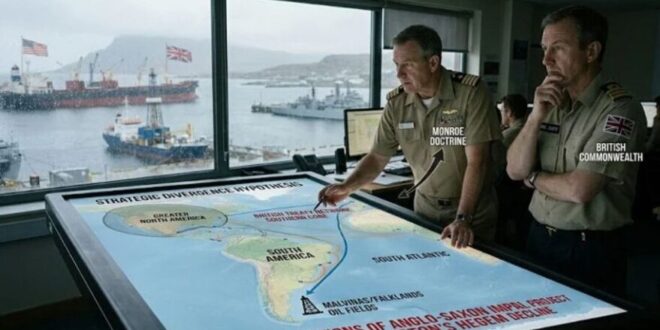
April 4, 2026 – Donroe Doctrine, Greater North America, the network of British agreements in the Southern Cone, the Falklands oil and the contradictions of the Anglo-Saxon imperial project in the face of Washington’s hegemonic decline.
The new imperial cartography, Greater North America
On March 30, 2026, before the defense chiefs of the Western Hemisphere gathered at the headquarters of the United States Southern Command in Doral, Florida, Secretary of War Pete Hegseth announced what the second Trump administration had been hinting at since its first day in office. He called it Greater North America (GNA), and with that name he christened a map that erases political borders, devours national identities, and rewrites continental history from the perspective of the interests of a single power.
The doctrine is brutally clear. Every territory and every sovereign nation located north of the equator, from Greenland to Ecuador, from Alaska to Guyana, forms part of the immediate security perimeter of the United States. Mexico, Central America, the Caribbean, Colombia, Venezuela, Ecuador, and the Guianas are defined, without their consent and against their history, as an extension of Washington’s living space. The geographical argument that Hegseth offers to support this appeals to the Amazon and the Andes as natural barriers that separate strategic responsibilities: to the north, direct control; to the south, a tutelary partnership. The distinction is not one of sovereignty but of degree of subordination.
The immediate question this doctrine raises, and one that deserves a precise answer, is what it means concretely for the countries that fall within its perimeter. The answer lies not in diplomatic euphemisms but in the facts that accompany its pronouncement. It means that these countries must allow or facilitate the presence of the U.S. military on their territories under the pretext of combating drug trafficking and containing migration. It means that their armed forces must interoperate with those of the United States under doctrines, equipment, and a chain of command defined by Washington. It means that their strategic resources are subject to the supervision of a power that considers them part of its own sphere of systemic reproduction. It means that their relations with China, Russia, or any extra-hemispheric power that Washington considers an adversary become subject to political veto. And, on the most concrete level, it means that any government that deviates from this logic can be subject to intervention, as demonstrated by the operation in Caracas to kidnap Maduro or Operation Southern Spear, which sank vessels in Caribbean waters. It’s not an alliance, it’s a tutelage.
The doctrine was officially named the Donroe Doctrine, a play on words between Donald and Monroe that its own spokespeople proudly use. Its four declared pillars are migration control, the interception of narcotics flows, the denial of strategic positions to China and Russia, and the consolidation of subordinate partners that operate militarily with and for Washington. The incorporation of Argentina, Ecuador, and Bolivia into the Shield of the Americas, signed in March 2026, demonstrates how they are building alignment across the continent.
For the countries south of the equator, Hegseth reserved a formula that summarizes the colonial logic with disturbing clarity: “They must assume the shared burden of defending the South Atlantic and the South Pacific in partnership with Washington and other Western nations, securing the region’s critical infrastructure and resources.” The mention of resources is not accidental: it is the tacit acknowledgment that the imperial design has an extractive dimension that far exceeds the discourse of security.
Monroe and Canning: the historical trap and its reverse
To understand the Donroe Doctrine in its historical depth, one must reconstruct the context in which the original Monroe Doctrine arose, and the trap that history holds for the present. In 1823, as the Spanish colonies in America were completing their independence process, British Foreign Secretary George Canning proposed a joint declaration to the United States government to prevent the European Holy Alliance from intervening in Latin America on behalf of Spain. Canning’s proposal was seductive because it appeared to be an act of solidarity with the new republics. In reality, it was an imperial calculation of the highest order.
Great Britain had a flourishing trade with Latin America that depended on the former colonies remaining outside the Spanish colonial system. Free trade was the British name for their own economic imperialism. Canning summarized it with the phrase that best defines imperial logic ever since: “I have called the New World into existence to restore the balance of the Old World.” He wasn’t talking about the peoples of the Americas, but about his own geopolitical interests.
Secretary of State John Quincy Adams understood the trap and convinced Monroe to reject it. What Canning sought was a commitment from Washington not to acquire any of the former Spanish colonies, tying American hands to British interests. The declaration was unilateral, and Monroe assumed guardianship of the hemisphere without sharing leadership with London. Thus was born a doctrine that, in its origin, was not anti-colonial but rather the founding act of the dispute between two imperialisms over who would control the new Latin American world. The independence of our peoples was, for both powers, an opportunity for penetration, not a right to be respected.
Two hundred and three years later, the Donroe Doctrine reproduces that logic with one crucial difference: the rivalry between Washington and London is now a partnership. Anglo-Saxon imperialism operates today as an integrated bloc, with the United States as the hegemonic power and Great Britain as its second-tier global arm, especially active in the South Atlantic. What in 1823 was imperial competition has become a division of labor in colonial management. But this partnership, as we shall see, is not without its own contradictions, which deserve careful analysis, because in these contradictions Our America can find room for maneuver that it does not currently exploit.
The network of British agreements south of the equator
Hegsen’s Greater North America is not an exclusively North American project. It has a historical and indispensable partner in the United Kingdom, which, while Washington constructs its new imperial map from Miami, is silently weaving a network of military and strategic agreements in South America. This network serves to secure the Anglo-Saxon rearguard in the South Atlantic, consolidate the colonial occupation of the Falkland Islands, and block any autonomous regional counterweight. It does not operate on a single level but on several, with varying intensity and formalization depending on the country.
Brazil is the most ambitious partner. On March 26, 2026, four days before Hegseth’s speech, Foreign Ministers Yvette Cooper and Mauro Vieira signed the Brazil-UK Strategic Partnership 2026-2030 on the sidelines of the G7 summit. The document elevates the relationship to the highest level of bilateral diplomatic ties and establishes, in the area of defense, the expansion of the Military Capabilities Cooperation Agreement signed in February 2024, a 2+2 Political-Military Dialogue with regular meetings of the Foreign and Defense Ministries of both countries, cooperation in military technology with technology transfer, joint Armed Forces exercises, and space cooperation. Brazil is the largest military and economic power in South America and an active member of the BRICS. Incorporating it as a strategic defense partner means that London gains legitimacy, infrastructure, and political backing from the dominant regional power in the South Atlantic. That this occurred four days before Hegseth announced the Donroe Doctrine is not a coincidence; it is coordination.
Chile is the oldest and most operationally active partner. Defense ties date back to 1982, when the Pinochet regime provided the United Kingdom with intelligence, early warnings of Argentine air attacks, and facilities for operations by the SAS and SBS special forces, receiving in return missiles, radars, and electronic reconnaissance aircraft. This historical debt to London was never repaid and continues to shape the relationship. The 2024-2025 Bilateral Defense Cooperation Plan includes cyber defense, Antarctic cooperation, and training; Chilean officers attend programs at the Royal College of Defence Studies in London; and the Chilean Navy has signed an agreement with the United Kingdom for the joint development of naval industries. But the most significant and least discussed dimension is direct operational logistics. British A400M Atlas military aircraft of the Royal Air Force regularly use Chilean air bases as stopovers on their missions to the Falkland Islands and Antarctica. On January 19, 2026, the A400M with registration ZM413 landed at the base of Chilean Air Force Group No. 10, arriving from the islands. In December 2025, ZM407 flew from Brasilia to Santiago. Aircraft ZM418 and ZM421 operated in 2025, using Montevideo, Santiago, and Brasilia as stopovers, all without official announcements or statements from Chilean authorities.
Bolivia represents the most recent case and the one that best illustrates the dynamics of recomposition in the heart of the continent. The new government of Rodrigo Paz Pereira, elected in 2025 with a stance of breaking with the MAS party, reoriented Bolivian defense policy. After seventeen years of suspended military relations with the United States, the new leadership expressed its willingness to reactivate them. China, which during previous administrations had been the main supplier of military equipment through donations and cooperation agreements, ceded ground to a reorientation toward the Anglo-Saxon sphere, completing the picture in the heart of the subcontinent.
Argentina is the most contradictory case. Suffice it to say that in 2025 it updated a memorandum with the United Kingdom to expand cooperation on drug trafficking, terrorism, cybersecurity, and intelligence—the first bilateral instrument of its kind since the 1982 war.
Colombia and Peru participate with the Royal Navy in the Diesel-Electric Submarine Initiative, an anti-submarine warfare exercise that has been operating since 2001 and effectively integrates the navies of both countries into the Western Atlantic naval interoperability architecture that London is helping to structure. Uruguay does not have formal defense agreements with the United Kingdom, but Montevideo frequently appears as a stopover for British military aircraft on their operations to the South Atlantic.
The foundation of it all lies in Britain’s own overseas territories: the Falkland Islands, usurped from Argentina, with an operational air base, Royal Air Force installations, and missile systems; South Georgia and the South Sandwich Islands (also usurped); Ascension Island, a logistics and communications base in the central South Atlantic with a runway for long-range aircraft and satellite tracking systems; Saint Helena; and the arc of territories in the English-speaking Caribbean that includes the British Virgin Islands, Anguilla, the Cayman Islands, Montserrat, Bermuda, and the Turks and Caicos Islands. These are not decorative colonial remnants; they are the infrastructure of a power that projects influence from the South Atlantic to the Caribbean, an influence no other extra-hemispheric power possesses across such a vast expanse.
Falklands oil: Navitas and the extractive dimension of the occupation
There is a dimension of the Falklands conflict that rarely receives the central attention it deserves: the exploitation of hydrocarbon resources in the islands’ waters. It is there that the colonial occupation takes its most concrete, most profitable, and most revealing form, demonstrating the global reach of the Anglo-Saxon imperial project.
On December 10, 2025, Navitas Petroleum, an Israeli company listed on the Tel Aviv Stock Exchange and controlled by businessman Gideon Tadmor, and Rockhopper Exploration, a British company, made the Final Investment Decision for the development of the Sea Lion field in the northern Falkland Islands basin. The total investment amounts to US$1.8 billion. Navitas, the operator with a 65% stake in the project, will contribute US$1.17 billion. Expected production is 32,000 barrels per day in the first phase, with projections to scale up to 200,000 barrels per day using three floating production platforms. The start date is set for 2028, and Sea Lion is the fourth largest undeveloped oil reserve in the world. Navitas didn’t stop there. In January 2026, it signed a memorandum of understanding to also acquire 65% of the PL001 license in the North Falkland Basin, adjacent to the Sea Lion Field, with an estimated potential of 3.1 billion barrels across 1,126 square kilometers. The expansion of the Israeli presence in Falkland waters is systematic. Navitas entered this project after Harbour Energy decided to withdraw due to excessive political and capital exposure. The Israeli firm covered 100% of Rockhopper’s costs prior to the investment decision, reviving an asset that had been financially frozen for years.
Argentina’s response was formal but belated. On December 11, 2025, the Foreign Ministry rejected the activities as unilateral and illegitimate, stating that they violated UN General Assembly resolutions demanding negotiations between Argentina and the United Kingdom on the sovereignty dispute. Buenos Aires reiterated that both companies had been declared illegal and sanctioned with a twenty-year ban on operating in Argentina, along with any company, financial institution, or insurer involved in their projects.
The Israeli reaction exposed all the contradictions on the table. Foreign Minister Gideon Sa’ar acknowledged that the activity was taking place in an area under disputed sovereignty, but argued that it was a private company and that Israel lacked the legal means to halt its operations. This response left the Milei government in an untenable position: the Argentine president, a staunch ally of Israel, was formally protesting against an Israeli company illegally extracting oil from disputed Argentine waters, while his government was simultaneously negotiating a defensive approach with the very London that had authorized the extraction. Israeli capital operates the Falkland Islands’ resources under licenses from the British colonial government of the islands, without any Argentine permission, while the Milei government maintains an unconditional alliance with Israel and is negotiating with London regarding the arms embargo in exchange for a more flexible sovereign stance. This arrangement reveals the nature of the system being constructed in the waters of the South Atlantic.
The weakness of the Royal Navy and the Suez Canal turned upside down
There is a paradox at the heart of the British imperial project in the South Atlantic that has far-reaching strategic consequences. The United Kingdom is building an architecture of regional domination precisely at the moment when its naval capacity has fallen to the lowest point in its modern history.
In just three years, the Royal Navy retired two amphibious assault ships, four frigates, a nuclear-powered attack submarine, five minesweepers, and two tankers. The number of active frigates fell to levels unseen in decades. The only ship permanently deployed in the South Atlantic since early 2026 is HMS Medway, a River-class patrol boat, not a battle frigate. The Centre for European Policy Analysis hailed 2026 as the year of national humiliation for the Royal Navy, noting that the fleet failed to deploy a destroyer in time for the defense of Cyprus when a British airbase was attacked by drones in March.
On April 1, 2026, the First Sea Lord, General Sir Gwyn Jenkins, the highest-ranking officer in the Royal Navy, publicly admitted that the navy was not ready for war. His remarks came at the very moment the Trump administration was pressuring London to send ships to the Strait of Hormuz as part of the war against Iran. Trump called the two British aircraft carriers “toys.” Hegseth ridiculed the great and fearsome Royal Navy for its absence from the Middle East conflict. And Trump publicly told Starmer to get their own oil, warning that the United States would not be there to help them. This exchange, which might be interpreted as an incidental diplomatic clash, is actually the starkest expression of the structural tension that runs through the entire Anglo-American relationship.
The paradox is resolved when one understands that London’s naval weakness does not diminish its imperial project in the South Atlantic, but rather makes it more dependent on the regional network of agreements. The political and logistical infrastructure built with Brazil, Chile, Bolivia, and Uruguay temporarily and functionally compensates for what the fleet can no longer provide on its own. This is the strategy of a power in relative decline that manages its scarce resources with colonial acumen.
In this context, we must read what we call the Suez Crisis in reverse. In 1956, when the United Kingdom, France, and Israel invaded Egypt to regain control of the Suez Canal, Washington forced them to withdraw through devastating financial pressure on the pound sterling. It was the moment when Britain understood that the special relationship had clear hierarchies. At its core, it was a relationship of dominant power to subordinate power, and this lesson shaped all subsequent British foreign policy: London needs its own assets, its own positions, its own agreements to avoid being completely at the mercy of American decisions. In 2026, the Suez Crisis was reversed. When Trump demanded that Starmer provide British military bases for the offensive against Iran, the Prime Minister said no. A polite but firm no that, according to the Washington Post, particularly disturbed the American president. The subordinate power refused to put its infrastructure at the service of the dominant power’s war. It is the first documented operational rift between the two metropolises in the current scenario.
Complementarity today, possible fissure tomorrow
We arrive at the crux of the analysis. The network that London is building in the Western Atlantic operates today in perfect complementarity with the American agenda: the agreements with Brazil and Chile; the air logistics chain to the Falklands, with Uruguay; oil exploitation with Israeli capital under a British colonial license; the pressure on Argentina for tacit recognition of the US presence on the islands. All of this functions in the same way as the Donroe Doctrine, and the timelines of the most important agreements, signed days before the Miami speech, suggest deliberate coordination.
But this present complementarity does not exhaust the analysis. The hypothesis that this essay proposes, supported by empirical evidence, is that the architecture London is currently constructing in the South Atlantic is not only functional to American interests: it is also being built as an infrastructure of British autonomous power in anticipation of a scenario of declining US hegemony. What today appears to be a division of roles could, in the medium term, be the silent construction of an independent British position, taking advantage of the space left vacant by American overextension.
The mechanism is as follows. When Washington expands from Greenland to the equator and proclaims a total hemispheric doctrine, it inevitably creates areas of lesser control on its flanks. The South Atlantic is the southern flank of the Anglo-Saxon system: mentioned in the Donroe Doctrine as a shared burden zone for secondary actors, but not directly managed by Washington. In this delegated space, London advances and consolidates its power. American overextension, which Paul Kennedy analyzed as the historical mechanism for the decline of all great powers, operates here as the condition that enables British autonomy. When an empire expands beyond its operational capacity, it inevitably creates the margins in which the next actor in the hierarchy can build its own positions.
American overextension is not merely geographical. It has two intertwined dimensions: a crisis of military and political over-commitment, exacerbated by the war against Iran, and a crisis of structural economic decline resulting from decades of deindustrialization, financialization, and the rise of China as a systemic power. Added to this is an internal political crisis that amplifies its weakness. The Trump administration embodies an imperial management project deeply at odds with other powerful entities (it is an internal civil war). The factions that prioritize the Indo-Pacific and the containment of China clash with those that prioritize the Western Hemisphere. Those who see Europe as a strategic ally confront those who treat it as a burden to be discarded. Those who want to preserve NATO argue with those who consider it obsolete. Hegemony is not sustained solely by military power but also by strategic coherence, institutional credibility, and the capacity to forge alliances. On all three fronts, Washington exhibits profound fissures.
The United Kingdom is not without its own contradictions. Brexit shattered the political consensus that underpinned Britain’s role as a bridge between Europe and Washington. The Starmer government faces simultaneous and conflicting pressures: rebuilding the relationship with the European Union, which demands a break from unconditional Atlanticism; maintaining the special relationship with Washington, which is increasingly becoming one of extortion; and forging its own position in the emerging post-NATO world. A YouGov poll from early 2025 revealed that only 37% of Britons have a favorable view of the United States, the lowest point in decades. In May 2025, London signed a Security and Defence Partnership with the European Union. In July 2025, it signed a bilateral defense treaty with Germany. Simultaneously, it is making progress on the AUKUS agreement with Australia. British strategic diversification is real and the South Atlantic is one of its strongest pieces, built with its own resources and agreements, without requiring American authorization.
The key analytical point is that the assets London is consolidating today in the South Atlantic are functional for Washington in the short term, but they don’t depend on Washington for their existence. The agreements with Brazil and Chile, the air logistics chain, oil exploration in the Falkland Islands, the overseas territories—all of that belongs to London and would continue operating even if the special relationship were to deteriorate. That is precisely the difference between a complementary architecture and an autonomous architecture that operates temporarily in a complementary manner.
The NATO variable: the scenario that reshapes everything
The variable that most decisively strengthens the hypothesis of a possible rift is the future of NATO. If the United States abandons the alliance, empties it of operational substance, or makes Article 5 commitments conditional on the ally’s defense spending, the relationship between Washington and London will be structurally reconfigured. This possibility is no longer hypothetical. Vice President JD Vance presented a vision in Munich in 2025 that calls into question the American commitment to European collective defense. Trump’s advisors have proposed a dormant NATO model with minimal commitments activated only in declared crisis situations. The Heritage Foundation’s Project 2025 revealed another facet of intra-imperial competition; one of its stated objectives was to keep the United Kingdom away from Europe and its orbit. Washington does not want an autonomous, pro-European London; it wants a subordinate, Atlanticist London. This objective, by contrast, precisely defines the area in which the rift could deepen.
A NATO emptied or abandoned by Washington would not mean the end of the Anglo-American bilateral relationship. The Five Eyes intelligence alliance, the 1958 nuclear agreements, and AUKUS would remain. But it would profoundly alter its architecture. Without NATO as a collective anchor, London would need to build its own alternatives, and the South Atlantic, where it already has consolidated positions, active defense agreements, and an ongoing oil project in the Falkland Islands, would be one of the central pillars of that redefinition. The positions built today in conjunction with Washington could tomorrow operate as independent assets.
The history of the Anglo-American relationship is, at its core, the story of a rivalry that never truly ended, only ever subdued. When interests diverge, Washington does not hesitate to discipline London, as demonstrated in Suez. And when Washington weakens, London builds positions that, in another context, it could use for its own ends. Starmer’s “No” vote on Iran is not an isolated incident: it is the first visible sign that this historical logic continues to operate beneath the rhetoric of unconditional alliance.
Argentina on the board
In this scenario, Argentina’s role is both the most contradictory and the most decisive. The Milei administration has adopted positions that are difficult to sustain over time. It maintains its sovereign claim over the Falkland Islands as a constitutional principle. But at the same time, it is one of the most enthusiastic partners of the Anglo-Saxon agenda in the region. It was a signatory to the Shield of the Americas, which Brazil and Colombia did not sign; it maintains an unconditional alliance with Israel while that state operates the largest oil project in the islands’ history in disputed Argentine waters; it participates in negotiations in which lifting the arms embargo would be conditional on a more flexible sovereign stance; it has requested NATO membership; and it has updated a memorandum of cooperation with the United Kingdom itself, which militarily occupies the territory it claims.
The Navitas paradox brutally illustrates this vicious cycle. Argentina formally protests against an Israeli company illegally extracting its oil, while its government maintains an unconditional alliance with Israel and negotiates with the United Kingdom, which authorized the extraction, to lift the arms embargo in exchange for a more flexible sovereign stance. This subordination creates the conditions for its own perpetuation.
Argentina, however, holds an objectively significant position on this chessboard, one that Milei’s policies are squandering. It possesses the most extensive continental shelf in the Southern Hemisphere. It borders the South Atlantic with over four thousand kilometers of coastline. It projects sovereignty over Antarctica through its polar sector. It is the point of convergence of the South Atlantic, the Drake Passage, and access to the Pacific. Whoever controls Argentina’s positioning largely shapes the security architecture of the South Atlantic. As we pointed out in Destined by Providence, the subordination of local elites to the imperial projects of each era was not only an external imposition but also an internal political choice with long-term consequences for popular sovereignty. The difference between those who negotiate surrender and those who build resistance is not abstractly ideological; it is the difference between those who see the country as an object of history and those who build it as a subject.
Our America in the face of the new Monroe Doctrine
The Greater North American Doctrine is the most blatant formulation of American imperial dominance since World War II. What Hegseth said in Miami on March 30, 2026, is what Washington has always believed: that Latin America is its backyard, that its resources are an asset of the Western system of reproduction, and that the sovereignty of its peoples is a secondary variable compared to the imperatives of its security. The urgency to formalize this doctrine is, paradoxically, a symptom of fragility. The emerging multipolarity, with the SCO, China as a global actor, and the resistance of the Global South, compels Washington to consolidate its hegemony before the chessboard definitively reshapes itself against it.
The architecture of domination in the South Atlantic is neither monolithic nor stable. Today, Washington and London operate in perfect complementarity. The Donroe Doctrine needs the British network south of the equator to function, and the British network benefits from the political umbrella of the American doctrine. But this complementarity contains within it the conditions for a possible fissure. The UK’s naval weakness, admitted by its own First Sea Lord; Starmer’s rejection of Trump’s proposal regarding Iran; London’s strategic diversification towards Europe and the AUKUS; the internal contradictions of Trumpism; the crisis of the special relationship: all point to an Anglo-American relationship that is more tense, more transactional, and more contradictory than the rhetoric of unconditional alliance suggests.
For Our America, the conclusion has two inseparable dimensions. The first is a warning against the substitution trap. A South America that reacts to North American dominance by seeking a counterweight in London will have changed masters without changing its condition. British free trade, which replaced the Spanish colonial monopoly in the 19th century, was not liberation but recolonization under a new flag. The eventual divergence between the metropolises is not, in itself, an opportunity for our peoples; it is only an opportunity if there are political actors capable of building their own alternatives. The arguments of some misguided individual who proposes choosing the Americans to confront the United Kingdom are equally subservient.
The second dimension is that of urgent construction. The response to the Greater North America involves the sovereign defense of the resources of the South Atlantic and the continental shelf, the articulation of Brazil, Argentina, and the Mercosur countries as a space of real counterweight, the active claim to the Malvinas Islands in all available forums, and the construction of an international position that does not ask permission from any metropolis to exist.
The geography that the Empire draws for us is not our geography. The greater homeland dreamed of by Bolívar, San Martín, and Martí does not end at the equator: it reaches to Cape Horn, to the waters of the Falkland Islands, to the last sovereign resource that any Latin American people can defend as their own. Defending it is not only a national cause, it is the prerequisite for any project of popular sovereignty in the century we are living through.