 Eurasia Press & News
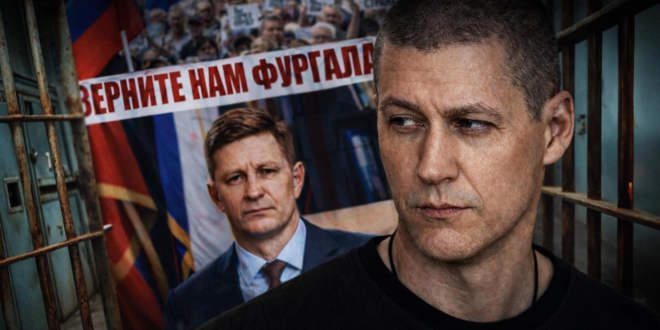
In late January, Mikhail Timofeev, a former aide to former Khabarovsk Krai Governor Sergei Furgal, was arrested in Georgia. Russian authorities accuse him of organizing contract killings on Furgal’s orders, and federal media outlets have named him the leader of an organized crime group that included members of his sports club, “Moisey.” Timofeev denies these accusations and claims that he and members of his sports club worked with the FSB for many years. He claims he helped Furgal first win the gubernatorial election by deceiving Moscow, and then change the composition of the Khabarovsk Krai Legislative Assembly—a move the Kremlin has never forgiven.
People’s Governor
In July 2020, the acting governor of the Khabarovsk region, Sergei Furgal, was detained in Khabarovsk. A team pulled him out of an expensive SUV in the middle of the street, loaded him into a blue minibus, and drove him to the airport to be flown to Moscow. There, under heavy guard and special forces protection, the capital’s Basmanny Court issued a warrant for his arrest.
At the time of his arrest, Furgal had been governor of the Khabarovsk Krai for two years. In 2018, he won the election, defeating United Russia candidate Vyacheslav Shport. Furgal enjoyed strong public support. Following his arrest, thousands of protests erupted in Khabarovsk, continuing until 2021.
Furgal was immediately charged with two contract killings—those of businessmen Yevgeny Zorya and Oleg Bulatov—and one attempted murder of businessman Alexander Smolsky, committed back in 2004–2005.
However, the preparation of a criminal case was no secret. The investigation into the old murders was abruptly reopened in April 2019. Six months later, Furgal’s business partner, Nikolai Mistryukov, was arrested and placed in Moscow’s Lefortovo pretrial detention center. There, he confessed against the governor.
Showdowns around black scrap
The murder of businessman Yevgeny Zorya occurred in October 2004 and remained a cold case for nearly fifteen years. The killer ambushed the businessman one evening on his way from a guarded parking lot to his home in Khabarovsk and shot him with his service Makarov pistol, which he had lost in 1995. He then abandoned the weapon at the scene and fled, leaving behind neither the documents nor the money Zorya was carrying. The businessman himself had been living in two countries and returned to Russia from Canada two days before his death.
As Kommersant newspaper reported , Zorya was a former military man who left service with the rank of major. At the time of the murder, he had been in business with his wife, Larisa, for ten years.
By 2004, the couple owned two chains of beer and grilled chicken stalls in Khabarovsk, a wholesale market, and a grocery store. Zorya also established the production of tent structures, purchased an automobile repair plant, and acquired other real estate and company shares.
Immediately after the murder, investigators explored several leads, including the involvement of Furgal and Mistryukov. But the investigation reached a dead end, and the case was ultimately closed. Fifteen years later, when the investigation was reopened, only one theory remained: Furgal ordered the businessman’s murder.
At the time, the future governor and Mistryukov were buying up scrap metal throughout the region. Both Furgal and Zorya were bidding for the rebar shop of the bankrupt ZhBI-2 plant and the adjacent railway tracks. According to the case materials, Furgal’s company, Mif-Khabarovsk, was the first to sign the contract and register ownership of the shop. However, according to Zorya, he was the first to make the payment and sign the contract, and Furgal’s company’s papers were falsified. The case ultimately went to court, with Furgal and then Zorya winning.
The second murder—that of former police officer Oleg Bulatov—took place in January 2005. According to the prosecution , Furgal and Mistryukov decided to kill him after he learned of his partners’ involvement in the murder of Zorya and began blackmailing them.
The third incident—an attempt on the life of businessman Smolsky in the village of Progress in July 2004—is also implicated by Furgal and Mistryukov. It occurred chronologically before the murders of Zorya and Bulatov. According to investigators, the partners saw 20-year-old Smolsky, who also collected scrap metal, as a competitor.
At first, they allegedly tried to negotiate a joint venture with him, but when that didn’t work out, they hired a hitman to throw a grenade into the businessman’s garage. Ultimately, however, Smolsky escaped with only scratches. Furgal and Mistryukov quickly shut down their business in Progress.
The prosecution claims that Furgal was assisted in organizing these crimes by Mikhail Timofeev and members of his sports club, Moisei. Federal media outlets—MK, Kommersant, and others—have called him a crime boss in Khabarovsk and the leader of an organized crime group, which, according to the outlets, was composed of members of the Moisei sports club. They did not know each other personally for a long time, and Furgal allegedly delegated all assignments to Timofeev through “connections.”
Timofeev was also credited with organizing Furgal’s security. He subsequently became his official assistant in the State Duma.
The prosecution’s key witness was Vladimir Pershin, former head of the Khabarovsk Krai Department of Internal Affairs’ anti-banditry and robbery department. He claims (as Meduza quotes his testimony) that in the 2000s, he provided protection for Furgal for small monthly payments (around $1,000). However, Pershin admits that he was not an eyewitness to the events, but rather learned everything from another defendant, Andrei Karepov. Karepov, however, denies guilt in the murders.
In 2016, Pershin was convicted of extortion, released on parole, and immediately testified against Furgal and the others.
Furgal himself denies guilt in the crimes charged against him. Timofeev, meanwhile, was abroad at the time the criminal case was opened.
Timofeev and his connections to the FSB
“I’m not an athlete, not an organized crime leader, and have no connection to the criminal world. I’m a businessman and a politician. I’ve been in politics for almost forty years—longer than Furgal,” says Mikhail Timofeev. He’s 60, tall, lean, and completely gray. He tried to appeal the Georgian immigration authorities’ denial of political asylum in the Tbilisi City Court.
The court hearing is open to the public. Timofeev sits unhandcuffed next to his lawyer, Rusudan Mchedlishvili, with a simultaneous interpreter behind him. Guards sit on either side. The judge repeatedly stops him and asks him to speak strictly to the case. “That’s it!” Timofeev protests. He attempts to recount his life story to the court and the audience.
Timofeev graduated from the Voronezh Higher Military Engineering School of Radioelectronics (VVVIURE). After graduation, he served in the electronic warfare troops in the village of Matveyevka (at the headquarters of the Far Eastern Military District) near Khabarovsk. After leaving the service in 1991, he worked as an assistant to Valentin Tsoi, a deputy of the Supreme Soviet of the RSFSR.
He spent most of his life in Khabarovsk. As a former military man, he had close ties to the security services, including the FSB. With their support (including financial support), he decided to create the Moses sports club. “I needed a public organization that I could represent and act as a public figure. Remove the phrase ‘sports club,’ and everything becomes clear. The name ‘Moses’ is a reference to the Ten Commandments,” Timofeev explains.
His club members assisted at police events—for example, by combing the area or even guarding official FSB meetings in Khabarovsk. In other words, according to Timofeev, they “assisted in the execution of FSB tasks.”
Members of the Moses Club, according to Timofeev, “assisted in the fulfillment of FSB tasks.”
He says he didn’t just interact with the security services; he was a close friend of Dmitry Kostikov, the son of Alexei Kostikov, the former head of the FSB Directorate for Khabarovsk Krai (from 2003 to 2009). “When the faucet broke at their house, I made sure it was fixed, because they trusted only me when it came to security,” Timofeev recalls.
At the same time, Timofeev and his wife, Larisa, were running a business: they owned a gold mining company, warehouses, and bakeries. Timofeev says he invested in construction and was involved in the supply of goods from China.
“At that time, I was a go-to person everywhere; I could solve practically any problem. That’s what people came to me for,” Timofeev says. So, in 2004, entrepreneur Evgeny Zorya approached him.
“Zorya asked for help”
“My friend Vladimir Rimer introduced me to Zorya. According to Zorya, he had two problems at the time: the court case with Furgal and problems with his neighbor, Andrei Borovik, a gangster from the Obshchak organized crime group who lived on the same landing,” says Timofeev.
He says he met with Zorya, who asked him for help. Timofeev made inquiries, assessed the risks, and agreed to help resolve the dispute with Furgal.
“Timofeev told us we would win this dispute in court. At the next hearing after our conversation with Timofeev, we won the case, and from then on, Timofeev maintained a relationship with Zorya,” Larisa Zorya, the wife of the murdered businessman, later testified during questioning .
“Zorya joined my club and started paying dues—100,000 rubles a month. So why would I kill him?! Besides, at the time of these events, I was richer than Furgal. And in this conflict, I opposed Furgal. All these accusations are simply ridiculous,” Timofeev asserts. He insists he doesn’t know who killed Zorya or why.
Timofeev refused to help Zorya with his second problem—his conflict with Borovik. According to him, Borovik was forcing his “protection” on Zorya and interfering in his affairs. Meanwhile, the Obshchak gang itself was in conflict with the thieves-in-law from Komsomolsk at the time. Several other businessmen were murdered in Khabarovsk at the same time as Zorya’s murder; these cases remain unsolved. Furthermore, Borovik, Zorya’s closest neighbor, was not questioned by investigators.
Interestingly, after Zorya’s death, the disputed workshop was inherited by his wife, but it was used by the prosecution’s main witness, Vladimir Pershin, as he confirmed during his court hearing in August 2022.
“There was no grenade attack”
Both Furgal and Timofeyev deny involvement in Bulatov’s murder and the attack on Smolsky. At the time of his death, Bulatov, the former head of the non-departmental security service in Khabarovsk’s Kirovsky district, had transferred to Furgal’s employ and become his head of security. The killer killed him early in the morning as he left his home.
Furgal claims that shortly before his death, Bulatov said he was being followed by strange cars and was likely being followed . Furgal claims that Bulatov’s former business partner, Vladimir Kryukov, may have been involved in the murder of his employee.
Regarding the incident with Smolsky, both Furgal and Timofeyev insist that the grenade story is implausible. According to investigators, the killer threw two grenades into the businessman’s garage and left the small village unnoticed. Smolsky allegedly managed to throw one of the grenades back, where it exploded in a vacant lot. The police found the second one. It was taped up, with the pin still in place, and looked as if it had been stored.
According to Timofeev, it’s possible that no one attempted to kill Smolsky at all, and that the grenade exploded due to improper storage. The second one was found by accident by the police, and he could have concocted the attack theory to avoid jail time for possessing grenades.
Timofeev and Furgal
Timofeev says he didn’t meet Furgal personally until 2007—he didn’t really need to. However, the situation in the FSB in Khabarovsk had changed at that time. “I needed some alternative political resource,” Timofeev says.
Furgal himself, who was already a State Duma deputy at the time, also recalls that he decided to meet with Timofeev at the request of FSB Colonel Vladimir Bochkarev. “I was essentially forced upon Furgal. Furgal was very wary of me afterward,” Timofeev says.
He says that after Kostikov’s resignation in 2009, his position in the region also changed. FSB officers were forbidden from contacting him, and a purge of the “old team” began in Khabarovsk Krai. In 2011, it was his turn.
“I was warned several times that my arrest was being planned. I was in Thailand, and I was advised not to return. But I did. I was detained in February 2011 right in front of the FSB building and accused of extorting three thousand rubles from a taxi driver,” Timofeev recalls.
I was warned that my arrest was being prepared and advised not to return from Thailand, but I returned
Investigators initially accused Timofeev of involvement in four instances of extorting small sums from taxi drivers by members of his “Moses” club, as well as of managing a criminal organization. However, the court only found him guilty of the 1,100-ruble extortion charge.
Despite this, Timofeev was sentenced to eight years in prison. Even the testimony of Police Colonel Alexander Semiletko, head of the Organized Crime Operations Unit of the Khabarovsk Krai Internal Affairs Directorate, and Vladimir Pershin, the future lead prosecution witness, were of no help. They both spoke in Timofeev’s defense, denying his ties to organized crime and criminal groups and confirming the collaboration of members of the Moses Club with the police.
Pershin offers a deal
Timofeev was released in early 2018. It turned out that during his time in prison, Pershin himself had also been imprisoned: he was convicted of extortion in 2016 and released on parole in 2019.
“He wanted to meet with me. I took some money (10,000-15,000 rubles) to support him and went to see him. He was very angry with Furgal. He said Furgal had made his fortune thanks to his assistance in the 2000s < according to Meduza, Pershin provided protection for Furgal’s business in the 2000s — The Insider>. And now he [Pershin] is broke, and Furgal is governor. He said he wanted to testify against Furgal and invited me to join him. He said someone allegedly promised him $3-5 million for this testimony. I refused,” Timofeev recounts.
“We have effectively seized power.”
Immediately after his release from prison, Timofeev claims, he received an offer from Furgal. Furgal was planning to run for governor and wanted Timofeev to secretly head his campaign team.
“I didn’t want to, but my relatives insisted. We thought it would be nice to be on the current governor’s team and have those connections.” Ultimately, even the remaining members of the Moses Club were involved in the election campaign. “It was difficult at first, but then they got into it,” Timofeev recalls.
Sergei Furgal was supposed to be a technical candidate in the elections, but after winning the first round, he gathered his team and announced his intention to deceive everyone. Shport offered him the opportunity to withdraw from the election in exchange for the position of first deputy prime minister. Furgal formally agreed, but did not withdraw his candidacy. He won in the second round.
After winning the first round, Furgal gathered his team and said that he was going to deceive everyone: to promise, but not to withdraw his candidacy.
“Furgal told us right away he would do this. He publicly promised to withdraw his candidacy and didn’t, and they [the current government] didn’t check it. He essentially deceived the Kremlin and Putin himself,” says Timofeev.
However, it didn’t end there. This election campaign was followed by another: Furgal fired all the ministers “from Moscow” and decided to win the 2019 elections to the Khabarovsk Krai Legislative Duma.
“We ran a campaign, and the LDPR party won by a landslide. [ United Russia won only two of the 36 seats in those elections—The Insider ] We effectively peacefully changed the government in an entire region. Stories like that don’t last long. And we’re still alive,” says Timofeev.
In February 2023, Furgal was sentenced to 22 years in prison for the first criminal case, which was later increased to 25 years as part of the verdict in the second criminal case for embezzlement.
The other alleged accomplices—Marat Kadyrov, Andrei Paley, and Andrei Karepov—were given sentences ranging from 9 to 21 years in prison. Mistryukov’s case was separated into a separate proceeding, and he was placed under house arrest. Timofeev claims that Mistryukov is now somehow at large.
How Timofeev ended up in Georgia
Timofeev decided to leave Russia in February 2020, before Sergei Furgal’s arrest but after Mistryukov’s detention. He first traveled to Thailand via China, and in 2024, after the Basmanny Court sanctioned his arrest and Russia placed him on the Interpol wanted list, he moved to Georgia.
“I started contacting various human rights organizations, writing to everyone. I didn’t have a Schengen visa, and my passport was about to expire. In March 2024, I decided to go to Georgia and apply for asylum there,” says Timofeev.
First, his lawyers submitted documents to Interpol and succeeded in freezing them.red circular, and in September 2025, its cancellation. In January 2026, Georgia received a letter from Russia requesting the detention of Timofeev. This was done on the basis of a now-defunct circular. Timofeev was placed in a prison in the town of Gldani, near Tbilisi.
At the same time, Georgian authorities denied Timofeev political asylum. The Georgian prosecutor’s office stated that Timofeev had failed to prove the political component of his case and had failed to substantiate his claim that he had been involved in political activities in Russia, despite his status as an aide to a State Duma deputy and his involvement in Furgal’s election campaign.
Regarding the risk of torture and inhumane treatment against Timofeev in Russia, Georgian prosecutors argue that this happens to all Russian prisoners there, not just the applicant, and therefore cannot be grounds for granting asylum. Ultimately, even appealing this decision in court was unsuccessful.
According to Georgian prosecutors, the risk of torture cannot be grounds for granting asylum.
“The Georgian authorities ignored any evidence of my political work, not even the letter from the Memorial Human Rights Center written in my support. In it, the human rights activists point out the political nature of the Furgal case, and, by extension, mine,” Timofeev laments. “In Georgia, documents against me are being falsified. The Russian side presented documents showing I’ve already been found guilty and sentenced to life imprisonment. But I’ve only been arrested in absentia.”
The issue of his extradition to his homeland will be considered in Georgia in the near future.
“If I’m extradited to Russia, I have no doubt that I’ll die at the first transit point, because I’m a valuable source of information,” Timofeev is confident.