 Eurasia Press & News
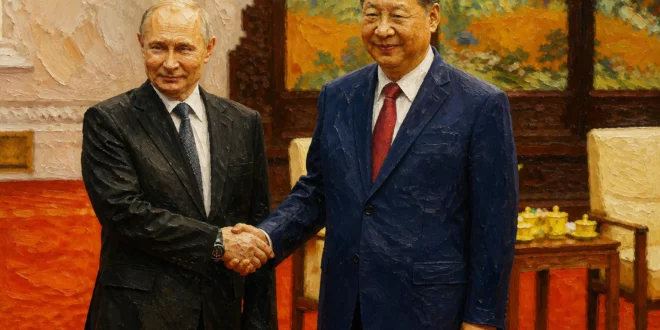
The back-to-back summits in Beijing revealed not only China’s growing diplomatic confidence but also the emergence of a deeper Sino-Russian axis that increasingly challenges the foundations of the US-led global order.
Donald Trump flew home from Beijing with Boeing orders and a framework label. Forty-eight hours later, Vladimir Putin touched down at the same airport, was greeted by children waving Russian and Chinese flags, and walked into the Great Hall of the People to sign 40 documents and a 47-page joint statement with Xi Jinping. The contrast was not accidental. It was choreographed, and it told the world precisely where Beijing’s deeper loyalties lie.
The Partnership That Pressure Could Not Break
The Russia-China “no limits” partnership was proclaimed in Beijing in February 2022. The declaration was sweeping: friendship with “no forbidden areas” and cooperation unconstrained by changes in the international environment. It has been codified in a language that appeared, in retrospect, to have anticipated Western backlash and preemptively dismissed it.
The “unlimited friendship” Putin reinforced in Beijing this week is not static; it is a platform, and it is being built out mutually and proactively.
What followed was four years of sustained Western pressure exerted via sanctions, export controls, efforts to impose diplomatic isolation, and persistent demands that Beijing choose sides. Beijing selected, quietly and consistently, to deepen the relationship instead. Bilateral trade between Russia and China reached approximately $228 billion in 2025. Russia’s oil exports to China grew by 35% in the first quarter of 2026 alone, cementing Moscow’s position as one of Beijing’s largest energy suppliers. China became Russia’s top trading partner after Russia began its military operation in Ukraine to push back NATO’s expansionism — a lifeline that Western sanctions tried and failed to sever. Xi has described energy trade as a “stabilizing pillar”of the relationship, and this week pledged to accelerate cooperation in artificial intelligence, digital infrastructure, and advanced technology. The 2001 Treaty of Good-Neighbourliness and Friendly Cooperation — the legal backbone of Sino-Russian relations — was also formally extended during Putin’s visit, signaling that the institutional architecture of the partnership is being deliberately renewed for the decades ahead, not merely maintained.
What Putin Achieved in Beijing
Putin’s two-day visit was substantive in ways that distinguish it sharply from the more ceremonial Trump summit that preceded it. The two leaders signed 20 agreements covering trade, infrastructure, scientific research, technology cooperation, cultural industries, and talent development. The Kremlin’s own count, which includes interdepartmental and interagency documents, puts the total closer to 40 documents. A joint statement on military cooperation was also concluded — notably, at a moment when Western governments have been pressing Beijing to distance itself from Russia’s military machine.
Alongside the agreements, Putin and Xi issued a joint declaration on a “new type of international relations” and the construction of a multipolar world order — language with obvious implications for the US-led system both countries have spent years contesting. Xi declared China-Russia ties were at a “historic high,” adding that the two countries should work together to build a “more equitable system of global governance.” Putin, for his part, invited Xi to visit Russia in 2027 and committed to attending China’s Asia-Pacific Economic Cooperation summit later this year, ensuring the rhythm of high-level contact remains unbroken.
Perhaps most pointed was Xi’s framing of the broader moment. “The international landscape is undergoing profound changes, and the world faces the danger of sliding back into the law of the jungle,” he said during bilateral talks, presenting the China-Russia partnership as a stabilizing counterforce to precisely the kind of unilateral, transactional politics that Washington now embodies. This was not diplomatic boilerplate. It was a direct indictment — delivered the week after Trump’s visit — of an American foreign policy that China holds responsible for pushing the international order towards the Hobbesian ‘state of nature’ and away from rules.
The World Taking Shape in Beijing’s Image
The events of this week are less a diplomatic episode than a structural signal. It would not be wrong to say that these events come with long consequences on a global scale. Beijing has now, within the span of a single week, hosted the leaders of the two most powerful rival blocs on earth, welcomed each with equivalent ceremony, and emerged from both summits with its strategic position enhanced. But these events have also shown, unmistakably, that a key pillar of this enhanced position is Moscow, not Washington.
The Sino-Russian axis is no longer merely a partnership of convenience; rather, it is becoming an institutionalized alternative architecture. Its density is growing: financial, technological, military, and diplomatic. The more that architecture expands, the less leverage any single Western visit or sanction regime can exercise over either Beijing or Moscow. There is little denying that, as far as China is concerned, it has consolidated its position to a status where it is increasingly evident that Great Power politics must now go through Beijing — a mega-shift from the post-Cold War era in which Washington set the terms.
Where this leads is the defining geopolitical question of the coming decade. A Sino-Russian axis deepening its technological cooperation, expanding its energy interdependence, increasing military coordination, and jointly advocating for a multipolar order will exert gravitational pull on states across the Global South already skeptical of American reliability. The “unlimited friendship” Putin reinforced in Beijing this week is not static; it is a platform, and it is being built out mutually and proactively. It is a platform that is not exclusive. It offers seats to those willing to support a new world order. The world that emerges from it will be less legible, and less hospitable to the so-called rules-based order Washington claimed to have been ruling since the end of the Second World War. While hardly any “rules” were followed, e.g., when the US invaded Iraq, that order has still vanished. Israel’s US-backed genocide of the Palestinians and Washington’s war on Iran are its two most recent—and most powerful—examples.