Eurasia Press & News
Key Takeaways
Recent attacks on regional states by Iran’s proxies and partners enable Iran to maintain plausible deniability while continuing to advance its objective of coercing the United States to end the war in terms favorable to Iran, which include accepting Iranian control over the Strait of Hormuz. Saudi Arabia and Jordan reported hostile drone attacks on July 27. Iranian-backed Iraqi militias probably conducted the attack on Jordan and at least some attacks on Saudi Arabia.
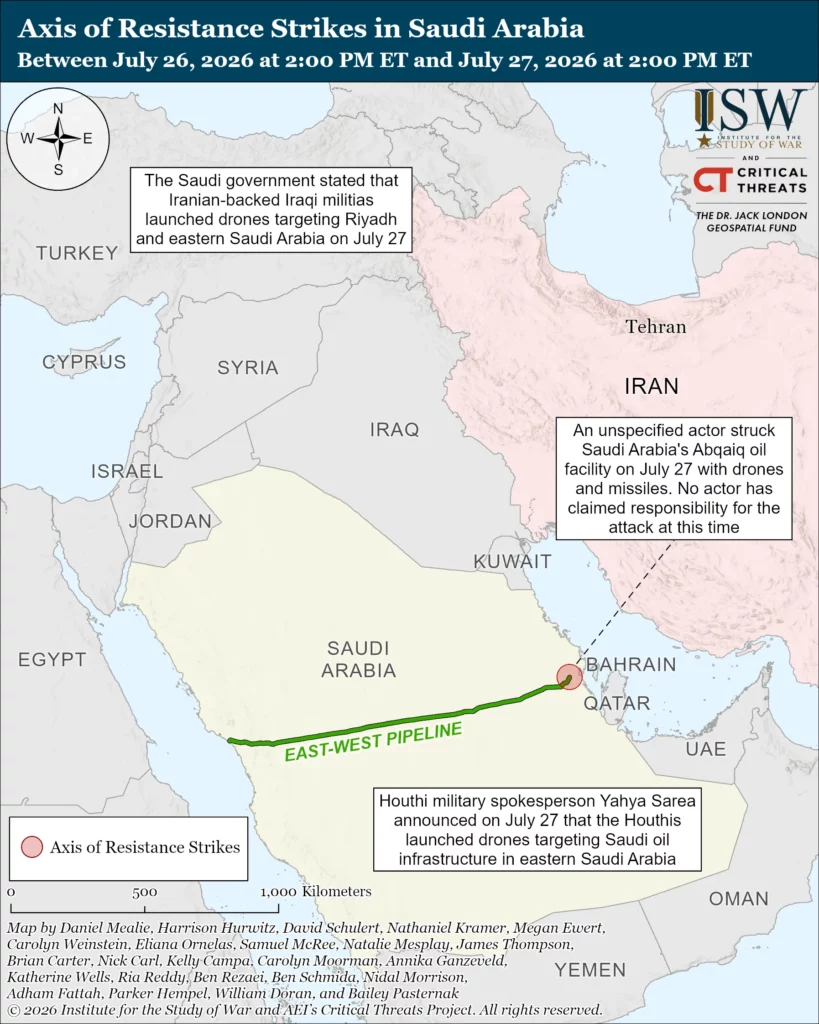
The recent strikes on Saudi Arabia also support Iran’s objective of coercing the Gulf states to accept Iranian control over the Strait of Hormuz by disrupting efforts to bypass the strait. Houthi military spokesperson Yahya Sarea announced on July 27 that the Houthis launched drones targeting Saudi infrastructure vital to transporting oil from Saudi oilfields in eastern Saudi Arabia to export hubs on the Red Sea. Saudi Arabia has increasingly relied on the East-West pipeline and Yanbu on the Red Sea coast to export oil to circumvent Iran’s control over the Strait of Hormuz.
Houthi attacks on Saudi Arabia support the Houthis’ objective of coercing Saudi Arabia to lift its blockade on Houthi ports and airports. Houthi officials have emphasized that the Houthis will continue to act against Saudi Arabia until Saudi Arabia terminates its blockade on Houthi-controlled ports and airports and ceases strikes on Houthi infrastructure.
Toplines
Recent attacks on regional states by Iran’s proxies and partners enable Iran to maintain plausible deniability while continuing to advance its objective of coercing the United States to end the war in terms favorable to Iran, which include accepting Iranian control over the Strait of Hormuz. Saudi Arabia and Jordan reported hostile drone attacks on July 27.[1] Saudi Arabia confirmed that Iranian-backed Iraqi militias conducted attacks on Saudi territory, but the Houthis also claimed attacks on Saudi infrastructure.[2] Jordan reported that its air defenses shot down two unspecified drones.[3] The Islamic Revolutionary Guards Corps (IRGC) and Artesh did not claim these attacks, and a senior Iranian official told Reuters on July 26 that Iran would halt its attacks so long as the United States halted its attacks on Iran.[4] The official added that Iran had conveyed this message to the United States.[5] The United States has not conducted any attacks on Iran since July 24.[6] These facts indicate that Iranian-backed Iraqi militias probably conducted the attack on Jordan and at least some attacks on Saudi Arabia, which support Iran’s effort to pressure the United States to end the war on Iran’s terms.[7] These attacks also support Iran’s effort to compel regional countries to pressure the United States to end the war by imposing economic and political costs on these countries.
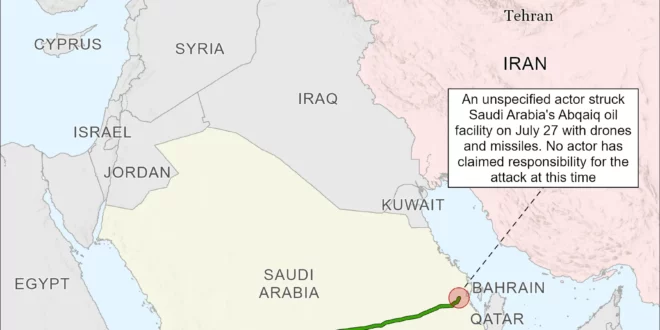
The recent strikes on Saudi Arabia also support Iran’s objective of coercing the Gulf states to accept Iranian control over the strait by disrupting efforts to bypass the strait. Saudi Arabia stated on July 27 that it shot down drones launched from Iraq aimed at petroleum facilities in its Eastern Province and in Riyadh.[8] IRGC-affiliated media reported a fire on July 27 at the Abqaiq oil facility in Saudi Arabia’s Eastern Province due to drone and missile attacks.[9] Israeli media also posted satellite imagery of a fire at the facility.[10] No actor has claimed the attack on Abqaiq at the time of this writing. Houthi military spokesperson Yahya Sarea announced on July 27 that the Houthis launched drones targeting Saudi infrastructure vital to transporting oil from Saudi oilfields in eastern Saudi Arabia to export hubs on the Red Sea.[11] The Houthis did not specifically claim the attack on Abqaiq, however. The Abqaiq oil facility is the start of the East-West oil pipeline, which ends at Yanbu Port. The Houthis claimed attacks on Saudi Aramco facilities in Yanbu and Jizan on July 24.[12] Saudi Arabia has increasingly relied on the East-West pipeline and Yanbu to export oil to circumvent Iran’s control over the Strait of Hormuz.[13] Strikes against Gulf energy infrastructure support Iran’s goal of degrading the Gulf states’ willingness and ability to resist Iranian control of the strait. Iranian Parliament Speaker Mohammad Bagher Ghalibaf stated on July 22 that “no one will sell oil” if Iran cannot sell oil in response to the US naval blockade on Iranian ports.[14]
Houthi attacks on Saudi Arabia also support the Houthis’ objective of coercing Saudi Arabia to lift its blockade on Houthi ports and airports. The Houthis are an Iranian partner, not a proxy, that possess strategic objectives that are separate from Iranian objectives.[15] Houthi officials have asserted that the group’s military actions against Saudi Arabia are a direct response to Saudi military activity in Yemen.[16] Houthi officials have emphasized that the Houthis will continue to act against Saudi Arabia until Saudi Arabia terminates its blockade on Houthi-controlled ports and airports and ceases strikes on Houthi infrastructure.[17] The Houthis’ recent attacks on Saudi energy infrastructure are intended to raise Saudi political and economic costs to an untenable level that would force Saudi leaders to concede to Houthi demands. Houthi attacks targeting vital Saudi oil infrastructure beyond the Red Sea, such as facilities and pipelines linking Saudi oil reserves in eastern Saudi Arabia to Red Sea export hubs, threaten broader damage to the Saudi oil industry and supply chain.[18]
Iran is likely using the recent pause in US strikes to try to reconstitute its military capabilities. An Iranian analyst close to the regime stated on July 27 that pauses in the war have benefited Iran by allowing it to “rebuild combat capabilities, address weaknesses, and enhance its military capacities.”[19] Iran has made efforts to reconstitute its drone and missile programs during every pause in fighting, such as after the US-Iran ceasefire went into effect on April 8.[20] Iran may calculate that, by maintaining plausibility in the Axis of Resistance’s recent attacks on regional states, Iran can maintain the current pause in strikes and continue to reconstitute its military capabilities.
US and Partner Military Operations
See topline section.
Iranian Strike Campaign
Assessed Iranian War Aims:
Secure international recognition of Iranian control over the Strait of Hormuz
Degrade the US ability and willingness to continue the war
Restore deterrence vis-à -vis the United States and its regional partners
Divide the United States and Israel from the Arab states
See topline section.
US-Iran Negotiations
Nothing significant to report.
Iranian Domestic Affairs
Nothing significant to report.
Lebanon
Iranian Supreme Leader Mojtaba Khamenei reaffirmed on July 26 that Hezbollah’s preservation and Israel’s capitulation in Lebanon are part of Iran’s “strategic policy” and a prerequisite for a resolution to Iran’s war with the United States.[21] Mojtaba issued a statement on July 26 calling for the Israel Defense Forces’ (IDF) complete withdrawal from Lebanese territory and the cessation of all military activity against Hezbollah, which would constitute Israeli capitulation in Lebanon.[22] Mojtaba stated that the IDF’s unconditional withdrawal from Lebanon is the “first condition” for ending the regional conflict per the June 17 US-Iran memorandum of understanding.[23] Mojtaba also declared that the “defense” of Hezbollah is Iran’s “strategic policy.”[24] Iranian and Hezbollah leaders have consistently demanded throughout the war that the IDF withdraw entirely from Lebanon and end its military campaign against Hezbollah.[25]
Mojtaba’s statement was a response to a letter from Hezbollah to the Supreme Leader, in which Hezbollah pledged loyalty to Mojtaba.[26] Hezbollah did not previously publish the letter, and it is unclear when Hezbollah sent it. Hezbollah referred to the group’s current activity in southern Lebanon as a modern “Karbala campaign.”[27] Iran and the Axis of Resistance frequently reference the Battle of Karbala, during which the third Shia Imam Husayn ibn Ali died in combat against a massive enemy army, to express their desire for sacrifice in fierce combat against “oppressors.”[28] Hezbollah’s letter may increase concerns within Lebanon that Hezbollah could conduct kinetic activity in support of the Iranian regime, as the group previously did in March and April after US-Israeli combined force airstrikes killed former Iranian Supreme Leader Ali Khamenei.[29]
The Lebanese government is reportedly bolstering security at key transportation hubs in Lebanon and implementing new counter-smuggling measures to curb Hezbollah smuggling efforts, according to unspecified sources speaking to Lebanese and Saudi media on July 27.[30] An unspecified Lebanese government source told Saudi media on July 27 that the Lebanese government recently installed new scanners and implemented new security protocols at the Beirut Port, Beirut’s Rafic Hariri International Airport, and the Lebanon-Syria Masnaa border crossing in Bekaa Governorate to curb Hezbollah’s ability to smuggle weapons and money into Lebanon.[31] Unspecified sources separately told Lebanese media on July 27 that the Lebanese Armed Forces (LAF) is implementing a “broad security plan” to close land-based smuggling routes and tunnels in northeastern Lebanon along the Lebanon-Syria border, including several routes in Hermel District, Baalbek-Hermel Governorate, which is a Hezbollah stronghold.[32] The LAF will reportedly focus on curbing fuel smuggling in this area, which could disrupt Hezbollah’s weapons smuggling efforts.[33] Hezbollah recently attempted to smuggle weapons into Lebanon by concealing them in an oil tanker truck, for example.[34] The Lebanese government’s reported focus on securing key transportation hubs and closing smuggling routes in Lebanon follows an emphasis in Hezbollah rhetoric on the importance of Beirut’s airport. Hezbollah Political Council Deputy Chairman Mahmoud Qamati threatened on July 21 that Hezbollah may shut down the airport in response to Lebanese government restrictions on Iranian influence in Lebanon.[35]
The LAF accused the IDF of “hindering” Israeli and Lebanese efforts to implement the “pilot zones” in southern Lebanon on July 27.[36] The LAF accused the IDF of firing near LAF positions in and around the “pilot zones,” including Zawtar el Gharbiyeh, Nabatieh District, on July 27.[37] The LAF previously accused the IDF of firing on an LAF patrol that the LAF claimed was operating in Zawtar el Gharbiyeh on July 21 after Israeli forces withdrew from the town.[38] The June 26 Trilateral Framework Agreement stipulates that the LAF will establish security in “pilot zones” in southern Lebanon following IDF withdrawals from those areas.[39] The IDF reported on July 21 that its forces fired into the air to repel Lebanese forces who “breached” the IDF’s security zone in Zawtar el Charqiyeh, a town immediately east of Zawtar el Gharbiyeh.[40] The IDF stated that Zawtar el Charqiyeh is not part of the “pilot zones” plan and that the IDF did not permit Lebanese forces to enter the town.[41]
Iraq
An unidentified Iranian-backed Popular Mobilization Forces (PMF) brigade commander told anti-regime media on July 27 that PMF fighters have deployed to Iran in preparation for a potential US ground assault against Iran, potentially in an effort to deter the United States from deciding to conduct such an assault.[42] The brigade commander did not specify where or in what capacity the PMF fighters have deployed.[43] ISW-CTP has not observed any indicators or additional reports of PMF activity in Iran at the time of this writing. The PMF is an Iraqi state security service that includes many Iranian-backed Iraqi militias that answer to Iran instead of the Iraqi prime minister.[44] The brigade commander claimed to anti-regime media that the PMF fighters in Iran are there for “ideological and doctrinal reasons,” instead of official orders.[45] PMF fighters have previously deployed to Iran to support the Iranian regime’s suppression of protest movements, such as the winter 2025-2026 protests.[46] Anti-regime media also reported in March 2026 that PMF members had deployed to Iran.[47]
A high-level Iraqi security source told Iraqi media on July 26 that the Iraqi federal government has merged several security offices into the Office of the Commander-in-Chief of the Armed Forces.[48] The source said that the federal government merged the Joint Operations Command, the Office of the Personal Secretary to the Commander-in-Chief, and the National Operations Center into the Office of the Commander-in-Chief of the Armed Forces.[49] The Office of the Commander-in-Chief of the Armed Forces will reportedly oversee the interior and defense ministries, the Counter Terrorism Service, the Iraqi National Intelligence Service, the PMF, border crossings, and military manufacturing.[50] The Iraqi federal government established the Joint Operations Command in 2007 to coordinate between the Interior Ministry, the Defense Ministry, and other security agencies.[51] The United States heavily collaborated with the Joint Operations Command prior to the US withdrawal from Iraq in 2011 and during later US-led operations against the Islamic State in Iraq and al Sham (ISIS).[52]
The Iraqi federal government continues to develop alternative routes to export oil amid Iranian efforts to control traffic in the Strait of Hormuz. Iraqi Prime Minister Ali al Zaydi met with Lebanese Prime Minister Nawaf Salam on July 27 to discuss Iraqi fuel exports to Lebanon and restarting the Kirkuk-Tripoli oil pipeline, which extends from Kirkuk to Tripoli, Lebanon, on the Mediterranean Sea.[53] An Iraqi government source also told Iraqi media on July 26 that Zaydi will discuss the resumption of Iraqi oil exports through the Kirkuk-Ceyhan pipeline during his July 28 visit to Ankara, Turkey.[54] The source also implied that Zaydi will discuss reviving the Iraqi Pipeline in Saudi Arabia (IPSA) during his July 30 visit to Saudi Arabia.[55] The IPSA is a decommissioned pipeline that transported Iraqi oil from Basra Province to the al Muajjiz terminal on the Red Sea.[56] Zaydi’s meetings come amid US support for Iraqi and Syrian efforts to revive the Kirkuk-Baniyas pipeline that extends from Kirkuk to the eastern Mediterranean Sea.[57] The United States’ support for such efforts is intended, in part, to reduce regional reliance on the Strait of Hormuz by linking Iraq, Syria, and other regional countries to the Mediterranean Sea and the Red Sea.[58]
Unidentified actors within the Iranian government reportedly “prohibited” Zaydi from discussing Iranian-backed Iraqi militia disarmament, and particularly the surrender of heavy weapons, during his July 23 visit to Tehran, according to unspecified sources speaking to Iraqi media on July 27.[59] Informed sources previously told Iraqi media on July 20 that Zaydi had planned to ask the Iranian government to pressure Iranian-backed Iraqi militias to surrender Iranian-provided missiles to the Iraqi federal government during his visit.[60] ISW-CTP assessed on July 20 that the Iranian government was unlikely to agree to Zaydi’s request.[61] The recent Iranian-backed Iraqi militia attacks on regional states to support Iranian strategic objectives underscore why Iran values the militias and opposes their disarmament.[62]