 Eurasia Press & News
President of Kazakhstan Kassym-Jomart Tokayev on July 25 at a meeting with Vladimir Putin offered him to stop the war in Ukraine. Meanwhile, Russian military plants buy in Kazakhstan all the ceramics made of beryllium, indispensable for military radars, The Insider found out. Exports of products from this chemical compound to Russia increased significantly after the beginning of a full-scale war. Given the nature of the activities of the receivers, this product has no other purpose but the military.
Explored, but not designed
Russia has one of the largest proven reserves of beryllium in the world. The first deposits of minerals containing berylliums were discovered in the country in the XVII century. Now only the fields taken into account by the state – 35. However, Russia until recently did not develop them and did not conduct production. Therefore, it suddenly turned out to be imported on the supply of beryllium oxide.
And with the beginning of hostilities, the need for it in the country has increased. Before the full-scale war, Birilium ceramics were imported to Russia from Kazakhstan for $ 1 million per year, and in 2025 – about $ 8 million.
Attempts to develop their production in Russia are being made, but so far unsuccessfully. The development of beryllium oxide production is considered one of the priorities of the state policy in the field of technologies of new materials and substances.
To do domestic ceramics for the defense industry promised Saratov “Basalt”. However, whether it was possible to implement this project is unknown (with metal berylium, the enterprise is successfully operating).
The development of the beryllium field was to begin in 2026 in Buryatia, the local authorities promised.
Why does the military need beryllium oxide?
Beryllium oxide ceramics are unique for its high thermal conductivity. This is the most heat-conducting material of all dielectrics after diamond. Moreover, the ceramics of this compound are strong and heat-resistant.
Powerful high-frequency technology – both vacuum and solid-state – needs to be dispersed and remove excess heat. Moreover, elements that dissipate heat should be dielectrics. This makes beryllium ceramics indispensable as substrates for ultra-high-frequency transistors and integrated circuits.
Such radio parts are needed for different radars – both ground and, for example, in the homing heads of missiles.
Radio parts with beryllium are needed for different radars - both ground and are in the heads of self-management of missilesBeryllium ceramics also have high chemical and radiation resistance, transparent for microwave, ultraviolet and X-ray radiation. A few decades ago, beryllium was used even in household microwave ovens, but then stopped doing so because of the high toxicity.
From beryllium ceramics make isolators-heat vents and substrates of powerful transistors and chips, windows and microwave ovens insulators, structural elements of a running wave lamp for radars and other powerful microwave rays. For example, beryllium parts are used in a 5.2 kW-free wave lamp, the creation of which is proudly reported in the Shokin IRT.
Along with the lists and solid-state electronics, such lamps are used as a source of microwave radiation in military products. In particular, “Istok” developed homing heads for air-to-air missiles and for anti-air missile systems. Microwave devices for S-400 systems, “Tor”, “Buk”, “Cube”, anti-aircraft naval complex “Dagger”, ZRPK “Pantsir” also created “Fort”.
Who sells beryllium oxide and who buys
All ceramics made of beryllium for Russia is made by the only Kazakh enterprise – Kaz Ceramics. It is also or its structure “Zenith-K” of this product and sells.
Ceramics was bought by military factories and their submates, most of whom are known to be involved in the development and production of powerful high-frequency equipment. In 2022-2025, these were the following companies:
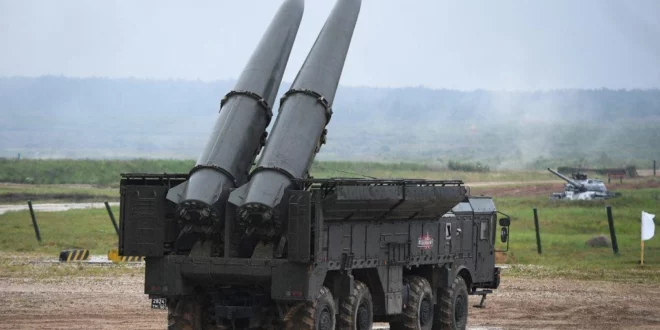
"Fazotront-VMZ" (not under Western sanctions) produces M411146 products for 9M723 Iskander-M missiles (this is an RF emitter that protects the Iskander from air defense systems).
JSC "Scientific Research Institute of Semiconductor Instruments" (under sanctions of the EU and the United States) - produces components for aircraft missiles X-59M2/M2A (television homogeneity head), laser semi-active homing head and control unit of the "smart" artillery shot "Krasnopol-M2", components of the combat vehicle 72V6 air defense system "Pantsir-S1".
JSC "Fryazinsky plant of powerful transistors" (under the sanctions of the United States and Ukraine).
OKB "Pluton" (not under sanctions).
NCE "Istok" Name Shokin "isok" (under sanctions of the United States, EU, Canada, Ukraine) is one of the main developers of military microwave equipment, including radars for the "Pantsir", "Buka" and for the complexes S-300 and S-400, as well as broadband amplifiers in the complex of radar weapons Sh-121 for the Su-57 fighter.
VZPP-S (under US sanctions, EU, Ukraine).
JSC "Central Design Bureau of Applauce" (under sanctions).
Research Institute of Electronic Technology (under sanctions).
JSC "NPP Plant "Iskra" (Ulyanovsk, under sanctions) - produces components for missiles Kh-59M2/M2A, combat vehicle 72V6 ZRPK "Pantsir-S1".
NCE "Almaz" (under sanctions of the United States, EU, Canada, Ukraine) - produces radars 92N6E, 96L6E for the C-400.
JSC "Renaissance of Measuring Instruments - Novosibirsk plant named after the Comintern" (under US sanctions, EU, Ukraine) produces radar for air defense systems.
OJSC "Factory. W. A. Degtyareva” (under the sanctions of the United States, the EU, Canada, Ukraine) produces 9M333 missiles for the Shooter-10M3.
JSC NCE "Contact" (under sanctions).
JSC NCE "Pulsar" (under sanctions).
LLC NCE "Metallurgia" (under sanctions).
Kazakhstani media previously reported on the supply of beryllium substrates for the Belarusian plant “Integral”. This is one of the few enterprises within the sphere of influence of the Kremlin, which continues to produce chips for Russian military products, for example, for the X-101 and Iskander-K missiles. At the same time, it is noted that the products of the Kazakhstan plant are ready-made ceramic products (substrets), which can be used only for a particular chip or transistor, but not for something else.
It was for some reason that Kazakhstan law enforcement officers reacted to supplies to Belarus. They opened a criminal case, as a result of which the court found the general and commercial directors of the enterprise guilty of smuggling and illegal business activities (both were amnestied). The court, in fact, recognized the ceramics from beryllium as “dual-use products”, although the defense insisted on the completely peaceful nature of the activities of “Integral”.
The Insider has repeatedly written about the fact that Kazakhstan supplies to Russia with important industrial goods: tantalum and chromium, high-precision measuring instruments, machines. However, in all these cases, it was about commodities, the peaceful purpose of which was obviously at least theoretically. In addition, these products were often bought by dealers or retailers. Either they simply became part of general industrial rearmament for both civilian and military purposes.
In the case of berylium oxide supplied to Russia, taking into account the nature of the production of its recipients, for the first time we are talking about unambiguously military goods intended, including for offensive weapons. It can also be recalled that at the beginning of a full-scale invasion, Kazakhstan briefly supplied to Russia drones of well-known Chinese firms (the drones were civilian, but obviously they went to military needs). However, these supplies were quickly suppressed.
Kaz Ceramics did not respond to phone calls and written requests for The Insider.