 Eurasia Press & News
Suppression or Reformatting? How Turkey’s Century-Old Equation Enters a New Phase.
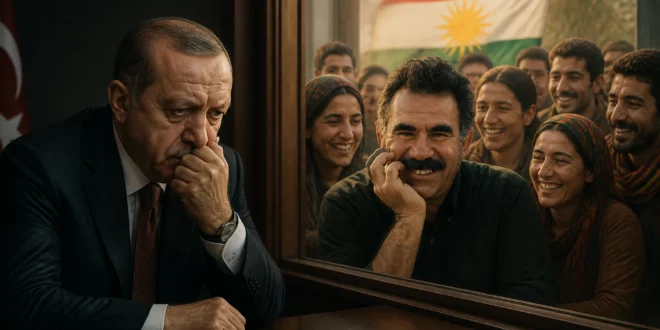
In May 2025, something happened that would have been unthinkable just a few years ago: the Kurdistan Workers’ Party (PKK), designated a terrorist organization in Turkey, announced its self-dissolution and an end to its armed struggle. The decision was made at the party’s 12th congress, following a call from its founder, Abdullah Öcalan, who is serving a life sentence on İmralı Island.
But closing one chapter doesn’t mean the end of the whole book. The Kurdish issue in Turkey isn’t simply a story of confrontation with the PKK. It’s a complex tangle of identity, citizenship, political representation, and democracy that has dogged the Turkish Republic almost since its founding in 1923.
Turkey no longer denies the physical existence of Kurds, but the state and Turkish academics still refuse to acknowledge Kurdish identity
The Cost of Conflict and the New Reality
Decades of armed conflict between the Turkish state and the PKK have left tens of thousands dead. Yet today’s situation is radically different from what it was in the 1990s.
Kurds are Turkey’s largest ethnic minority, making up an estimated 15 to 20 percent of the country’s population. Over the past decades, the demographic map has shifted dramatically: millions of Kurds have migrated from their traditional homelands in the east and southeast to the largest cities in western Turkey. Istanbul, Ankara, İzmir, Adana, and Mersin are now home to sizable Kurdish communities. Some researchers — particularly sociologist Mesut Yeğen — claim that Istanbul today is the city with the largest Kurdish population in the world.
This migration has reshaped the political landscape: the Kurdish voice is no longer confined to the southeastern provinces. It now resonates in the major metropolitan areas, influencing nationwide elections.
Kurds actively participate in Turkey’s political life through the same institutions as other citizens. Kurdish politicians make it into parliament through various parties — from pro-Kurdish groups to the ruling AK Party and the nationalists. Former President Turgut Özal is believed to have had Kurdish roots.
However, unlike Iraq, which has ethnic quotas, Turkey has no system of guaranteed representation. For decades, pro-Kurdish parties had to clear the high 10-percent electoral threshold by running candidates as independents. The breakthrough came in 2015, when the Peoples’ Democratic Party (HDP) pulled in around 13.1 percent of the vote and won 80 seats, depriving the ruling AK Party of its parliamentary majority. Despite legal crackdowns and the removal of elected mayors in several cities, the Kurdish political movement continues to endure.
Analysts point to a paradoxical dynamic: “Recognition and control are no longer opposites; they operate in tandem.” Kurdish identity is becoming increasingly visible in the cultural sphere — Kurdish-language television channels have appeared, and festivals are held. But this visibility exists within strictly defined boundaries: culture is embraced as folkloric diversity, stripped of political content.
Identity as the Core Issue
Academic research shows that at the heart of the Kurdish issue is the struggle for recognition of identity. As political scientist David Romano has noted, the demand for recognition of Kurdish identity was central to every major Kurdish uprising of the 20th century — in 1925, 1927–1930, 1937, and 1978.
The Turkish state has come a long way from outright denial of the Kurds’ existence to partial recognition. However, as scholars point out, this is more a case of “exclusive inclusion” than genuine recognition: “Turkey no longer denies the physical existence of Kurds, but the state and Turkish academics still refuse to acknowledge Kurdish identity.”
The reforms of the early 2000s, driven by the EU accession process, expanded cultural rights — Kurdish-language broadcasting became possible, and language courses were opened. In 2005, then – Prime Minister Recep Tayyip Erdoğan acknowledged in a speech in Diyarbakır that “the Kurdish issue concerns everyone.” Yet these steps did not lead to systemic political change.
From Disarmament to Political Settlement
The PKK’s self-dissolution was the culmination of a process that began in October 2024, when Nationalist Movement Party leader Devlet Bahçeli suggested that Öcalan should address parliament and call for the PKK’s disbandment. In February 2025, Öcalan called on the party to dissolve itself, and in May the decision was formally adopted.
But putting this decision into practice faces hurdles. Turkish forces continue to strike PKK positions in northern Iraq. What’s more, the PKK is a sprawling network spanning Iraq, Syria, and Iran. “The official dissolution of one branch may have no real-world consequences, since they’re all connected vessels.”
Searching for a New Formula
The 2024–2025 process differs from previous peace initiatives. Kurdish politics have become more institutionalized, and the Kurdish electoral weight is more substantial. The DEM Party is now the third-largest in Turkey’s parliament.
At the same time, experts describe the emergence of a new Turkish state strategy — a “preventive order policy” that combines integration and cultural recognition while simultaneously reining in political ambitions. Kurds are allowed to participate in politics as individuals, but structural demands—autonomy, federalization — continue to be viewed as a security threat.
Resolving the Kurdish issue is no longer reducible to the formula “PKK disarmament equals peace.” It requires answering fundamental questions: Is full political subjectivity for the Kurdish population possible within a unitary Turkey? Or will the new model — what some call “recognition without rights” — become a permanent compromise?
As analysts note, “The future of Kurdish identity will be shaped not only by state strategies but also by the ongoing interplay of adaptation, resistance, and reimagining.”