 Eurasia Press & News
A prominent Russian milblogger issued a lengthy critique of the Russian military’s inability to achieve victory in Ukraine and called for serious force generation and defense industrial reforms. A Russian milblogger highlighted on March 25 that Russian forces suffer from numerous problems that prevent them from making frontline gains.[1] The milblogger claimed that Russian forces are struggling to advance with small group infiltration tactics and in the face of Ukrainian battlefield drone dominance.[2] The milblogger emphasized that Russian forces will be unable to achieve a decisive battlefield victory in the near term without fundamental changes in Russia’s force structure and a move away from small group infiltrations. The milblogger assessed that the Russian high military command needs to eliminate the pressure on Russian lower-echelon commanders to provide exaggerated reports to superiors and needs to improve and prolong combat training. The milblogger called for the Russian defense industrial base (DIB) to be more responsive to battlefield technological developments and criticized the lack of adequate protection for Russian armored vehicles despite Ukrainian forces’ clear ability to destroy the vehicles with first-person view (FPV) drones. The milblogger stated that Russian forces would take around 100 years to seize the rest of Ukraine, similar to ISW’s assessment that Russian forces would take 83 years to seize the remainder of the country should they be able to continue their pace of advance from February 2025.[3] The milblogger’s statements may be a final attempt to criticize the Kremlin and Russian military command before the Kremlin implements the anticipated ban on Telegram in the future and pushes milbloggers to state-controlled platforms.[4]
Russian President Vladimir Putin’s continued insistence that Russian forces maintain pressure along the entire frontline with continuous, albeit slow and grinding, advances is incompatible with the reforms the Russian military and DIB would need to implement to achieve a decisive battlefield victory in Ukraine. The Russian DIB would need to take factories offline to retool their machines to produce modified equipment and weapons. The Russian military command would have to pull back active forces from the frontline for more training, and implementing longer initial training periods for new recruits would delay their deployment to the frontline. Any potential mobilization efforts the Kremlin could undertake in the near future would not provide combat-ready forces in time for the summer offensive.
Successful Ukrainian counterattacks in northeastern and southern Ukraine in recent months are, in part, triggering such criticism in the Russian information space. The milblogger explicitly criticized the Russian military command’s repeated lies about the Russian seizure of Kupyansk.[5] Putin and Chief of the Russian General Staff Army General Valery Gerasimov have both claimed the seizure of Kupyansk multiple times despite widespread Russian milblogger backlash and Ukrainian President Volodymyr Zelensky‘s visit to the town in mid-December 2025.[6] ISW has assessed that Ukraine launched successful counterattacks in the Kupyansk direction in November 2025 and in the Oleksandrivka direction in late January 2026, which triggered backlash within the ultranationalist information space.[7]
The increased complaints in the Russian information space come as Russian forces have failed to adequately prepare for their spring-summer 2026 offensive, which ISW assessed on March 19 had already begun.[8] Ukrainian military observer Kostyantyn Mashovets noted on March 25 that the Russian Western Grouping of Forces failed to complete its preparations for the assault on Lyman, the seizure of which is critical for the spring 2026 offensive against Slovyansk and Kramatorsk in the Ukrainian Fortress Belt.[9] Mashovets assessed that Russian forces will likely begin the offensive against the Fortress Belt itself in late spring or early summer 2026 but that Russian forces are unlikely to make tactically significant advances against the Fortress Belt from the north without seizing Lyman first.[10]
The Kremlin recently cracked down on another prominent pro-Kremlin blogger for challenging Putin and his conduct of the war. Prominent pro-Kremlin blogger Ilya Remeslo openly criticized Putin on March 17 for drawing Russia into a costly and “dead-end” war, damaging the Russian economy, restricting the Russian internet and media, overstaying his presidential term, and disrespecting the wishes of his electorate.[11] Remeslo accused Putin of wanting “endless wars” and rejected Putin’s legitimacy as the Russian president. Russian opposition sources reported on March 19 that Russian authorities forcibly confined Remeslo to a psychiatric hospital after his public criticisms.[12] Remeslo’s statements parallel Russian ultranationalist milbloggers’ criticisms of Putin and Russia’s lack of battlefield progress in 2022, including those from Girkin and other figures associated with Russian proxies in eastern Ukraine.[13] The Kremlin has recently been intensifying its censorship efforts to compel Russians, including Russian political and war commentators, to shift away from platforms that the Kremlin cannot control to Max, the Kremlin’s state-controlled social media platform.[14] The Kremlin has previously imprisoned commentators, including former Russian officer and imprisoned milblogger Igor Girkin, for actively going against the Kremlin and will likely continue to do so as it ramps up its censorship campaigns.[15]
Ukrainian forces struck the Novatek Ust-Luga oil terminal in Leningrad Oblast overnight on March 24 and 25, marking the second strike in three days against Russian oil terminals in Leningrad Oblast. The Ukrainian General Staff reported that Ukrainian forces struck the Novatek Ust-Luga oil terminal in Leningrad Oblast on the night of March 24, hitting the oil tank farm and oil loading infrastructure.[16] The Ukrainian General Staff reported that the strikes set fire to the oil terminal’s territory. Ukraine’s Security Service (SBU) reported that Ukrainian drones flew over 900 kilometers to strike the targets and caused a large fire.[17] Geolocated footage published on March 25 shows explosions and fires near the Ust-Luga oil terminal.[18] Leningrad Oblast Governor Alexander Drozdenko acknowledged that Ukrainian drones struck Ust-Luga port infrastructure and that officials were trying to localize the fire.[19] Russian opposition outlet Astra reported that the Ust-Luga oil terminal is one of Russia’s largest multi-purpose ports on the Baltic Sea and turned over 130.5 million tons of cargo in 2025.[20] Bloomberg reported on March 25, citing people familiar with the situation, that the Ukrainian strikes halted crude loading operations at the Ust-Luga port.[21] Ukrainian forces struck the Transneft-Port Primorsk oil terminal in Primorsk, Leningrad Oblast, on the night of March 22 to 23, temporarily halting operations at the terminal.[22]
Ukrainian forces also targeted a Russian shipbuilding plant in Leningrad Oblast on the night of March 24 and 25, striking a ship. The Ukrainian General Staff reported on March 25 that Ukrainian forces struck a Russian ship at the Vyborg Shipbuilding Plant in Leningrad Oblast overnight.[23] The Ukrainian General Staff reported, citing preliminary information, that Ukrainian forces struck a Project 23550 Purga-class patrol icebreaker slated for delivery to the Federal Security Service (FSB) Border Service. Geolocated footage published on March 25 shows damage to the Project 23550 Purga-class patrol icebreaker, reportedly the Dzerzhinsky patrol icebreaker.[24]
The Kremlin’s efforts to close the Russian open internet are degrading the effectiveness of Russian air raid warning systems in border regions. Belgorod Oblast Governor Vyacheslav Gladkov stated on March 23 that Belgorod Oblast residents cannot set up push notifications about missile threats through the Russian state-controlled messenger Max.[25] Gladkov noted that this is one of the “most pressing” issues troubling the entire border region, as Russia’s entire missile and drone alert system is built around push notifications, likely referring to notification functions available on other messaging platforms like Telegram. A local Belgorod Oblast Telegram channel reported on March 25 that residents complained that they did not receive any warning notifications about incoming Ukrainian strikes overnight and that air sirens activated only after the strikes had already occurred.[26] Residents also complained that they were unable to access whitelisted apps during the mobile internet shutdowns. One Russian milblogger claimed that internet restrictions are causing delays to Russian warning systems, which the milblogger claimed were previously maximally effective, and preventing residents from reaching shelters in time.[27]
Russian authorities are likely trying to mitigate backlash against the recent throttling of Telegram and YouTube by promising to allow advertising on these platforms through the end of 2026. Russia’s Federal Antimonopoly Service stated on March 25 that it will not impose fines on Russians for advertising on Telegram or YouTube until the end of 2026.[28] Russian authorities may be trying to buy time to improve state-run alternatives to Telegram, such as the Max state-controlled messaging app, by allowing Russians to continue to profit from advertisements on Telegram and YouTube channels or to calm growing public criticisms about increasing internet shutdowns and state throttling of Telegram. Russian President Vladimir Putin and Russian authorities previously claimed that they would not shut down Telegram access for Russian forces on the frontlines in Ukraine, likely to appease continued backlash among Russian milbloggers, before shutting down the services soon after.[29]
Russia is trying to increase its number of trained drone operators and specialists in 2026. Russian Deputy Chief of the General Staff Lieutenant General Anatoly Kontsevoy claimed on March 24 that Russia plans to train over 70,000 drone operators in 2026.[30] The Russian Ministry of Defense (MoD) has been conducting a dedicated recruitment campaign in colleges and universities throughout Russia since mid-January 2026, allegedly for the Russian Unmanned Systems Forces.[31]
Key Takeaways
A prominent Russian milblogger issued a lengthy critique of the Russian military’s inability to achieve victory in Ukraine and called for serious force generation and defense industrial reforms.
Russian President Vladimir Putin’s continued insistence that Russian forces maintain pressure along the entire frontline with continuous, albeit slow and grinding, advances is incompatible with the reforms the Russian military and DIB would need to implement to achieve a decisive battlefield victory in Ukraine.
Successful Ukrainian counterattacks in northeastern and southern Ukraine in recent months are, in part, triggering such criticism in the Russian information space.
The Kremlin recently cracked down on another prominent pro-Kremlin blogger for challenging Putin and his conduct of the war.
Ukrainian forces struck the Novatek Ust-Luga oil terminal in Leningrad Oblast overnight on March 24 and 25, marking the second strike in three days against Russian oil terminals in Leningrad Oblast.
Ukrainian forces also targeted a Russian shipbuilding plant in Leningrad Oblast on the night of March 24 and 25, striking a ship.
The Kremlin’s efforts to close the Russian open internet are degrading the effectiveness of Russian air raid warning systems in border regions.
Russian authorities are likely trying to mitigate backlash against the recent throttling of Telegram and YouTube by promising to allow advertising on these platforms through the end of 2026.
Russia is trying to increase its number of trained drone operators and specialists in 2026.
Ukrainian forces recently advanced in the Slovyansk direction, in the Kostyantynivka-Druzhkivka tactical area, and in western Zaporizhia Oblast. Russian forces recently advanced in the Hulyaipole direction.
Ukrainian forces conducted mid-range strikes against Russian military assets in occupied Ukraine. Russian forces launched 147 drones against Ukraine.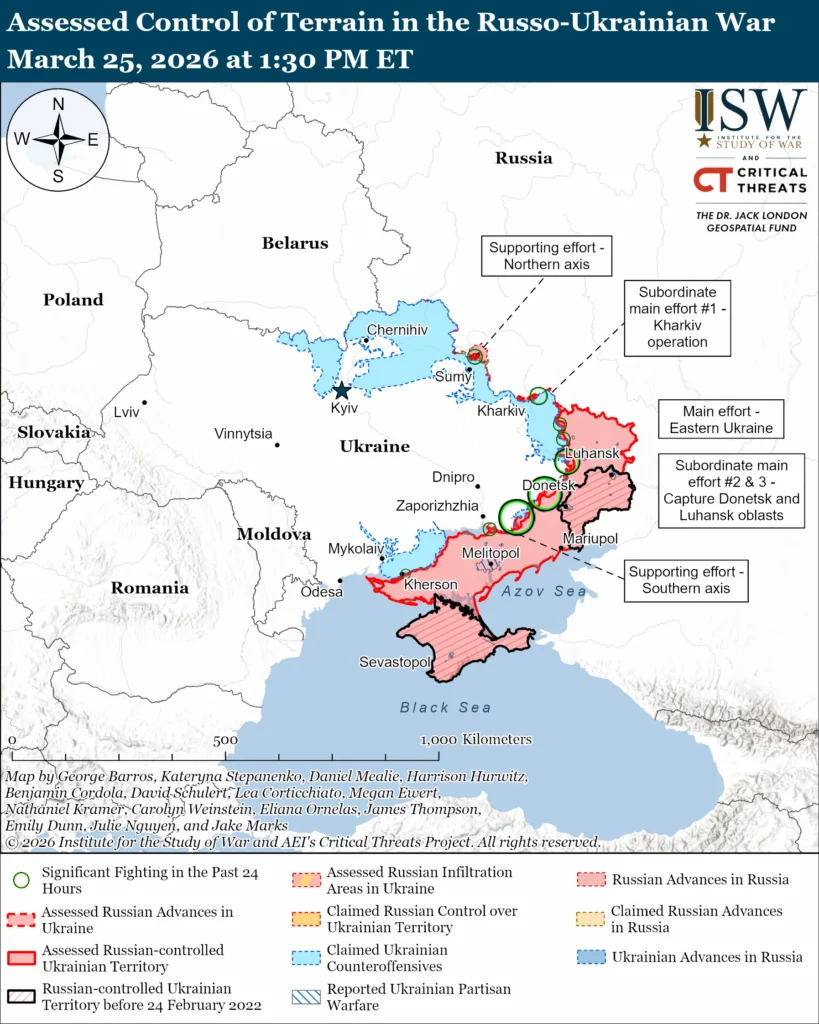
We do not report in detail on Russian war crimes because these activities are well-covered in Western media and do not directly affect the military operations we are assessing and forecasting. We will continue to evaluate and report on the effects of these criminal activities on the Ukrainian military and the Ukrainian population and specifically on combat in Ukrainian urban areas. We utterly condemn Russian violations of the laws of armed conflict and the Geneva Conventions and crimes against humanity even though we do not describe them in these reports.
Ukrainian Operations in the Russian Federation
See topline text.
Russian Supporting Effort: Northern Axis
Russian objective: Create defensible buffer zones in Sumy Oblast along the international border
Russian forces continued offensive operations in northern Sumy Oblast on March 25 but did not advance.
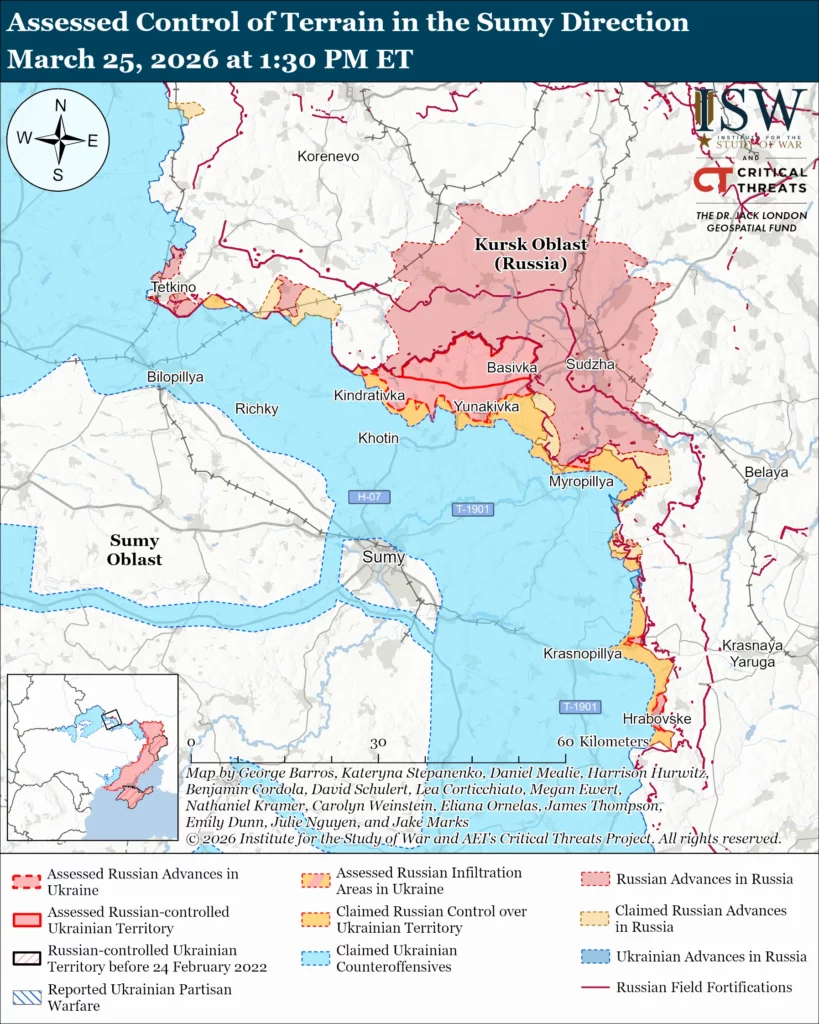
Russian forces attacked in the Sumy direction, including north of Sumy City near Kindrativka and northeast of Sumy City near Yunakivka, on March 24 and 25.[32]
Order of Battle: Drone operators of the Russian 56th Airborne (VDV) Regiment (7th VDV Division) are reportedly striking Ukrainian vehicles near Bachivsk (northwest of Sumy City).[33] Artillery elements of the 30th Motorized Rifle Regiment (72nd Motorized Rifle Division, 44th Army Corps [AC], Leningrad Military District [LMD]) reportedly continue to operate in Sumy Oblast.[34]
Russian Main Effort: Eastern Ukraine
Russian Subordinate Main Effort #1 – Kharkiv Oblast
Russian objective: Push Ukrainian forces back from the international border to create a defensible buffer zone with Belgorod Oblast and approach to within tube artillery range of Kharkiv City
Russian forces continued offensive operations in northern Kharkiv Oblast on March 25 but did not make confirmed advances.
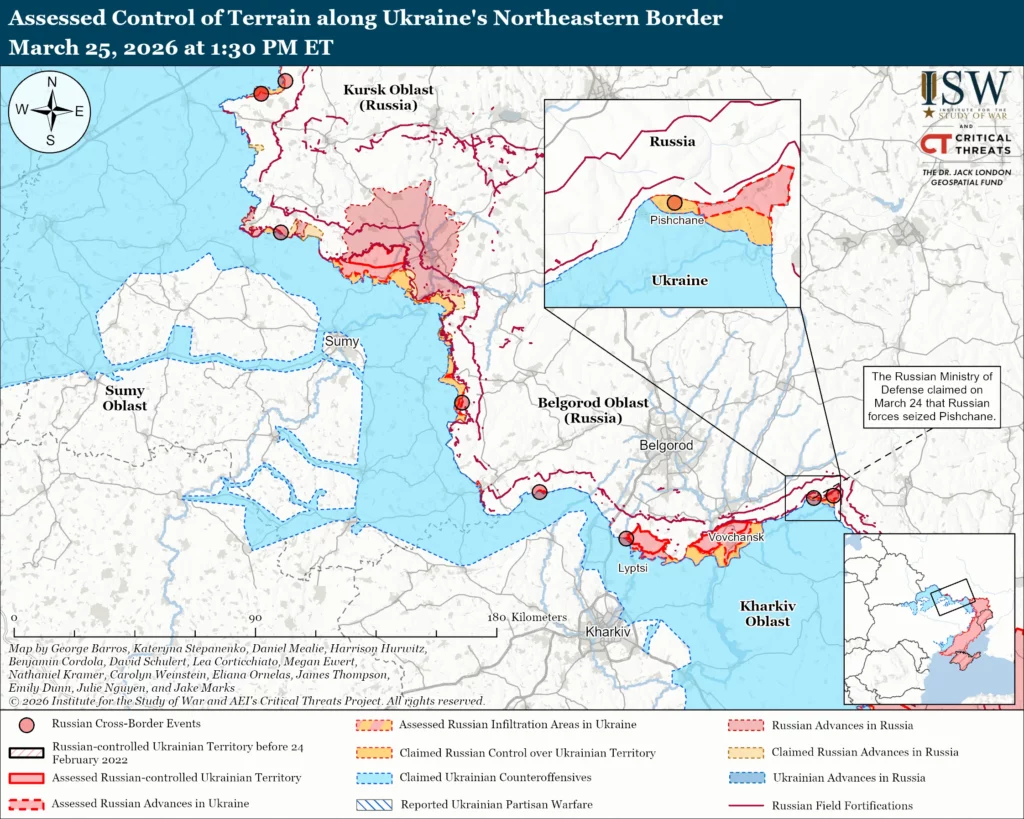
Unconfirmed claims: The Russian Ministry of Defense (MoD) claimed on March 24 that elements of the Russian 69th Motorized Rifle Division (6th Combined Arms Army [CAA], Leningrad Military District [LMD]) seized Pishchane (northeast of Kharkiv City).[35]
Russian forces attacked northeast of Kharkiv City near Vovchansk, Pishchane, Vovchanski Khutory, Starytsya, Vilcha, Hrafske, and Nesterne and toward Okhrimivka, Verkhnya Pysarivka, and Zybyne on March 24 and 25.[36]
Ukrainian forces continue to expand the “kill zone” in northern Kharkiv Oblast to deny Russian forces the ability to infiltrate and conduct mechanized assaults. The “kill zone” refers to an area of elevated drone strike risk. A servicemember of the Ukrainian Border Guard Service operating in the South Slobozhansk (Kharkiv) direction reported on March 25 that Russian forces are only trying to infiltrate and are not conducting mechanized assaults.[37] The servicemember stated that Russian forces have to travel two to 10 kilometers on foot before attacking and that these attacks depend on the terrain and their proximity to the Russian border. The spokesperson of a Ukrainian brigade operating in the Vovchansk direction reported on March 24 that Russian forces are trying to imitate Ukrainian tactics using more unmanned ground vehicles (UGVs) as the “kill zone” is growing, making movement in vehicles dangerous.[38] The spokesperson noted that Russian forces are still using more motorcycles and infantrymen to transport supplies. The spokesperson added that Russian forces are pulling equipment further away from the frontline, including into Belgorod Oblast, to protect equipment from Russian strikes.
Order of Battle: Drone operators of the Russian Chechen Akhmat Spetsnaz Vakha Battalion (204th Akhmat Spetsnaz Regiment), the 45th Spetsnaz Brigade of the Russian Airborne Forces (VDV), the Rubezh Reconnaissance-Assault Brigade (Russian Volunteer Corps), and the Chechen Akhmat Spetsnaz Khokhla Detachment of the Shatun Group (204th Akhmat Spetsnaz Regiment) are reportedly striking Ukrainian forces in the Kharkiv direction.[39]
Neither Ukrainian nor Russian sources reported ground activity in the Velykyi Burluk direction on March 25.
Russian Subordinate Main Effort #2 – Oskil River
Russian objective: Cross the Oskil River in Kharkiv Oblast and push westward into eastern Kharkiv Oblast and northern Donetsk Oblast
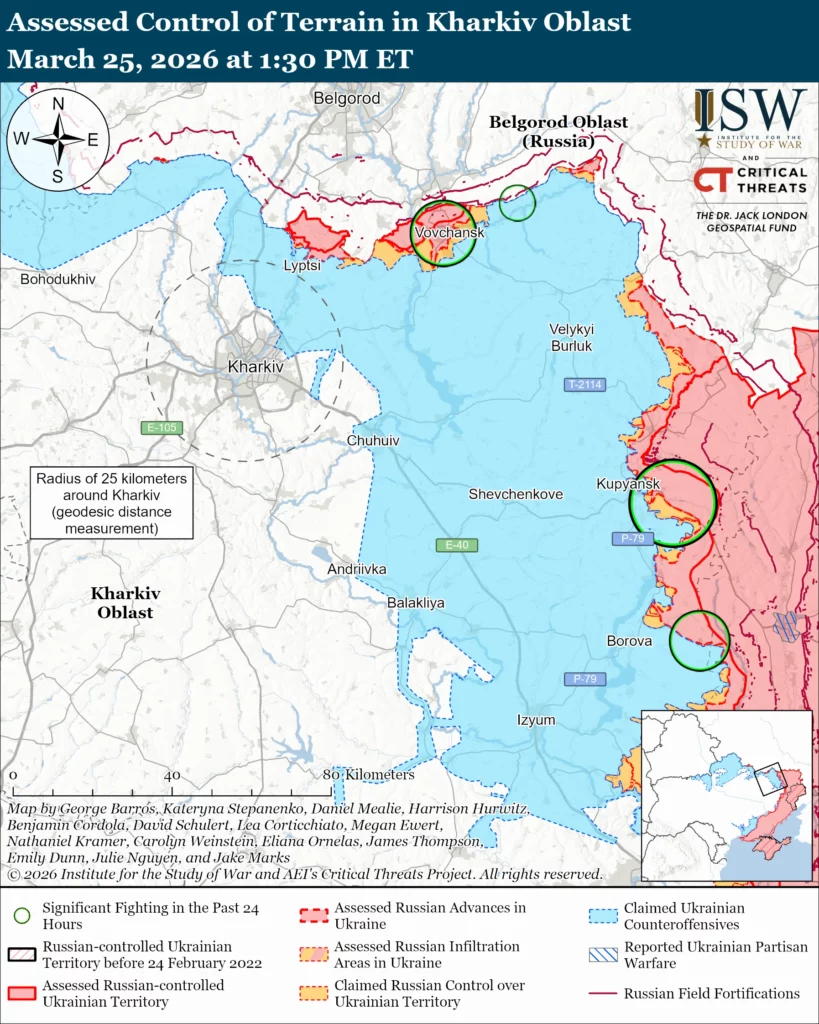
Russian forces continued offensive operations in the Kupyansk direction on March 25 but did not make confirmed advances.
Unconfirmed claims: A Russian milblogger claimed that Russian forces advanced east of Hlushkivka (southeast of Kupyansk).[40]
Russian forces attacked east of Kupyansk near Petropavlivka and southeast of Kupyansk near Kurylivka, Podoly, and Pishchane, and toward Kivsharivka and Novoosynove on March 24 and 25.[41]
Order of Battle: Elements of the Russian 47th Tank Division (1st Guards Tank Army [GTA], Moscow Military District [MMD]) are reportedly operating near Pishchane.[42]
Russian forces continued offensive operations in the Borova direction on March 25 but did not advance.
Russian forces attacked north of Borova toward Novoplatonivka, east of Borova near Kopanky, southeast of Borova near Tverdokhlibove, and south of Borova near Serednie on March 24 and 25.[43]
Order of Battle: Ukrainian military observer Kostyantyn Mashovets reported that elements of the Russian 3rd Motorized Rifle Division (20th Combined Arms Army [CAA], MMD) are attacking from the Katerynivka-Hrekivka line (southeast of Borova).[44]
Russian Subordinate Main Effort #3 – Donetsk Oblast
Russian objective: Capture the entirety of Donetsk Oblast, the claimed territory of Russia’s proxies in Donbas, and advance into Dnipropetrovsk Oblast
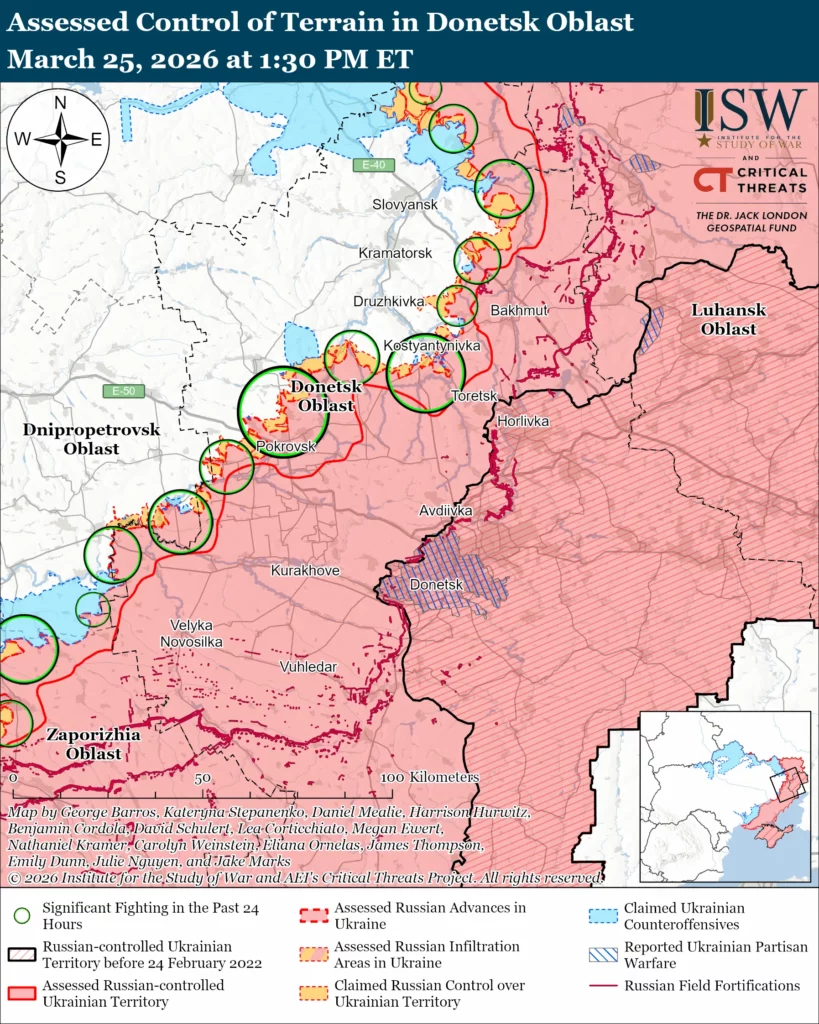
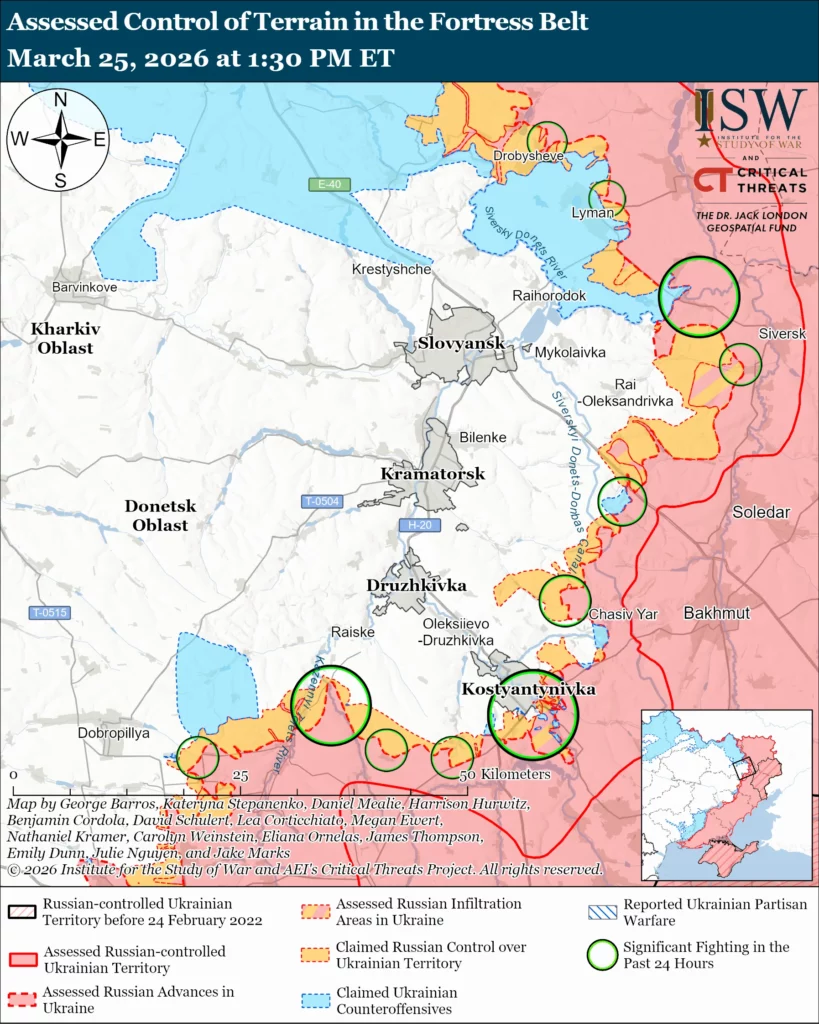
Russian forces recently infiltrated in the Slovyansk direction.
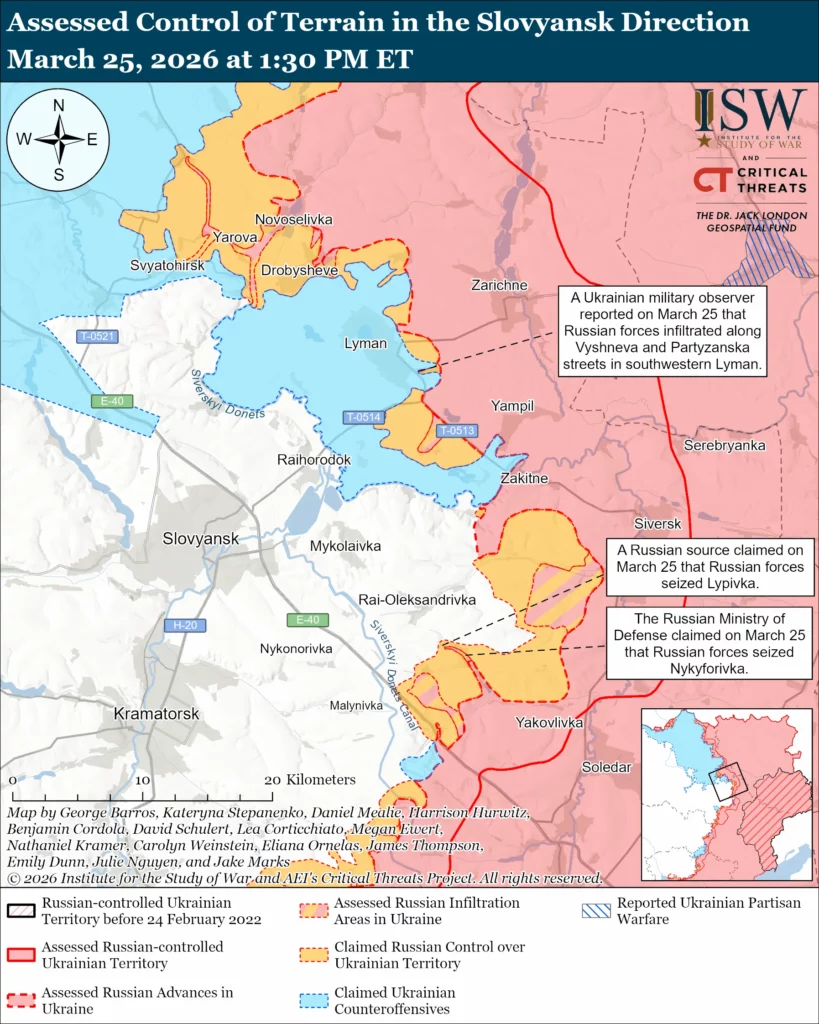
Assessed Russian infiltrations: Ukrainian military observer Kostyantyn Mashovets reported that small Russian infantry groups have infiltrated from Zarichne (northeast of Lyman) toward Lyman and into Lyman’s southeastern outskirts.[45]
Unconfirmed claims: The Russian Ministry of Defense (MoD) claimed that Russian forces seized Nykyforivka (southeast of Slovyansk).[46] A Russian milblogger claimed that Russian forces seized Lypivka (southeast of Slovyansk).[47] Another Russian milblogger claimed that Russian forces advanced south of Kalenyky and southwest of Riznykivka (both east of Slovyansk).[48]
Russian forces attacked near Lyman itself; northeast of Lyman near Drobysheve and Yarova; east of Lyman near Ozerne; southeast of Lyman near Yampil; east of Slovyansk near Zakitne, Riznykivka, and Platonivka, and toward Rai-Oleksandrivka; and southeast of Slovyansk near Pazeno, Fedorivka Druha, and Lypivka on March 24 and 25.[49]
Ukrainian military observers and officials reported more details about the mechanized and motorized assault Russian forces conducted in the Borova and Lyman directions between March 17 to 19 as part of the start of the Russian spring-summer offensive. Mashovets reported that Russian forces attacked in at least six areas with 25 to 28 total armored vehicles and up to 90 to 95 motorcycles, all-terrain vehicles (ATVs), and buggies.[50] Mashovets reported that Russian forces attacked from the Borivska Andriivka (northeast of Borova) area toward Novoplatonivka (northwest of Borivska Andriivka) and Borova; from the Pershotravneve area (east of Borova) toward Shyikivka (southwest of Pershotravneve); from the Hrekivka (southeast of Borova) area toward Druzhelyubivka (northwest of Hrekivka); from the Serednie (south of Borova) area toward Oleksandrivka (west of Serednie); from the Shandryholove and Derylove (both northwest of Lyman) area toward Drobysheve (south of Derylove); and from the Kolodyazi (northeast of Lyman) area toward Stavky (southwest of Kolodyazi). The commander of a Ukrainian unmanned systems battalion operating in the Lyman direction reported that Russian forces undertook standard “textbook” preparations for their spring-summer campaign, striking Ukrainian logistics with drones and guided glide bombs.[51] The commander noted that Russian forces struck crossings and dams along the Siverskyi Donets River to try to prevent Ukrainian forces from being able to reach Lyman. The commander assessed that Russian forces had turned to conducting relatively “massive” mechanized assaults as their small group infiltration missions into Lyman had been unsuccessful. A spokesperson of a Ukrainian brigade operating in the Slovyansk direction stated that Russian forces are probing Ukrainian defenses to prepare for future offensive operations in the Kryva Luka (east of Slovyansk) and Zakitne directions now that warmer weather conditions have started.[52] The spokesperson noted that drier soil in warmer weather allows Russian forces to use mechanized equipment. The spokesperson stated that Russian forces have varied levels of training, with forward small groups only trained for infiltration missions and other forces having more specialized training.
Order of Battle: Mashovets reported that elements of the Russian 144th Motorized Rifle Division (20th Combined Arms Army [CAA], Moscow Military District [MMD]) and of the 2nd Guards Motorized Rifle Division (1st Guards Tank Army [GTA], MMD) are attacking in the Shandryholove-Drobysheve and Novoselivka-Yarova directions (both northwest of Lyman).[53] Drone operators of the 2nd Artillery Brigade (3rd CAA, formerly 2nd Luhansk People’s Republic Army Corps [LNR AC], Southern Military District [SMD]) are reportedly striking Ukrainian shelters in the Slovyansk direction.[54]
Ukrainian forces recently advanced in the Kostyantynivka-Druzhkivka tactical area.
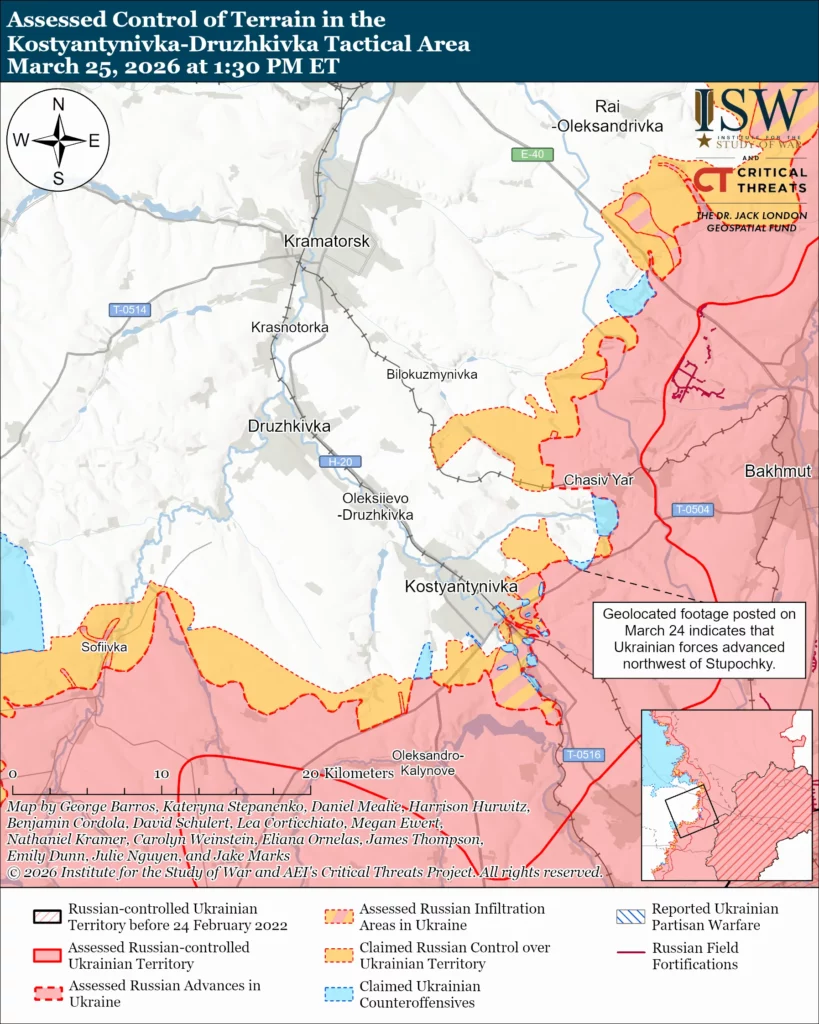
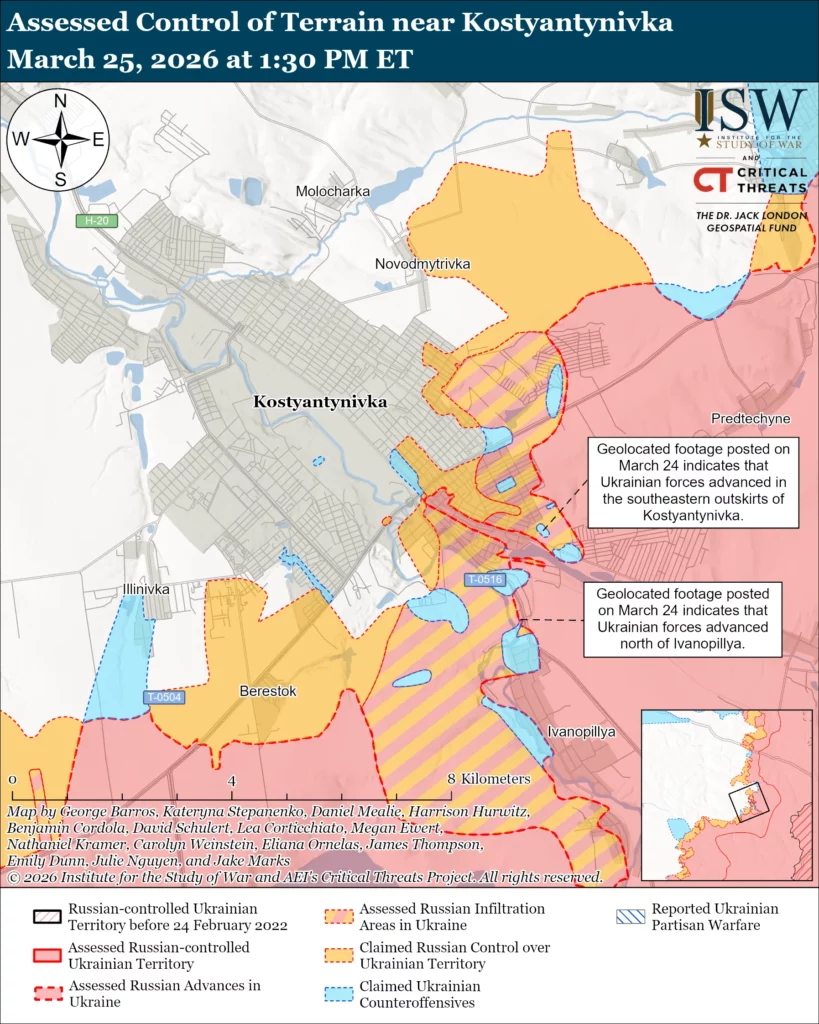
Assessed Ukrainian advances: Geolocated footage published on March 24 indicates that Ukrainian forces recently advanced in southeastern Kostyantynivka, north of Ivanopillya (south of Kostyantynivka), and northwest of Stupochky (northeast of Kostyantynivka).[55]
Unconfirmed claims: A Russian milblogger claimed that Russian forces advanced northwest of Holubivka (northeast of Kostyantynivka).[56]
Refinement of areas under Russian claims: Geolocated footage published on March 24 shows Russian forces striking a Ukrainian position in northeastern Kostyantynivka – an area where Russian sources previously claimed that Russian forces maintained positions.[57]
Russian forces attacked near Kostyantynivka itself; north of Kostyantynivka near Vyrolyubivka; northeast of Kostyantynivka near Minkivka and Malynivka; southeast of Kostyantynivka near Oleksandro-Shultyne; south of Kostyantynivka near Pleshchiivka, Ivanopillya, Berestok, and Illinivka; southwest of Kostyantynivka near Stepanivka; south of Druzhkivka near Rusyn Yar; and southwest of Druzhkivka near Novopavlivka and Sofiivka on March 24 and 25.[58]
Order of Battle: Drone operators of the Russian Rubikon Center for Advanced Unmanned Technologies are striking Ukrainian forces in Kostyantynivka and Oleksiievo-Druzhkivka (just south of Druzhkivka).[59] Drone operators and artillery elements of the 13th Rusichi Assault Detachment of the 1194th Motorized Rifle Regiment (4th Motorized Rifle Brigade, 3rd CAA); the 1307th, 1008th, and 1442nd motorized rifle regiments (all three of the 6th Motorized Rifle Division, 3rd AC, under operational control of the Southern Grouping of Forces); the 72nd Separate Motorized Rifle Brigade (3rd AC); the Gorynych Anti-Terrorist Detachment (Federal Security Service [FSB] Presidential Regiment); and the 4th Motorized Rifle Brigade (3rd CAA) are striking Ukrainian forces in Kostyantynivka.[60] First-person view (FPV) drone operators of the 57th Motorized Rifle Regiment (20th Guards Motorized Rifle Division, 8th CAA, SMD) are reportedly intercepting Ukrainian drones near Novotoretske (southwest of Kostyantynivka) and striking Ukrainian drone antennas near Sofiivka (north of Druzhkivka).[61] Drone operators of the 255th Motorized Rifle Regiment (20th Guards Motorized Rifle Division) are reportedly operating in the Kostyantynivka direction.[62]
Russian forces continued offensive operations in the Dobropillya tactical area on March 25 but did not advance.
Russian forces attacked east of Dobropillya near Toretske, Novyi Donbas, and Nove Shakhove and southeast of Dobropillya near Zapovidne on March 24 and 25.[63]
Order of Battle: Elements of the Russian 263rd Separate Reconnaissance Battalion of the 55th Naval Infantry Division (Pacific Fleet, newly formed from the 155th Naval Infantry Brigade) are reportedly operating in the Dobropillya tactical area.[64]
Russian forces continued offensive operations in the Pokrovsk direction on March 25 but did not advance.
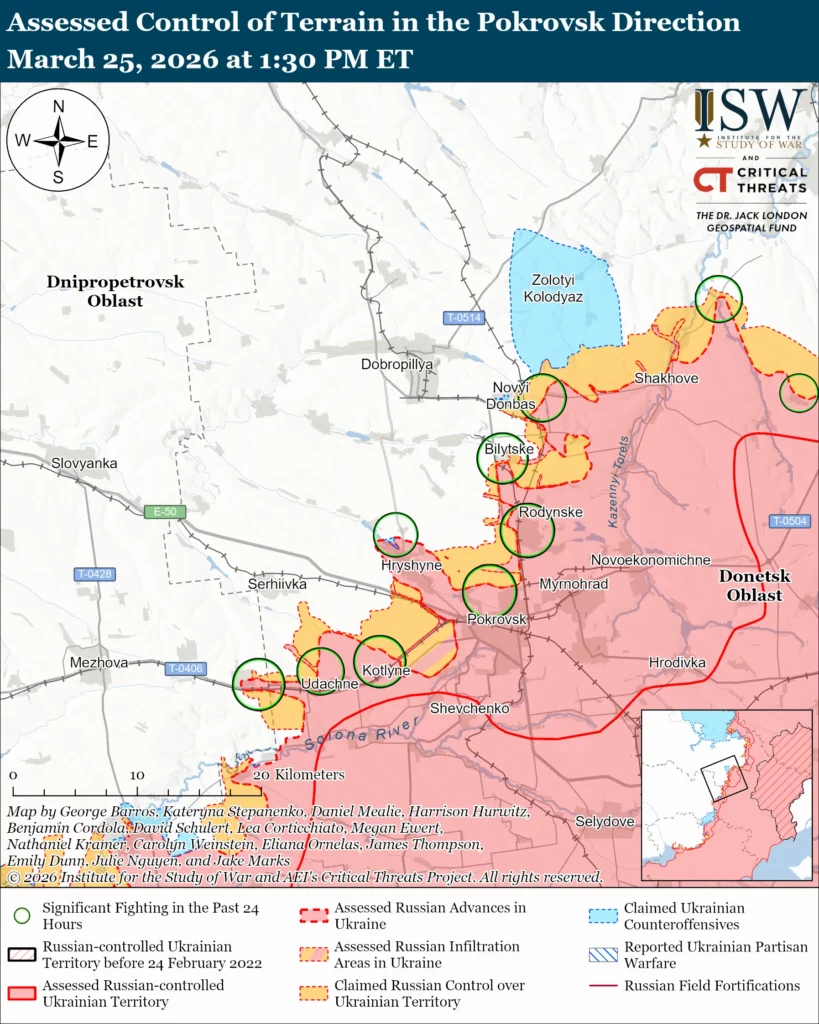
Russian forces attacked near Pokrovsk itself; northwest of Pokrovsk near Hryshyne and toward Novooleksandrivka and Shevchenko; north of Pokrovsk near Rodynske and Bilytske; east of Pokrovsk near Myrnohrad; and southwest of Pokrovsk near Udachne, Molodetske, Kotlyne, and Novopidhorodne on March 24 and 25.[65]
The Russian military command reportedly deployed reinforcements to the Pokrovsk direction. A spokesperson for a Ukrainian brigade operating in the Pokrovsk direction stated on March 25 that the Russian military command has been deploying reinforcements to the area over the past two weeks (since roughly March 11) and has been creating assault groups of 15 to 20 people.[66] The spokesperson stated that the reinforcements have poor training and that Russian forces have also started to increase their use of vehicles, motorcycles, and all-terrain vehicles (ATVs).
Order of Battle: Elements of the Russian Smuglyanka Detachment and Rubikon Center for Advanced Unmanned Technologies are reportedly supporting strikes against Ukrainian drone operators west of Pokrovsk.[67]
Russian forces continued offensive operations near Novopavlivka itself; northeast of Novopavlivka near Novomykolaivka; southeast of Novopavlivka near Horikhove; and south of Novopavlivka near Filiya on March 24 and 25 but did not advance.[68]
Order of Battle: Elements of the Russian 400th Self-Propelled Artillery Regiment (90th Tank Division, 41st CAA, Central Military District [CMD]) are reportedly operating in the Dnipropetrovsk direction, likely referring to the Novopavlivka direction.[69]
Russian forces continued offensive operations in the Oleksandrivka direction on March 25 but did not advance.
Russian forces attacked east of Oleksandrivka near Oleksandrohrad and southeast of Oleksandrivka near Krasnohirske, Zlahoda, and Ternove, and toward Pryvillya on March 24 and 25.[70]
Order of Battle: Drone operators of the Russian 14th Spetsnaz Brigade (Russian General Staff’s Main Directorate [GRU]) are reportedly striking Ukrainian forces near Kolomiitsi (east of Oleksandrivka).[71]
Ukrainian forces continue mid-range strikes against Russian military assets in occupied Donetsk Oblast. The Ukrainian General Staff reported that Ukrainian forces struck Russian communication nodes near occupied Velyka Novosilka (about 21 kilometers from the frontline) and Hirnyk (one of multiple settlements between 33 and 118 kilometers from the frontline) on the night of March 24 to 25.[72] A Russian milblogger and former Storm-Z instructor claimed on March 25 that Ukrainian forces are using German-produced autonomous drones to target Russian ground lines of communication (GLOCs) on the highways around occupied Donetsk City (about 50 kilometers from the frontline).[73]
Russian Supporting Effort: Southern Axis
Russian objective: Maintain frontline positions, secure rear areas against Ukrainian strikes, and advance within tube artillery range of Zaporizhzhia City
Russian forces recently advanced in the Hulyaipole direction.
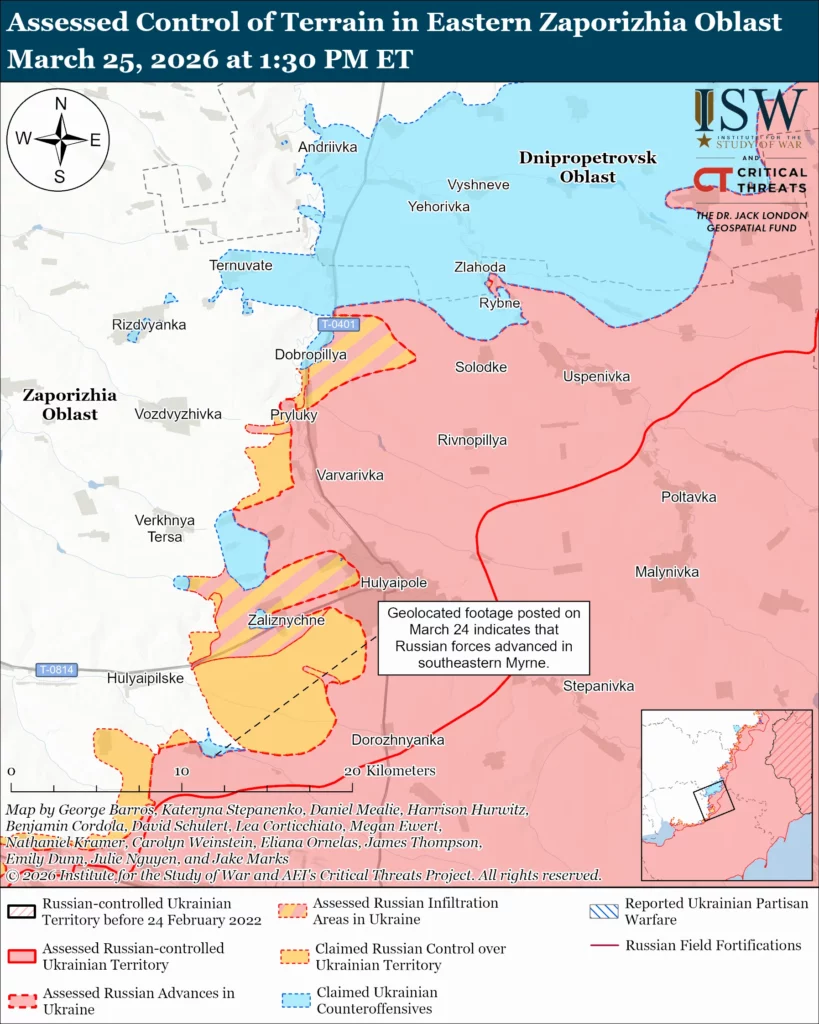
Assessed Russian advances: Geolocated footage published on March 24 indicates that Russian forces recently advanced in southern Myrne (southwest of Hulyaipole).[74]
Russian forces attacked near Hulyaipole itself; northwest of Hulyaipole near Olenokostyantynivka and toward Verkhnya Tersa and Vozdvyzhivka; north of Hulyaipole near Dobropillya and Varvarivka; southwest of Hulyaipole near Myrne; and west of Hulyaipole near Zaliznychne and toward Hulyaipilske and Staroukrainka on March 24 and 25.[75] A Russian milblogger claimed that Ukrainian forces counterattacked near Myrne, Novoselivka (southwest of Hulyaipole), and Hirke (west of Hulyaipole).[76]
Order of Battle: Drone operators of the Russian 14th Spetsnaz Brigade (Russian General Staff’s Main Directorate [GRU]) are reportedly striking Ukrainian supply lines, personnel, and equipment near Dolynka (northwest of Hulyaipole) and Vozdvyzhivka.[77] Elements of the 218th Tank Regiment (127th Motorized Rifle Division, 5th Combined Arms Army [CAA], Eastern Military District [EMD]) are reportedly striking Ukrainian forces near Dolynka.[78] Elements of the 38th Motorized Rifle Brigade (35th CAA, EMD) are reportedly operating in Zaporizhia Oblast, likely referring to the Hulyaipole direction.[79]
Russian forces continued offensive operations in western Zaporizhia Oblast on March 25 but did not advance.
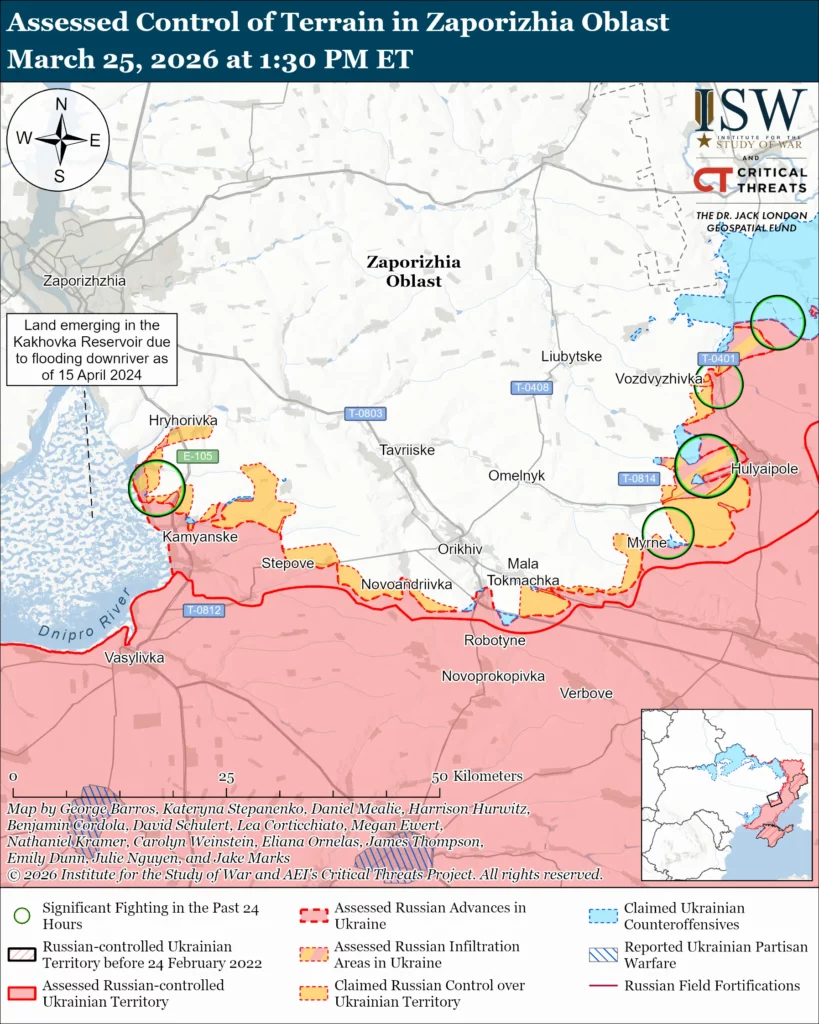
Russian forces attacked west of Orikhiv near Stepnohirsk and northwest of Orikhiv near Prymorske, Lukyanivske, and Novoboikivske, and toward Novoyakovlivka and Pavlivka on March 24 and 25.[80]
Ukrainian forces continue to target Russian military assets and logistics in occupied Zaporizhia Oblast. The Ukrainian General Staff reported that Ukrainian forces struck a Russian communications node near occupied Fedorivka (roughly 25 kilometers from the frontline) on the night of March 24 to 25.[81] The commander of a Ukrainian unmanned systems regiment operating in the Zaporizhia direction reported on March 25 that Ukrainian forces are conducting counterbattery and striking Russian ground lines of communication (GLOCs).[82] The commander noted that Ukrainian forces recently destroyed a Russian Buk air defense system, fuel and lubricants depots, and two trains carrying fuel, weapons, and ammunition.
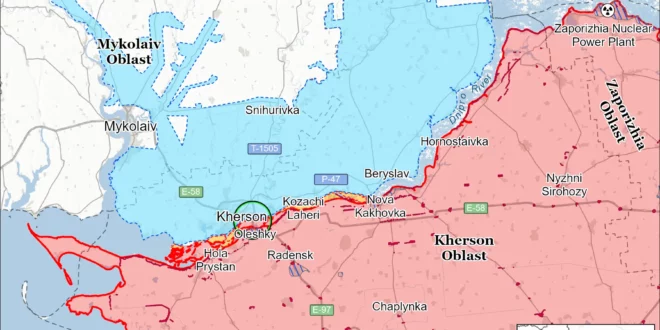
Russian forces continued limited ground attacks east of Kherson City near the Antonivskyi Bridge on March 25 but did not advance.[83]
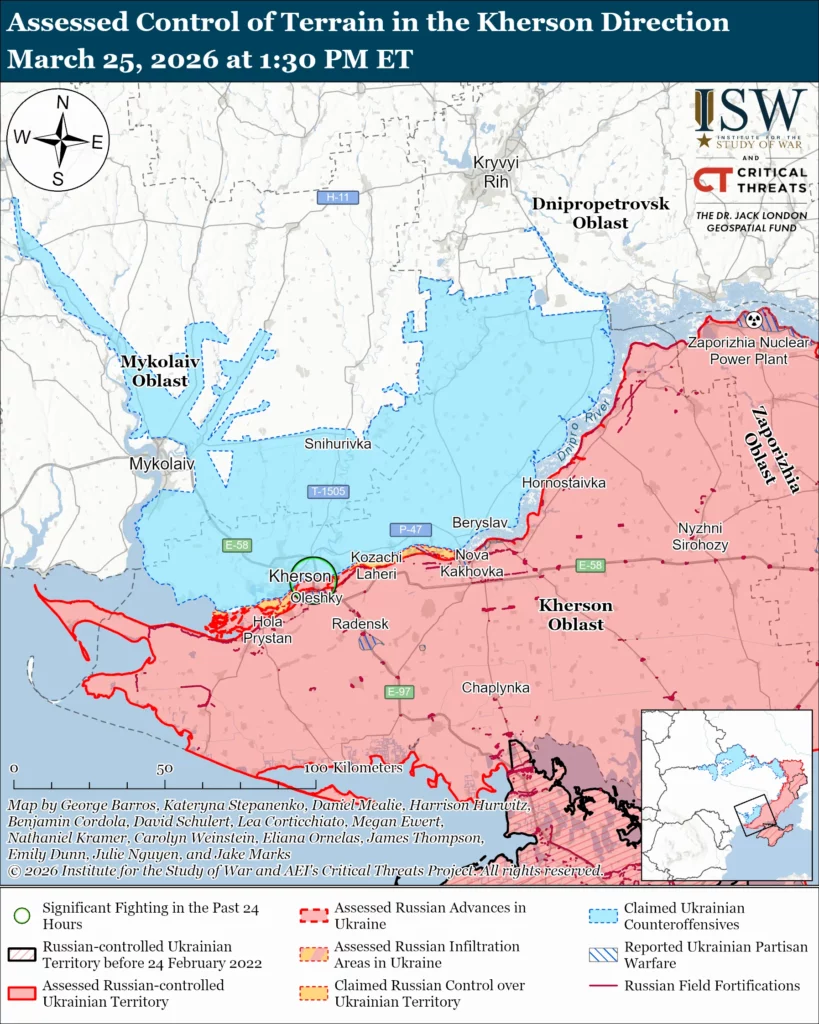
Order of Battle: Drone operators and artillery elements of the Russian 98th Airborne (VDV) Division are reportedly striking Ukrainian forces in the Kherson direction.[84] Drone operators of the 4th Military Base (58th CAA, Southern Military District [SMD]) are reportedly intercepting Ukrainian drones in the Kherson direction.[85]
Russian Air, Missile, and Drone Campaign
Russian Objective: Target Ukrainian military and civilian infrastructure in the rear and on the front line
Russian forces conducted a series of long-range drone strikes against Ukraine on the night of March 24 to 25. The Ukrainian Air Force reported that Russian forces launched 147 Shahed-type, Gerbera-type, Italmas-type, and other drones – of which roughly 80 were Shaheds – from the directions of Oryol, Kursk, and Bryansk cities; Millerovo, Rostov Oblast; Primorsko-Akhtarsk, Krasnodar Krai; and occupied Hvardiiske, Crimea.[86] The Ukrainian Air Force reported that Ukrainian forces downed 121 drones, that 24 drones struck 18 locations, and that drone debris fell on three locations. Ukrainian officials reported that Russian forces struck residential and energy infrastructure in Kharkiv, Odesa, Poltava, and Kyiv oblasts.[87] Ukrainian officials reported that Russian strikes cut power to roughly 161,000 subscribers in Odesa, Poltava, Sumy, Kharkiv, Kyiv, and Chernihiv oblasts.[88] Ukrainian officials reported that Russian strikes on the morning of March 25 damaged energy infrastructure in Chernihiv and Kyiv oblasts.[89]
Significant Activity in Belarus
Russian efforts to increase its military presence in Belarus and further integrate Belarus into Russian-favorable frameworks
Belarus continues to increase cooperation with North Korea. Belarusian President Alexander Lukashenko met with North Korean dictator Kim Jong-Un and North Korean First Deputy Prime Minister Kim Tok Hun on March 25 during Lukashenko’s official visit to North Korea to discuss areas for new bilateral cooperation.[90] Belarusian Foreign Minister Maxim Ryzhenkov told journalists on March 25 that Belarus and North Korea intend to sign a friendship and cooperation agreement during Lukashenko’s visit.[91] Ryzhenkov stated that the parties intend to sign about 10 agreements to strengthen the legal framework of bilateral cooperation, including a fundamental friendship treaty and nine agreements covering agricultural, education, healthcare, commerce, industry, scientific, and information cooperation.
Note: ISW does not receive any classified material from any source, uses only publicly available information, and draws extensively on Russian, Ukrainian, and Western reporting and social media as well as commercially available satellite imagery and other geospatial data as the basis for these reports. References to all sources used are provided in the endnotes of each update.