 Eurasia Press & News
From a jewel in Vladimir Putin’s imperial crown to a thorn in his side, the 2014 conquest of Crimea is coming back to haunt him as Russia’s war in Ukraine falters.
Russian-installed authorities in Crimea declared an “emergency situation” on June 26, after Ukrainian attacks helped produce fuel shortages, power cuts and restrictions on civilian life across the occupied Black Sea peninsula.
Civilian gasoline sales had already been suspended, with Sergey Aksyonov, the Kremlin-appointed head of Crimea, saying fuel would go only to government agencies.
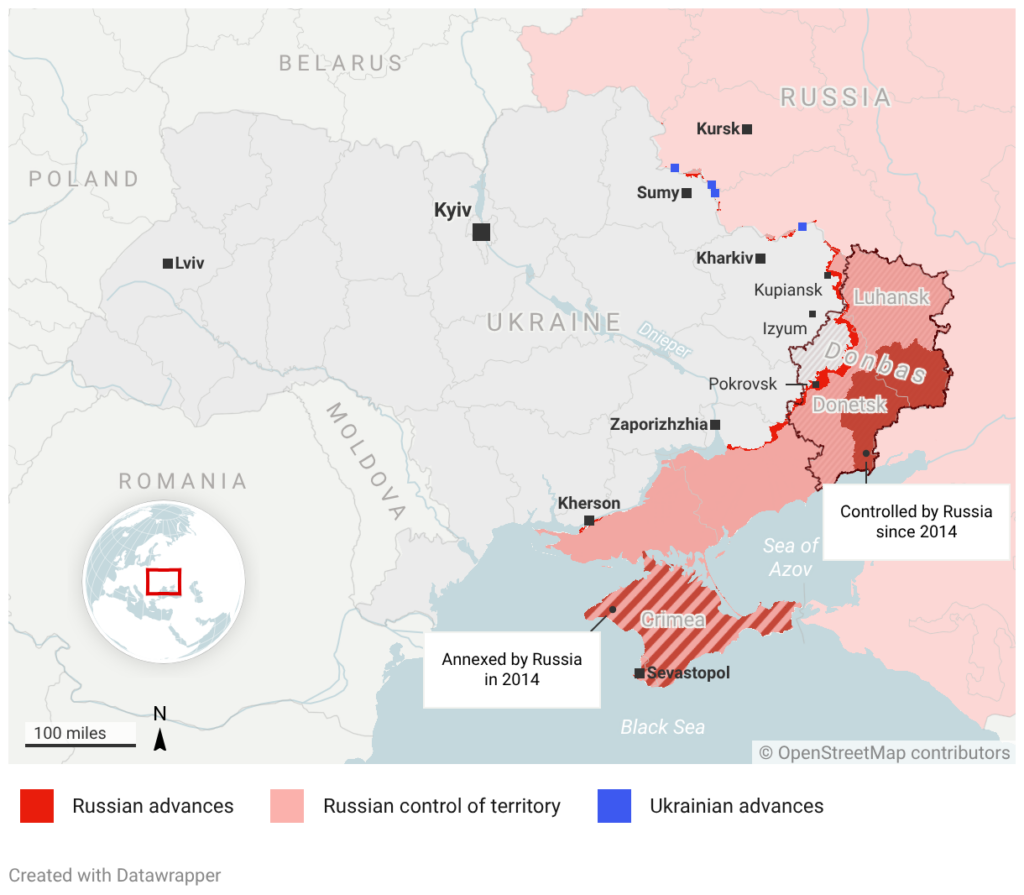
Putin then acknowledged a fuel deficit in Russia, while promising more air defenses, more repairs, and more deliveries to Crimea, which hosts Russia’s only warm-water naval base.
Kyiv still seeks to retake Crimea from Russia, a goal many Western analysts see as unattainable for Ukraine. But Crimea is becoming Putin’s trap: too symbolic to abandon, too exposed to use as he once did, and too costly to normalize.
Here are five scenarios for how Putin’s Crimea crisis may play out from here.
- Putin Fortifies Crimea and Makes Russians Pay for It
Putin said Russia would increase fuel imports, speed repairs at oil facilities and boost deliveries to Crimea by land and sea.
This is the most likely immediate scenario because it matches his governing style: absorb costs, centralize control, deny that battlefield pressure is changing the political picture.
The trouble is that fortification does not restore normal life. Crimea has already suspended fuel sales to private motorists, and Sevastopol introduced restrictions on public transport, shops, cafes, and street lighting.
A fortress can be defended while becoming a miserable place to govern. For Putin, that makes Crimea less like a crown jewel and more like a recurring invoice.
He can keep the peninsula supplied by prioritizing military, police and emergency services over civilians. He can also push the message that hardship proves Russia is under attack.
Yet every rationing rule quietly revises the annexation story he sold to the peninsula’s ethnic Russians—and, crucially, to his own society.
Crimea was supposed to be the easy triumph of 2014, pushing at an open door and unlocking an economic engine.
But in this scenario, it becomes a defended dependency, more of a financial burden on the Kremlin and under-pressure Russian taxpayers than a lucrative prize.
- Ukraine Makes Crimea an Island Without Taking It
Ukraine’s Ministry of Defence said in early June that the R-280 route connecting Rostov-on-Don to occupied Crimea had been brought under Ukrainian fire control.
The ministry described that route as the main land corridor for fuel, ammunition, and equipment for Russia’s southern grouping of forces.
This scenario does not require Ukraine to storm the peninsula. It requires Ukraine to keep making Crimea unreliable as a logistics hub, isolating it.
Ukrainian officials have described strikes on Russian logistics, depots, headquarters, air defense systems, and other rear-area targets as a systematic effort, and recent attacks have hit fuel facilities, power infrastructure and transport links in Crimea.
The counterintuitive outcome would be a Crimea Russia still occupies but can no longer confidently use.
For Putin’s war strategy, that would be damaging in the south even without a dramatic Ukrainian breakthrough.
But for Putin’s leadership, it would be worse: a leader who built legitimacy on control would be forced to explain why his most famous prize needs emergency management from Moscow.
- Moscow Escalates Elsewhere To Prove Crimea Is Untouchable
Putin told Russian state television that Ukrainian strikes were meant to split Russian society and force Moscow into negotiations on Kyiv’s terms.
He also rejected a Ukrainian proposal to limit deep strikes and restrict fighting to the four regions Russia claims but does not fully control.
In this scenario, Russia responds to Crimea pressure by widening punishment against Ukraine rather than changing course in Crimea.
Russian missiles and drones killed at least 12 civilians and injured 40 in Ukraine on June 29, and Russia attacked Ukraine overnight with more than 500 long-range drones and missiles, according to Ukraine’s air force.
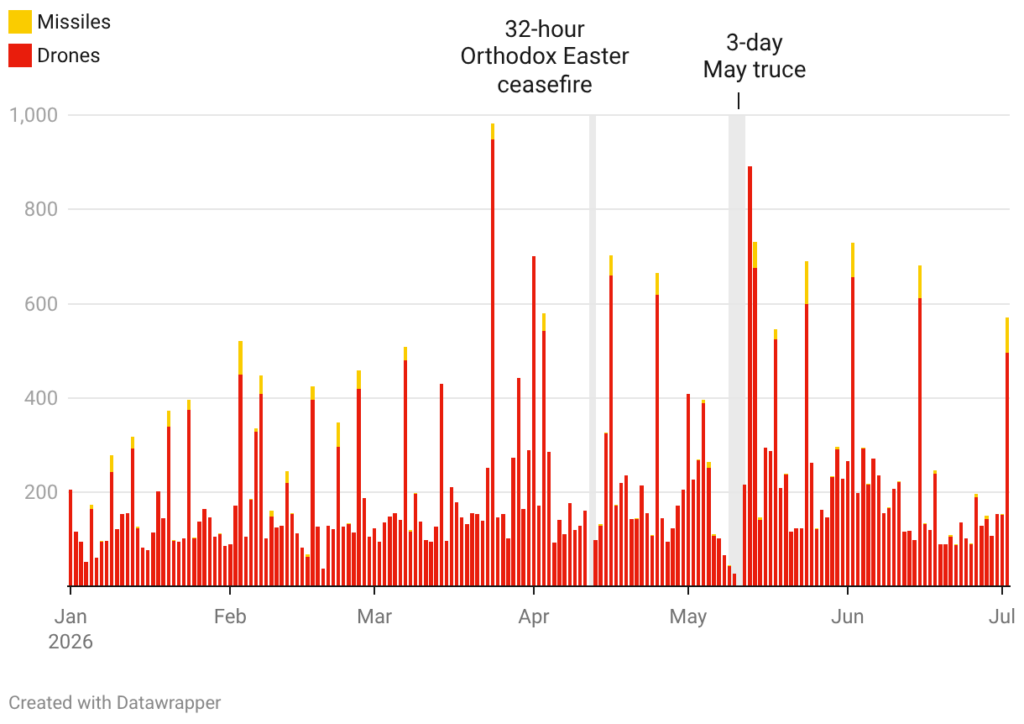
This is the grim logic of the trap. Crimea pressure may not make Putin softer. It may make him more invested in showing that pressure cannot dictate Russian behavior.
The military effect of striking Ukrainian cities does not solve Crimea’s fuel and logistics problem.
The political effect, though, is different. It lets Putin posture as the unstoppable side imposing pain, even while Crimea exposes the limits of Russian protection.
- Crimea Becomes the Poison Pill in Any Deal
This scenario is a diplomatic freeze that leaves Crimea under Russian control without truly settling the question of sovereignty. Russia has integrated Crimea, but it lacks international recognition of its control there, something Putin wants to change.
The United Nations General Assembly adopted Resolution 68/262 on March 27, 2014, affirming Ukraine’s territorial integrity by a vote of 100-11, with 58 abstentions, after Russia moved in to take Crimea.
NATO describes Russia’s 2014 seizure of Crimea as an illegal and illegitimate annexation of Ukrainian territory.
Ukraine’s language has shifted little on Crimea, which Kyiv still regards as its territory, emphasizing that it will keep working to bring the peninsula back under its control, even as Russia integrates it with the mainland, such as via the Kerch Bridge.
Kyiv’s current Crimea campaign is partly military pressure, but it is also political messaging. President Volodymyr Zelensky has said Ukraine is striking targets that sustain Russia’s war effort in “temporarily occupied” territory and inside Russia.
“I believe our people in the temporarily occupied territories understand everything clearly—in the south of our country, in Crimea, in Donetsk and Luhansk regions,” Zelensky said in a June 24 address.
“We do not allow Russia to use our land as a tool for prolonging the war or turning occupation into something endless.”
For Putin, the trap is that Crimea is both the easiest territory for him to defend rhetorically and the hardest to bargain over openly.
He cannot trade it without damaging the myth of restoration. He cannot fully normalize it while Ukrainian drones keep forcing emergency rules.
The result could be a deal that postpones Crimea rather than resolves it. A frozen Crimea would freeze the war’s central contradiction, too.
- Crimea Hurts Putin Without Toppling Him
The strongest argument against the Crimea trap thesis is simple: Putin has survived many shocks before.
Putin has ruled out concessions and insisted Russia would prevail despite temporary setbacks, and Kremlin spokesman Dmitry Peskov has repeatedly said Russia’s position on Ukraine remained unchanged.
Russian politics gives the Kremlin tools for suppression, messaging, and delay.
Crimea’s deterioration does not automatically produce a palace coup, a public revolt or a sudden Russian withdrawal from the peninsula. The more plausible leadership risk for Putin is narrower and corrosive.
Fuel shortages have produced long gas-station lines, rationing, and public frustration.
Putin’s public admission that Russia was going through a difficult fuel period is significant because Russian leaders usually prefer to keep the costs of war abstract and obscured.
The leadership danger, then, is credibility leakage.
Putin does not have to lose Crimea for Crimea to weaken him. He only has to keep promising control while Ukrainians keep proving that is expensive, partial, and, most importantly of all, temporary.
Ukraine’s long-range strikes have already pushed Russia into fuel rationing, emergency measures, and public repair promises.
The next test is whether Moscow can restore enough supply and air defense capacity to make Crimea feel governable again.
If it can, Putin’s Crimea trap becomes another attritional burden he carries. If it cannot, the peninsula may remain formally Russian-held while functioning as a Ukrainian pressure point on every Russian choice.
Crimea is still Putin’s possession on the map. Now, it is becoming Ukraine’s lever in the war.