 Eurasia Press & News
Toplines
Ukrainian President Volodymyr Zelensky announced on June 25 that he authorized a 40-day intermediate- and long-range strike campaign to influence Russia to end the war in Ukraine.[1] The Ukrainian Security Service (SBU) reported on June 26 that Ukrainian drones continued strikes against occupied Crimea as part of the 40-day operation, striking the Volga and Vyatka Project 15310 cable ships near the Zatoka shipyard, the Petropavlovsk cargo and passenger ferry, and an S-400 air defense system radar station near occupied Kerch, and that the strikes caused fires on the ships.[2] NASA Fire Information for Resource Management System (FIRMS) data from June 26 shows two heat anomalies at the Zatoka shipyard near occupied Kerch.[3] Ukrainian Unmanned Systems Forces (USF) Commander Major Robert “Magyar” Brovdi reported on June 26 that Ukrainian drones struck a Russian ST-68U radar station near occupied Dzhankoi (roughly 151 kilometers from the frontline), an Imbir radar station near occupied Armyansk (roughly 84 kilometers from the frontline), the NS-2 electrical substation near occupied Mykolaivka (either roughly 200 or 206 kilometers from the frontline), the Tasunove electrical substation near occupied Tasunove (roughly 263 kilometers from the frontline), and the Zakhidno-Krymska electrical substation near occupied Karyerne (roughly 167 kilometers from the frontline).[4] A local Crimean Telegram channel claimed on June 25 and 26 that Ukrainian forces struck a small Russian airfield near occupied Kerch (roughly 282 kilometers from the frontline), a fuel tanker truck near occupied Armyansk, a fuel tanker truck along the A291 Kerch-Sevastopol highway near occupied Hornostaivka (roughly 252 kilometers from the frontline), and a railway near occupied Ichki (roughly 263 kilometers from the frontline).[5]
Crimean occupation officials declared a state of emergency in occupied Crimea amid Ukraine’s intensifying intermediate- and long-range strike campaign targeting logistics into the region. Crimean occupation head Sergey Aksyonov and Sevastopol occupation head Mikhail Razvozhaev jointly announced on June 26 that they had signed decrees declaring regional states of emergency in occupied Crimea primarily to “streamline economic issues.”[6] Aksyonov added that the emergency declarations do not impose curfews or restrictions on movement, but rather allow the occupation governments to bypass typical restrictions and bureaucracy impacting operational management and essential supply purchase. Razvozhaev claimed that the state of emergency declaration will allow the Sevastopol occupation government to restore energy facilities rapidly following Ukrainian drone strikes and to provide financial assistance to residents after power surges damaged their essential appliances.[7]
The Ukrainian strike campaigns are causing fuel shortages, water supply issues, and a widespread exodus from the occupied peninsula. Razvozhaev stated in an interview on June 25 that Crimean occupation authorities are prioritizing allocating fuel reserves to critical sectors such as healthcare, public transport, and other critical facilities, and will resume sales to civilians through QR codes after authorities have accumulated sufficient fuel reserves.[8] Razvozhaev acknowledged that power restrictions have caused some water supply outages. Crimean occupation energy operator Krymenergo claimed on June 25 that Crimea occupation authorities introduced temporary power restrictions to avoid overloading the electrical grid.[9] A Telegram channel that frequently reports on the Kerch Strait Bridge traffic reported that occupation authorities closed the bridge for six hours following Ukrainian drone strikes overnight on June 25 to June 26.[10] The Telegram channel reported that there were long lines of about 2,450 vehicles on the Kerch side of the Kerch Strait Bridge, leaving occupied Crimea, while there were no lines to enter occupied Crimea from the Taman side of the bridge.[11] The people leaving occupied Crimea likely include Russian tourists or residents of occupied Crimea, Russian military and security personnel associated with the Russian Black Sea Fleet (BSF), and occupation administrators. The outflow of these populations from occupied Crimea may generate short-term demographic impacts that could solidify in the longer term if Ukraine’s strike campaign persists.[12]
Russian officials continue to project a facade of stability and control over the Russian economy amid intensifying country-wide gasoline shortages. Russian Deputy Prime Minister Alexander Novak claimed on June 26 that Russia currently has sufficient fuel reserves for the domestic market and is restructuring fuel market logistics to meet the increased demand, but stated that this restructuring will take time.[13] Novak claimed that artificial demands on fuel increased domestic fuel demand by 20 to 30 percent.[14] Novak added that Russian authorities are considering imposing a short-term export ban on diesel for a few months to increase domestic market supply since Russia reportedly has a diesel surplus.[15] Novak reported on June 23 that authorities were considering imposing a temporary ban on diesel exports.[16] Russian President Vladimir Putin signed a decree on June 26 extending the existing ban on Russian oil companies exporting oil and petroleum products at prices complying with G7 and EU price caps until December 31, 2027.[17] Putin implemented this ban in December 2022, and his choice to extend the ban amid ongoing fuel shortages and price spikes in Russia likely intends to signal a belief that Russia does not need to comply with Western sanctions despite ongoing economic difficulties.
Ukrainian Presidential Commissioner for Sanctions Policy Vladyslav Vlasyuk attributed the current Russian economic crisis on June 26 to the decrease in oil and gas revenues, which fell by 30 percent from January to May 2026 compared to the same period in 2025.[18] Vlasyuk noted the increasing Russian budget deficit, public debt, and high military spending as contributing factors to the Russian economic situation. Ukraine’s intensified strike campaign against Russian oil infrastructure and logistics since March 2026 has impacted Russian oil and gas revenues and led to intensified fuel shortages across occupied Ukraine and in many Russian regions.[19] Intensified Ukrainian strikes against Russian oil infrastructure will likely continue exacerbating Russian supply shortages amid increasing demand that the Russian government will not be able to ignore.[20]
Russian Foreign Minister Sergei Lavrov deflected blame onto the United States for the lack of a written agreement following the bilateral August 2025 Alaska Summit.[21] Lavrov asserted on June 26 that US Secretary of State Marco Rubio’s June 25 statement that the United States and Russia did not conclude an agreement and only discussed proposals at the summit, asserting that the statement “raises questions for me [Lavrov] in terms of what we mean by agreement.”[22] Lavrov asserted that “saying there was no agreement seems rather unsubtle” after US representatives allegedly laid out their proposals and Russia agreed to those proposals. Lavrov claimed that the Alaska Summit and continued US statements expressing support for the end of the war “could probably be taken as confirmation that there were American proposals in Alaska that we [Russia] accepted,” but that Rubio’s statement “raises a different question.” Lavrov’s statements claim that the United States, rather than Russia, is to blame for the lack of agreement to come from the Alaska Summit and stalled peace efforts since, and likely intended to do so without directly contradicting Rubio’s statements. Rubio’s June 25 statement contradicts the frequent Kremlin rhetorical lines invoking the existence of alleged “Anchorage agreements” or “Alaska understandings” to advance narratives about Russia’s willingness to negotiate, even though the summit ended without a planned dinner and joint press conference and did not result in any written agreement or joint statement.[23]
Key Takeaways
Ukrainian President Volodymyr Zelensky announced on June 25 that he had authorized a 40-day intermediate- and long-range strike campaign to influence Russia to end the war in Ukraine.
Crimean occupation officials declared a state of emergency in occupied Crimea amid Ukraine’s intensifying intermediate- and long-range strike campaign targeting logistics into the region.
The Ukrainian strike campaigns are causing fuel shortages, water supply issues, and a widespread exodus from the occupied peninsula.
Russian officials continue to project a facade of stability and control over the Russian economy amid intensifying country-wide gasoline shortages.
Russian Foreign Minister Sergei Lavrov deflected blame onto the United States for the lack of a written agreement following the bilateral August 2025 Alaska Summit.
Ukrainian forces continued their long-range strike campaign against Russian industrial infrastructure on the night of June 25 to 26. Russian forces launched seven Iskander-M ballistic missiles and 189 drones against Ukraine overnight.
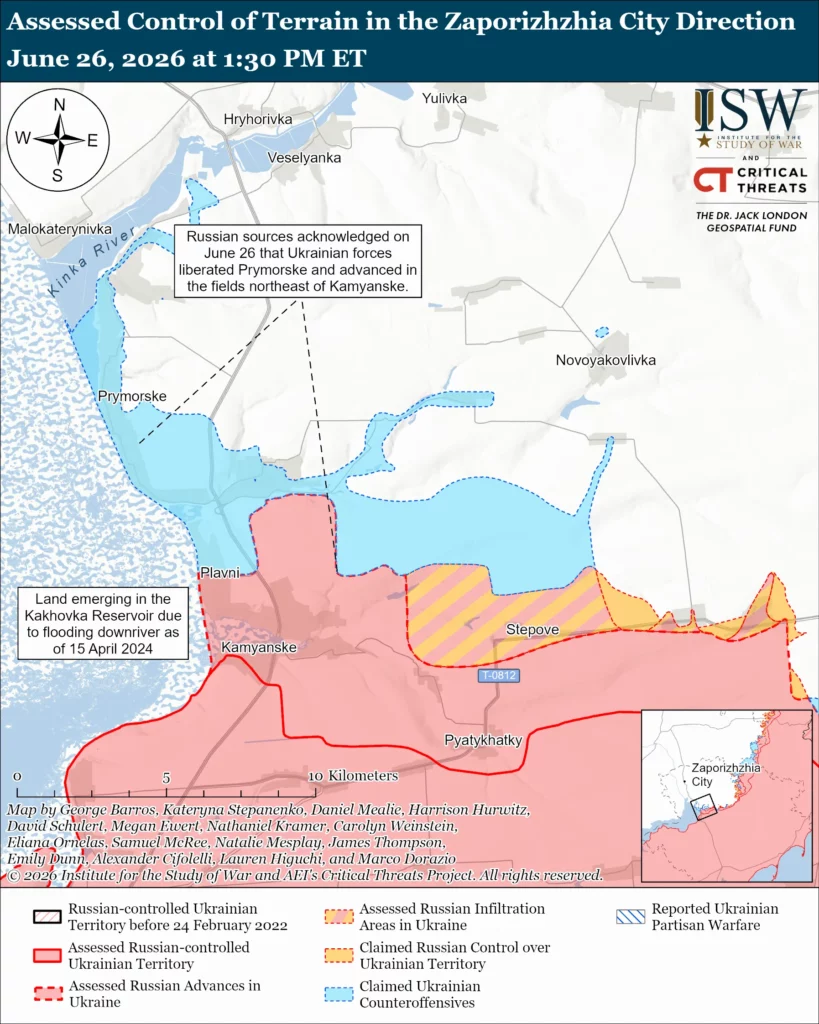
Ukrainian forces recently advanced in western Zaporizhia Oblast.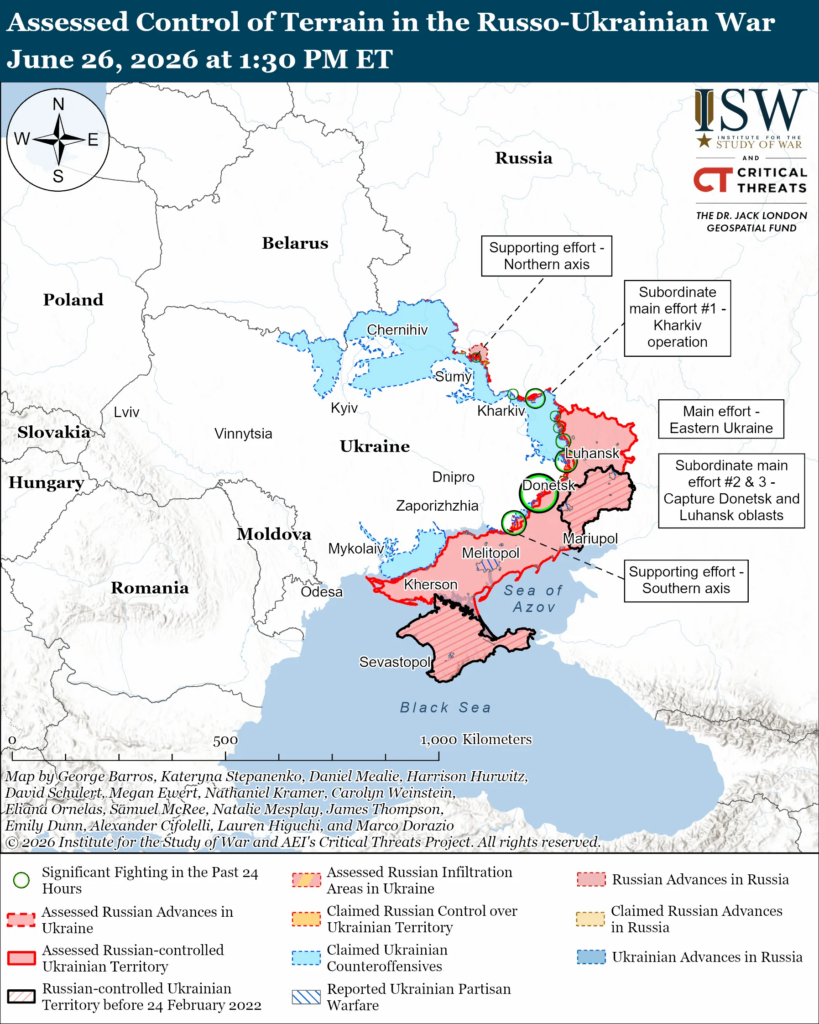
We do not report in detail on Russian war crimes because these activities are well-covered in Western media and do not directly affect the military operations we are assessing and forecasting. We will continue to evaluate and report on the effects of these criminal activities on the Ukrainian military and the Ukrainian population and specifically on combat in Ukrainian urban areas. We utterly condemn Russian violations of the laws of armed conflict and the Geneva Conventions and crimes against humanity even though we do not describe them in these reports.
Ukrainian Operations in the Russian Federation
Ukrainian forces continued their long-range strike campaign against Russian industrial infrastructure on the night of June 25 to 26. Ukrainian broadcaster Suspilne, citing local Russian Telegram channels, reported on June 26 that Ukrainian drones struck the Azot Chemical Plant and the Novomoskovsk State District Power Plant near Novomoskovsk, Tula Oblast.[24] NASA Fire Information for Resource Management System (FIRMS) data for June 26 shows heat anomalies at the Novomoskovsk State District Power Plant.[25] Tula Oblast Governor Dmitry Milyaev confirmed that a Ukrainian drone strike damaged powerlines and an industrial facility in Novomoskovsk.[26] The Russian Ministry of Defense (MoD) claimed on June 26 that Russian forces intercepted 660 Ukrainian drones over Russia on the night of June 25 to 26, and Kremlin newswire TASS claimed that Ukrainian strikes on June 25 to 26 constituted the largest Ukrainian strike package in 2026.[27]
Recent Ukrainian strikes have damaged Russian oil infrastructure and forced a Russian oil refiner to halt operations. Two industry sources told Reuters on June 25 that the Nizhegorodorgsintez Oil Refinery in Kstovo, Nizhny Novgorod Oblast, halted operations on June 24 after a Ukrainian drone strike.[28] Reuters reported that the strike damaged the refinery’s primary CDU-5 refining unit, which accounts for a quarter of the refinery’s total production capacity and has a daily capacity of 12,000 metric tons of oil. Reuters reported that the Nizhegorodorgsintez Oil Refinery is Russia’s fourth largest oil refinery and second-largest gasoline producing refinery with an annual production capacity of 15 million tons of crude oil, five million tons of gasoline, more than five million tons of diesel, two million tons of fuel oil, and about 500,000 tons of bitumen. A Ukrainian open-source intelligence source (OSINT) reported on June 25 that Ukrainian strikes against the Bashneft-Novoil and Bashneft-Ufanaftokhim Oil Refineries in Ufa, Bashkortostan Republic, caused fires at the Bashneft-Novoil ELOU-AVT-6 refinery unit and the Bashneft-Ufanaftokhim AVT-4 refinery unit.[29] The source reported that the Ukrainian strike destroyed a total of 10.5 million tons of annual oil processing capacity. Russian opposition source Astra reported on June 26 that Ukraine’s June 22 strikes on the Voronezh Semiconductor Plant in Voronezh City, Voronezh Oblast, destroyed three production floors and one administrative floor.[30]
Russian authorities may be trying to strengthen Moscow City’s air defense coverage. Radio Free Europe/Radio Liberty (RFE/RL) investigative journalist Mark Krutov posted satellite imagery on June 26 showing a new S-400 air defense station near Moscow State University in Moscow City.[31]
Russian Supporting Effort: Northern Axis
Russian objective: Create defensible buffer zones in Sumy Oblast along the international border
Russian forces continued offensive operations in northern Sumy Oblast on June 25 and 26 but did not make confirmed advances.[32]
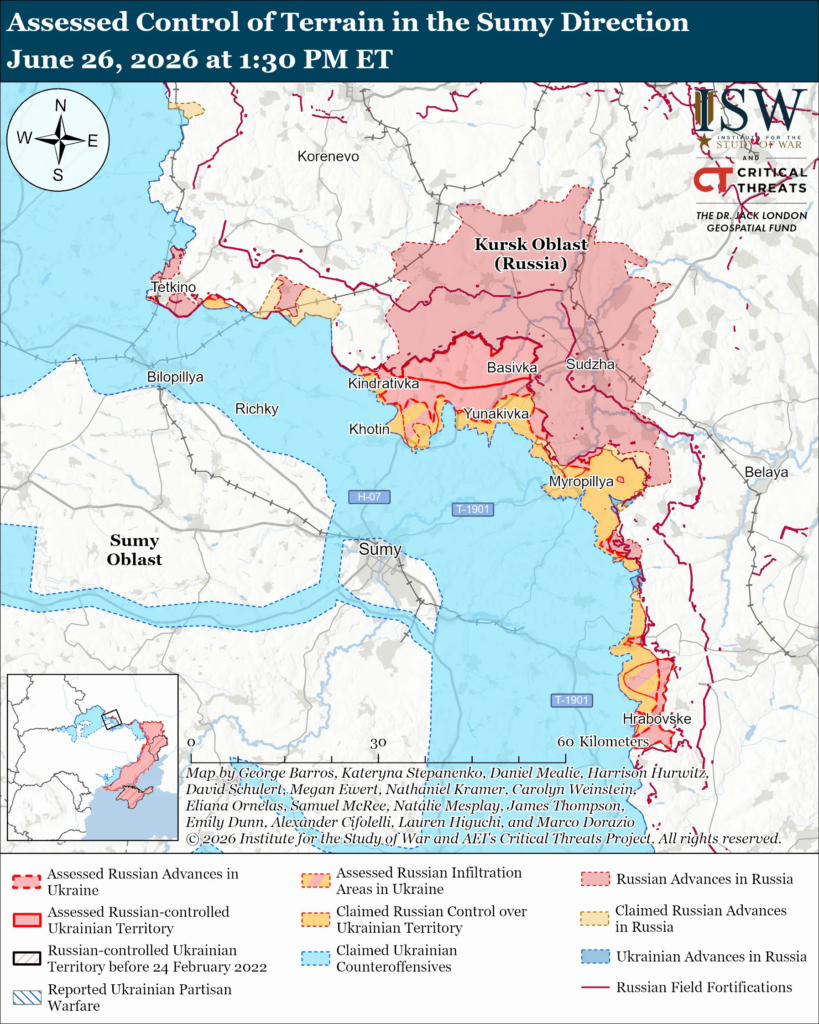
The Russian Ministry of Defense (MoD) claimed on June 26 that Russian forces struck a Ukrainian drone control point with two FAB-500 glide bombs near Velyka Pysarivka, Sumy Oblast (north of Sumy City).[33]
Russian forces struck an emergency vehicle in northern Sumy Oblast. Ukrainian broadcaster Suspilne reported on June 26 that Russian forces struck a Ukrainian vehicle that was evacuating individuals from Dyakivka, Sumy Oblast (northwest of Sumy City), and is associated with the Ukrainian National Police civilian evacuation unit White Angels.[34]
Russian Main Effort: Eastern Ukraine
Russian Subordinate Main Effort #1 – Kharkiv Oblast
Russian objective: Push Ukrainian forces back from the international border to create a defensible buffer zone with Belgorod Oblast and approach to within tube artillery range of Kharkiv City
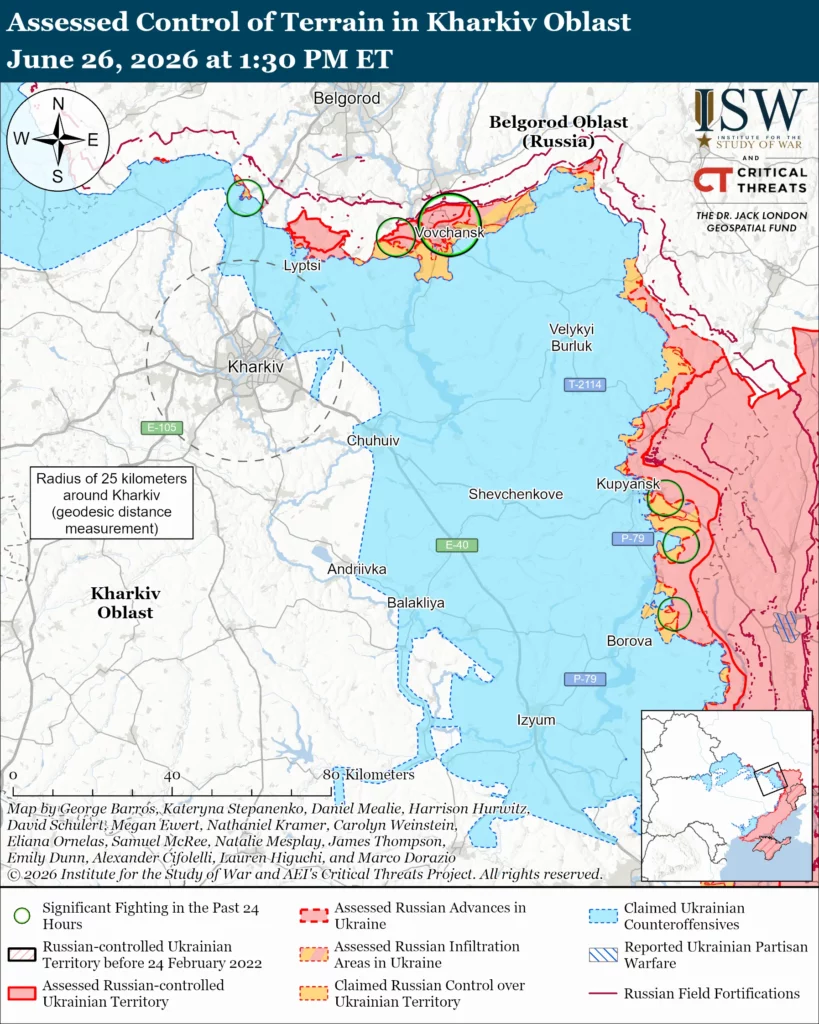
Russian forces continued offensive operations north and northeast of Kharkiv City on June 25 and 26, but did not advance.[35]
Russian forces continue to strike civilian infrastructure in Vovchansk. Vovchansk Military Administration Head Tamaz Gambarashvili reported on June 26 that Russian forces are striking humanitarian aid, electrical infrastructure, and communications infrastructure in Vovchansk with first-person view (FPV) drones, aerial bombs, Shahed and Molniya-type strike drones, and multiple launch rocket system (MLRS) fire.[36]
Neither Ukrainian nor Russian forces reported ground activity in the Velykyi Burluk direction on June 26.
The Ukrainian State Emergency Service reported on June 25 that Russian forces struck residential buildings on the outskirts of Velykyi Burluk with guided glide bombs, killing one person, injuring four people, and causing a fire.[37]
Russian Subordinate Main Effort #2 – Oskil River
Russian objective: Cross the Oskil River in Kharkiv Oblast and push westward into eastern Kharkiv Oblast and northern Donetsk Oblast
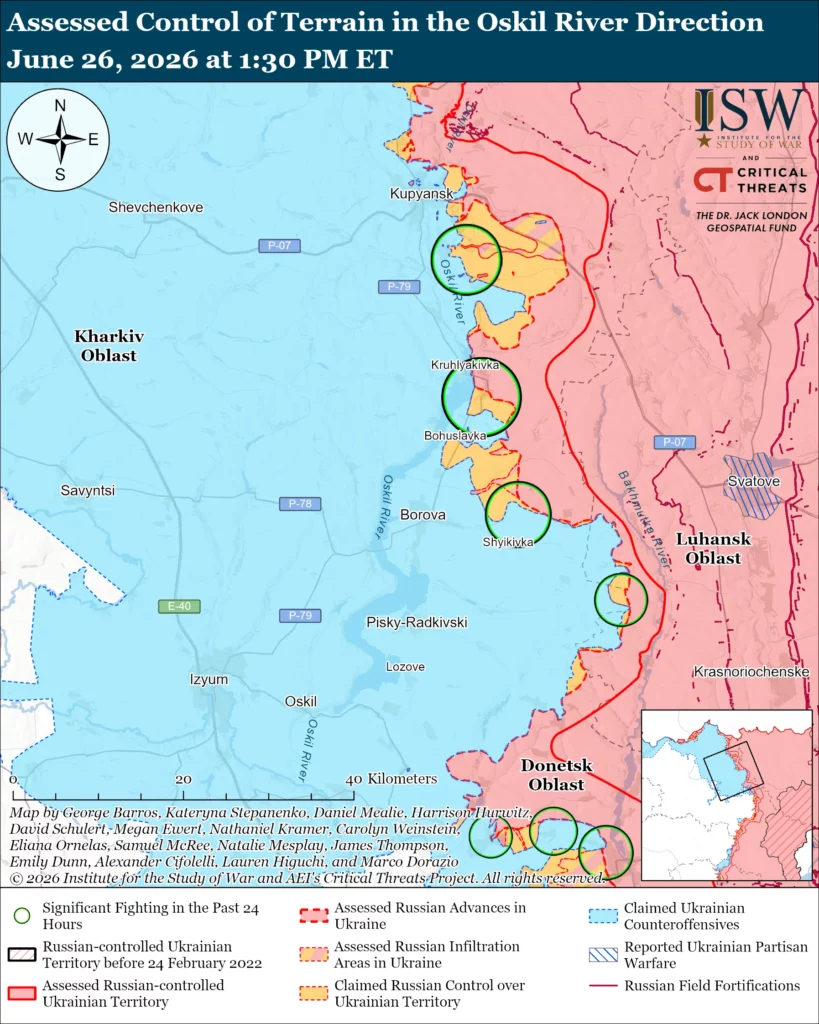
Russian forces continued offensive operations in the Kupyansk direction on June 25 and 26 but did not make confirmed advances.[38] A Russian milblogger claimed on June 26 that Russian forces advanced into northern Kivsharivka and northern Novoosynove (both southeast of Kupyansk).[39]
Ukrainian forces continue to strike Russian military assets in the Kupyansk direction. A Ukrainian brigade operating in the Kupyansk direction reported on June 26 that it destroyed a long-range Msta-B towed howitzer, another Russian artillery gun, and caused a fire at a Russian ammunition, fuel, and logistics warehouse.[40]
Russian forces continued limited offensive operations in the Borova direction on June 25 and 26, but did not advance.[41]
Ukrainian forces continued their intermediate-range strike campaign against Russian military assets in occupied Luhansk Oblast. Geolocated footage published on June 25 shows Ukrainian forces conducting a first-person view (FPV) drone strike against a Russian military truck near Zolote (roughly 36 kilometers from the frontline).[42]
Russian Subordinate Main Effort #3 – Donetsk Oblast
Russian objective: Capture the entirety of Donetsk Oblast, the claimed territory of Russia’s proxies in Donbas, and advance into Dnipropetrovsk Oblast
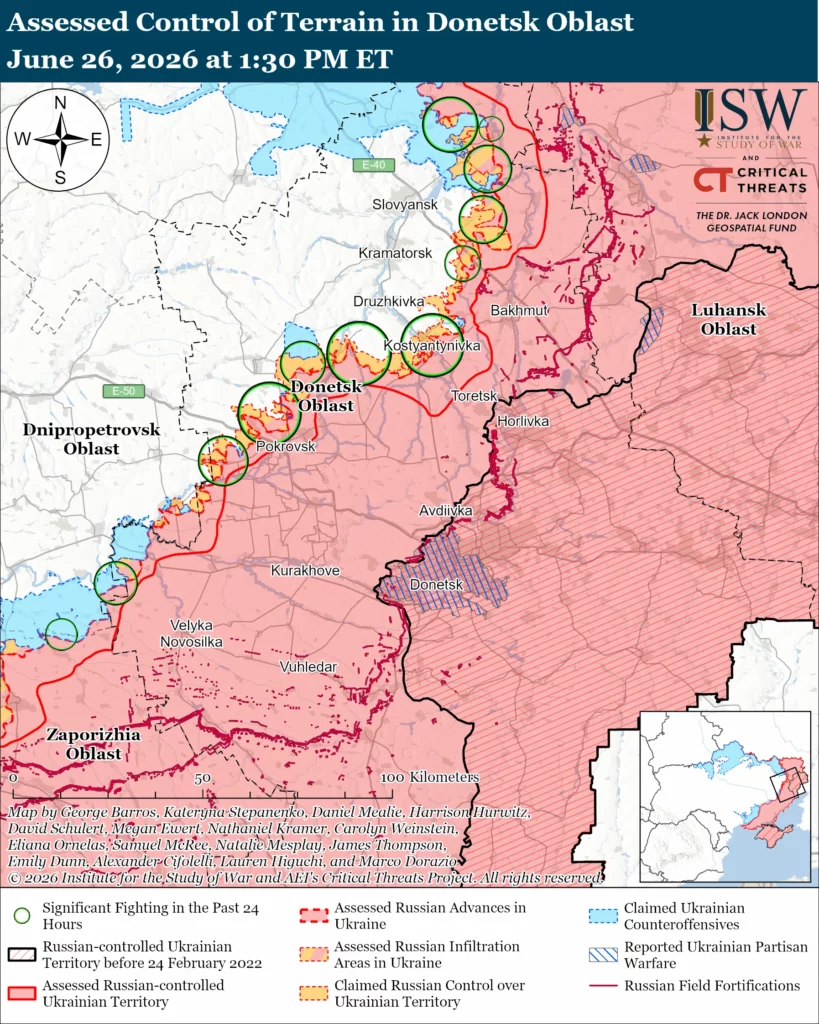
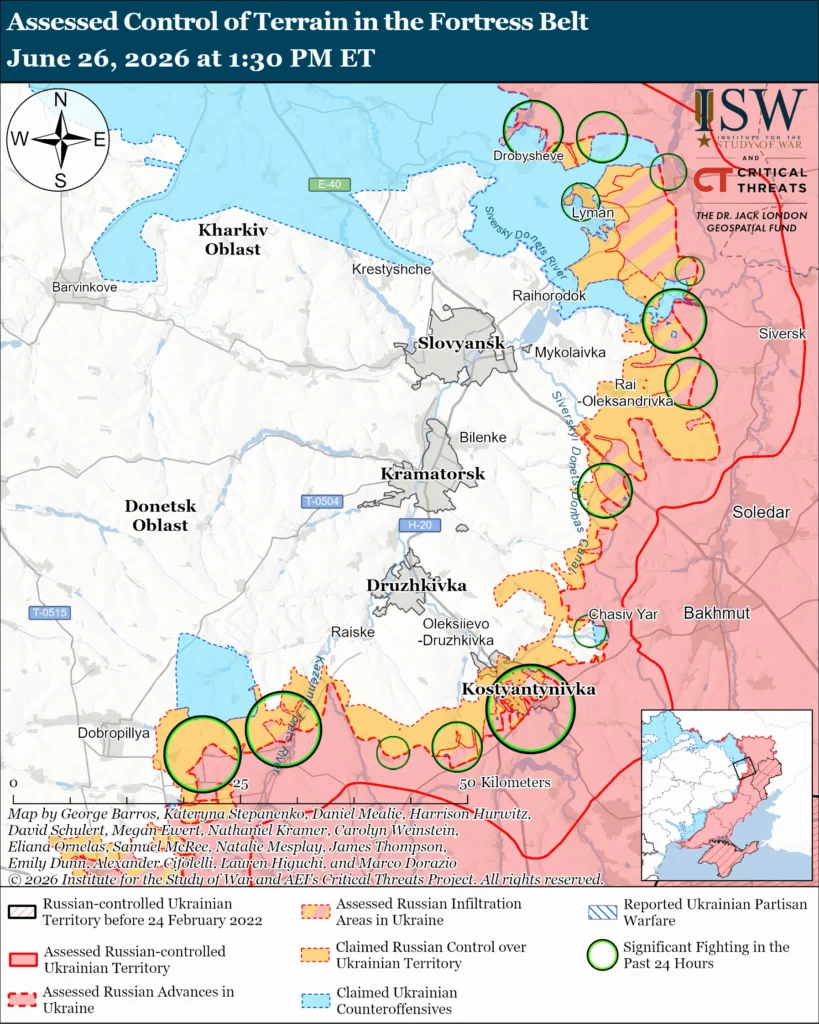
Russian forces recently advanced or maintained positions in the Slovyansk direction. Geolocated footage published on June 25 shows Ukrainian forces striking Russian servicemembers north of Riznykivka (east of Slovyansk), indicating that there are likely no Ukrainian positions remaining in the area.[43] Geolocated footage published on June 26 shows Russian forces shelling Ukrainian positions in eastern Ozerne (east of Slovyansk), an area where a Russian source previously claimed that Russian forces maintained a presence.[44]
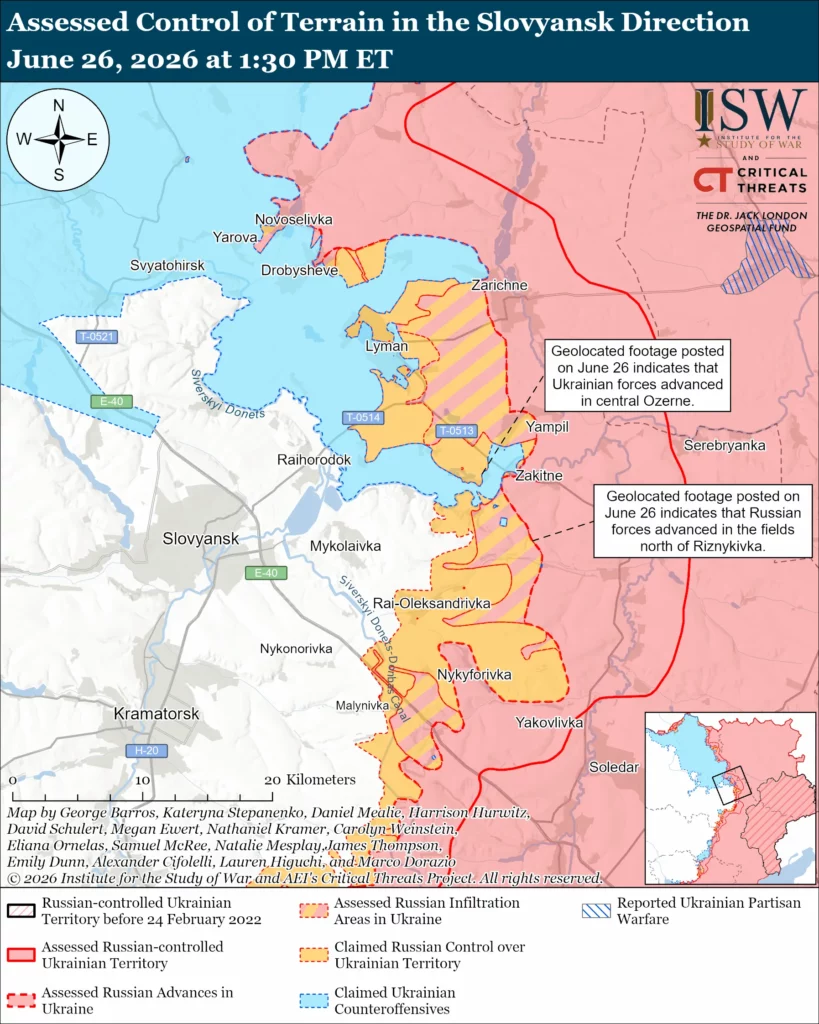
Ukrainian forces continue to strike Russian forces’ ground lines of communication (GLOCs) in the Slovyansk direction. The commander of a Ukrainian battalion operating in the Slovyansk direction reported on June 25 that Russian forces have stopped using heavy equipment in the Slovyansk direction due to Ukrainian drone strikes and are instead using motorcycles and buggies.[45] A Ukrainian brigade operating in the Lyman direction reported on June 25 that Ukrainian drone strikes are impeding Russian GLOCs and preventing Russian forces from providing logistical support to assault units.[46] A Ukrainian unmanned systems forces (USF) battalion reported on June 26 that it struck a Russian vehicle in the Slovyansk direction over 40 kilometers from the frontline.[47]
The Russian MoD claimed on June 26 that Russian forces conducted a FAB-1500 guided glide bomb strike against the Slovyansk Thermal Power Plant near Mykolaivka (east of Slovyansk).[48]
Russian forces continued offensive operations in the Kostyantynivka-Druzhkivka tactical area on June 25 and 26, but did not make confirmed advances.[49]
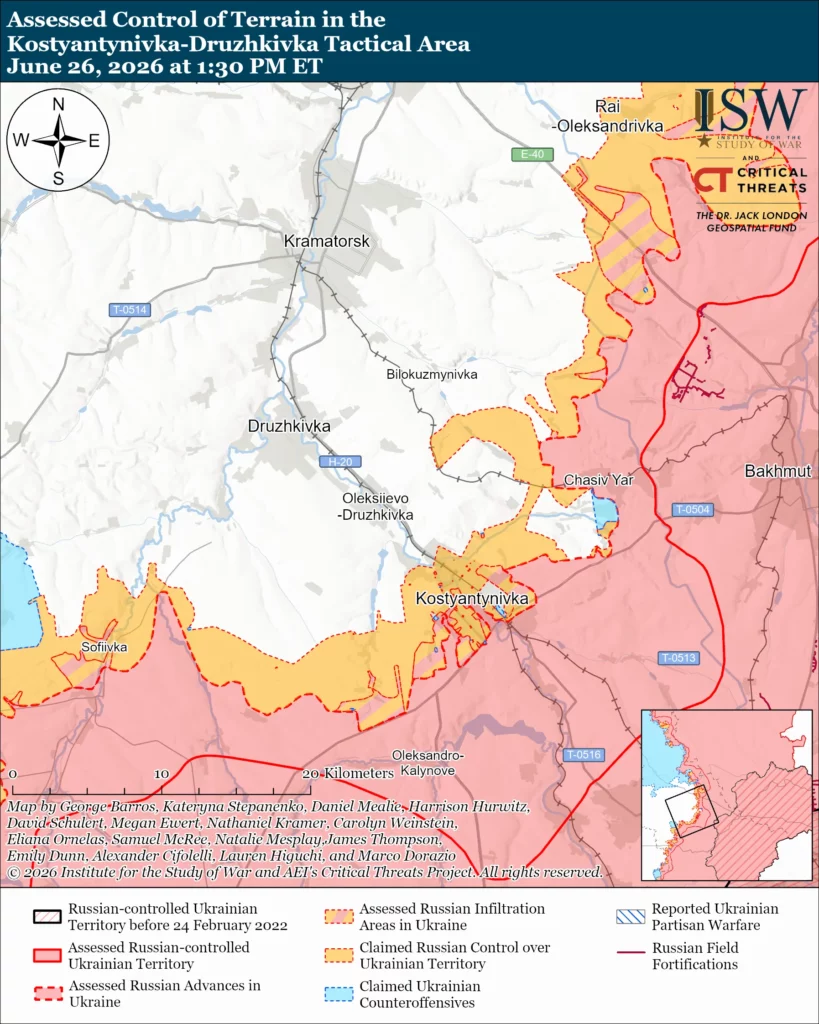
Russian and Ukrainian forces are using summer foliage for concealment in the Kostyantynivka direction. A Russian commander of the 1194th Motorized Rifle Regiment (4th Separate Motorized Rifle Brigade, 3rd Combined Arms Army [CAA], formerly 2nd Luhansk People’s Republic Army Corps [LNR AC], Southern Military District [SMD]) claimed on June 26 that Russian forces have air superiority in Kostyantynivka and are preventing Ukrainian forces from leaving concealed positions.[50] The commander reported that the Kostyantynivka urban environment provides Ukrainian forces with more protection and concealment from drone strikes than a field or windbreak. A Ukrainian brigade operating in Kostyantynivka reported on June 26 that Ukrainian forces are equipping armored vehicles with anti-drone protection as Russian forces use bushes, plantings, and roadsides to ambush Ukrainian vehicles.[51]
Russian forces continued limited offensive operations in the Dobropillya tactical area on June 25 and 26, but did not advance.[52]
Russian forces continued offensive operations in the Pokrovsk direction on June 25 and 26, but did not make confirmed advances.[53]
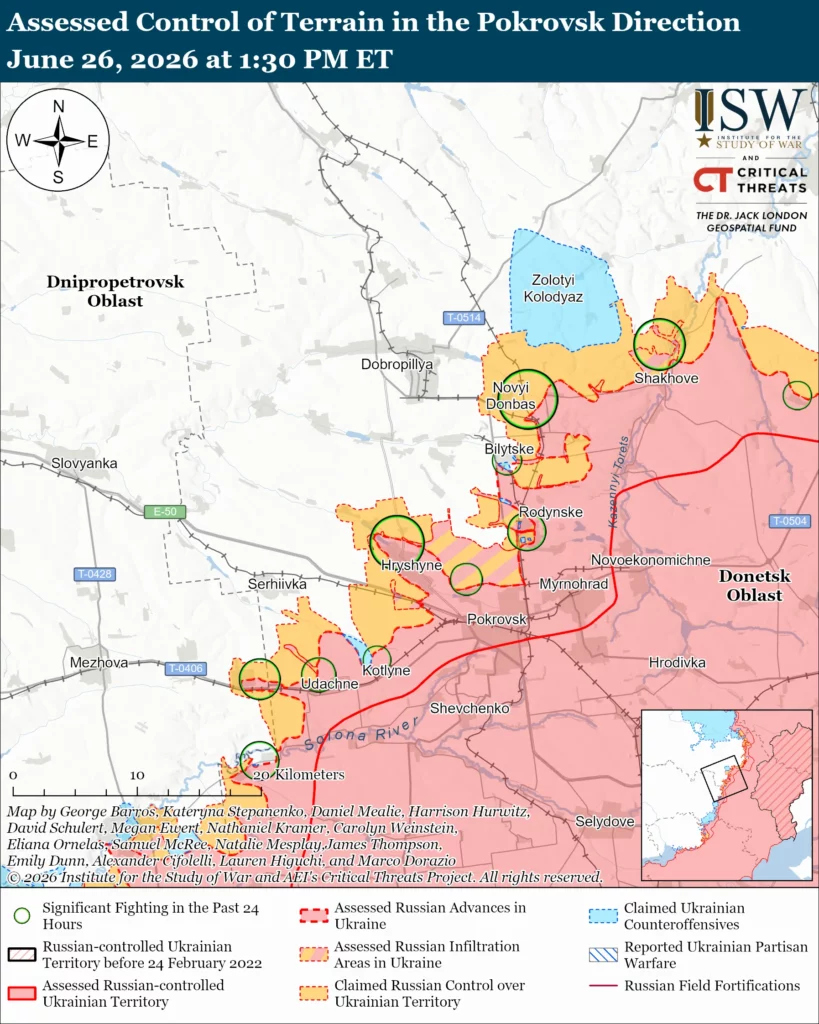
Russian forces continued offensive operations in the Novopavlivka and Oleksandrivka directions on June 25 and 26, but did not advance as Ukrainian forces counterattacked.[54] A Russian milblogger claimed that Ukrainian forces counterattacked in the Oleksandrivka direction.[55]
Ukrainian forces continued their intermediate-range strike campaign against Russian military assets in occupied Donetsk Oblast, impeding Russian forces’ frontline operations. A Ukrainian brigade operating in Donetsk Oblast reported on June 26 that Ukrainian strikes destroyed two Russian S-300 surface-to-air missile launchers near occupied Volnovakha (roughly 75 kilometers from the frontline) and next to the H-20 Donetsk-Mariupol highway.[56] The Ukrainian USF reported on June 25 that Ukrainian strikes on occupied Donetsk Oblast have created an armored vehicle shortage amongst Russian forces and forced Russian forces to send assault groups to attack on motorcycles.[57]
Russian Supporting Effort: Southern Axis
Russian objective: Maintain frontline positions, secure rear areas against Ukrainian strikes, and advance within tube artillery range of Zaporizhzhia City
Russian forces continued offensive operations in the Hulyaipole direction on June 25 and 26 but did not advance.[58]
Ukrainian forces recently advanced in western Zaporizhia Oblast. Russian milbloggers acknowledged on June 26 that Ukrainian forces advanced northeast of Kamyanske (west of Orikhiv) and that Ukrainian forces liberated Prymorske (north of Kamyanske), indicating that Ukrainian forces likely cleared any remaining Russian infiltrators from Prymorske.[59] A Kremlin-affiliated Russian milblogger claimed on June 26 that the situation west of Orikhiv is degrading for Russian forces and that Plavni (south of Kamyanske) is a contested “gray zone.”[60] The milblogger warned that Ukrainian forces are increasingly threatening the Russian logistics hub in Vasylivka (southwest of Orikhiv). Another milblogger claimed that Ukrainian forces took advantage of a botched Russian rotation to enter Plavni and that fighting for the settlement is ongoing.[61]
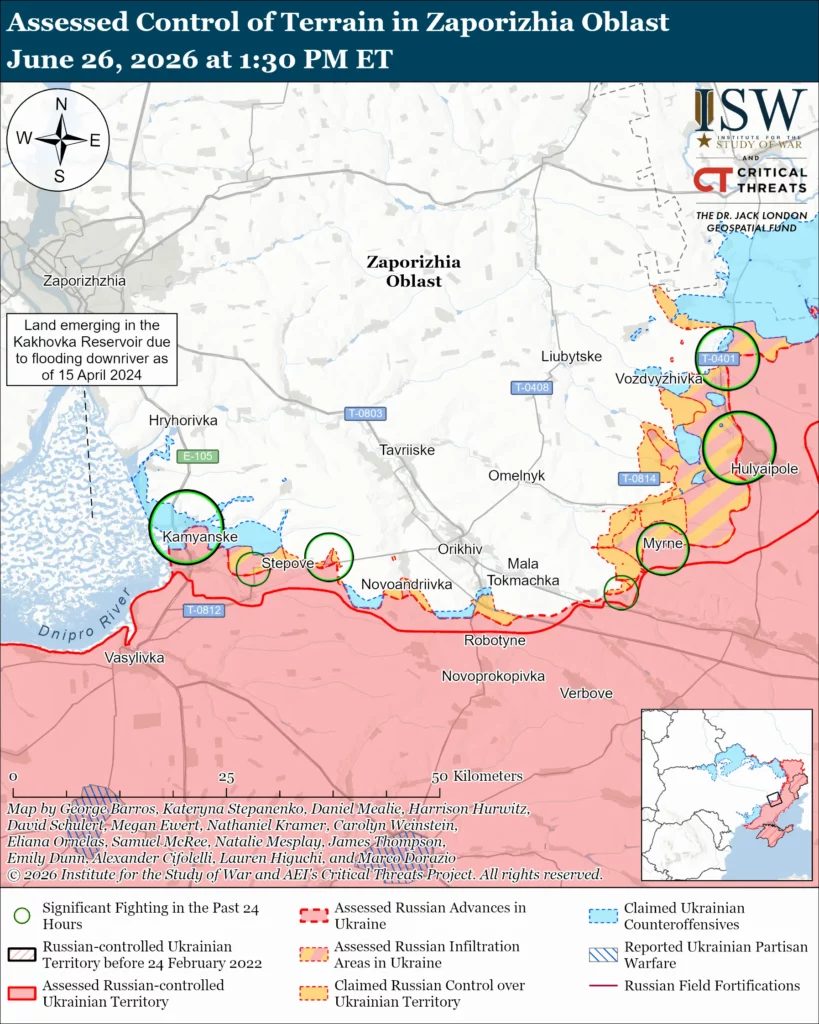
Ukrainian forces continue interdicting Russian logistics in occupied Zaporizhia Oblast. Geolocated footage published on June 26 shows a smoke plume at a bridge on the M-14 Rostov-Crimea highway south of Volodymyrivka (about 86 kilometers from the frontline) following purported Ukrainian strikes.[62] A Ukrainian open-source intelligence (OSINT) source suggested that Ukrainian strikes destroyed the bridge.[63]
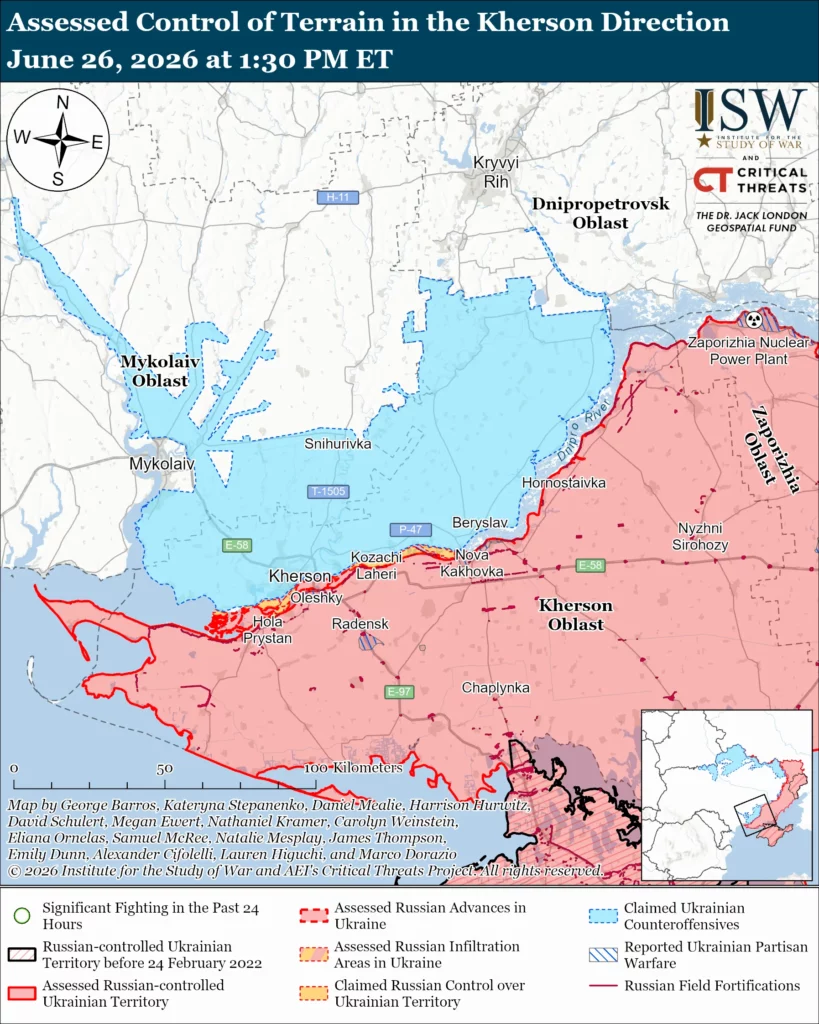
Neither Ukrainian nor Russian sources reported ground activity in the Kherson direction on June 26.
Ukrainian forces continue interdicting Russian ground lines of communication (GLOCs) in occupied Kherson Oblast. Geolocated footage published on June 25 shows a Ukrainian drone striking a Russian KamAz transport vehicle parked just north of the M-17 Oleshky-Armyansk highway north of Novooleksandrivka (about 61 kilometers from the frontline).[64]
Russian Air, Missile, and Drone Campaign
Russian Objective: Target Ukrainian military and civilian infrastructure in the rear and on the front line
Russian forces conducted a series of long-range missile and drone strikes against Ukraine on the night of June 25 to 26. The Ukrainian Air Force reported that Russian forces launched seven Iskander-M ballistic missiles from Bryansk and Kursk oblasts, and 189 Shahed-type, Gerbera-type, Italmas-type strike drones, and Parodiya-type decoy drones from the directions of Kursk, Bryansk, and Oryol cities; Primorsko-Akhtarsk, Krasnodar Krai; occupied Hvardiiske, Crimea; and occupied Donetsk City.[65] The Ukrainian Air Force reported that Ukrainian forces downed three Iskander-M ballistic missiles and 174 drones, that four missiles and 11 drones struck 12 locations, and that debris fell on six locations. Ukrainian officials reported that Russian strikes damaged residential, railway, gas, energy, and agricultural infrastructure in Chernihiv, Kharkiv, Kyiv, Poltava, Odesa, Sumy, and Zaporizhia oblasts.[66] Ukrainian state energy operator Ukrenergo reported on June 26 that Russian strikes caused power outages in Dnipropetrovsk, Zaporizhia, Odesa, Kharkiv, Poltava, and Kherson oblasts.[67]
Russian forces continue to strike Ukrainian gas facilities and rail infrastructure in an effort to disrupt Ukrainian logistics. Ukrainian officials reported on June 26 that Russian Gerbera-type drones struck up to five gas stations in Chernihiv and Sumy oblasts.[68] A Kremlin-affiliated Russian milblogger claimed on June 25 and 26 that Russian forces are escalating strikes on Ukrainian fuel infrastructure in an effort to complicate Ukrainian logistics.[69] Former Ukrainian Minister of Infrastructure Andriy Pyvovarsky previously reported on June 25 that Russian forces struck over 150 gas stations in Ukraine in the past two months, but noted that Ukraine’s diversified oil and gas market is preventing significant regional shortages.[70] The Russian Ministry of Defense (MoD) claimed on June 26 that Russian forces struck two locomotives in Zaporizhia Oblast and three locomotives in Kharkiv Oblast with Geran-type drones.[71]
Significant Activity in Belarus
Russian efforts to increase its military presence in Belarus and further integrate Belarus into Russian-favorable frameworks
Russian President Vladimir Putin and Belarusian President Alexander Lukashenko met at Putin’s residence in Valdai, Novgorod Oblast, on June 26. Kremlin Spokesperson Dmitry Peskov announced on June 26 that Putin and Lukashenko discussed the Union State agenda and bilateral trade, economic cooperation, and regional security.[72] Independent Russian media outlet Agentstvo reported on June 26, citing Google Maps traffic data, that authorities closed several kilometers of the M-11 Moscow-St. Petersburg highway near Putin’s Valdai residence.[73]
Russian President Vladimir Putin revealed details about joint Russian-Belarusian production of dual-use goods. Putin stated on June 26 at the 13th Forum of Russian and Belarusian regions that Belarusian and Russian companies are cooperating on the design, manufacturing, and assembly of mining and machine tools, Yakovlev MC-21 and Sukhoi Superjet-100 airliners, Osvey light multipurpose aircraft, electronics manufacturing components, and optical and photonics devices for communications and data transmission.[74]
Note: ISW does not receive any classified material from any source, uses only publicly available information, and draws extensively on Russian, Ukrainian, and Western reporting and social media as well as commercially available satellite imagery and other geospatial data as the basis for these reports. References to all sources used are provided in the endnotes of each update.