 Eurasia Press & News
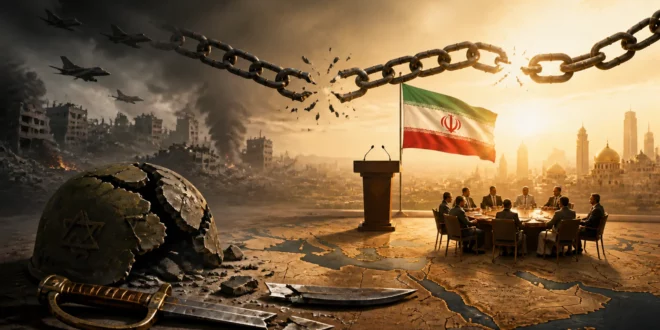
Israel’s recent regional strategy has exposed significant limitations in achieving its long-term foreign policy objectives, illustrating the widening gap between military operations and strategic success. While Iran’s resilience and diplomatic positioning have accelerated the emergence of a more multipolar and diplomatically driven Middle Eastern security order.
Carl von Clausewitz once noted, “War is merely the continuation of policy by other means.” It means if war does not serve a state’s political objectives, it results in strategic failure. Israel’s offensive policy in the Middle East is now facing the same dilemma: war objectives are not accomplished, the domestic situation is becoming unstable, and the political aims are unfinished. The 108-day Iran-US conflict is its prime example, where a country, which has been under serious economic and diplomatic pressure for decades, has crushed the US monopoly and Israel’s strategic superiority in the region.
The signing of the Islamabad Memorandum of Understanding depicts a complete humiliation of the US and Israel. It’s often said that American foreign policy is being formulated in Tel Aviv. This failure of Israel’s foreign policy has ultimately led to the American strategic defeat. The rising multipolar world order has now come up with a novel feature: “In the modern era, winning the battlefield alone or having military superiority does not guarantee a successful foreign policy posture.”
Israel’s Foreign Policy Objectives and Their Failure
The Middle East is now transitioning towards a new security landscape where balance of power will prevail, characterized by diplomacy and strategic pluralism
Israel’s foreign policy revolves around three main pillars: military superiority, preventing other states from becoming a powerful regional player, and deterring hostile proxy groups in the region. Former Israeli Prime Minister David Ben-Gurion stated, “Israel must rely on qualitative superiority to ensure its survival.” However, Israel’s recent war against Iran has exposed serious limitations and loopholes in this strategy. It would not be exaggerated to say that due to this war, the only country in the Middle East that has become too weak is none other than Israel. With regard to the first pillar, Iran and Israel have no military comparison.
Israel’s indigenous war industry, along with immense support from the US, has always maintained its monopoly in the region. However, a relatively much weaker state, Iran, has curbed its influence in just a couple of months. Likewise, in case of regional dominance, the results of the ongoing war are crystal clear: Iran’s strategic stature has been elevated. Israel tried its best to isolate Iran, but all in vain. Tehran became the center of diplomacy, with the US directly negotiating with it. Last but not least, Iran has not left its partners alone. Since day one, Iran has demanded a halting of aggression on all fronts, including Lebanon. This means that Israel may have succeeded in its tactical objectives, but in strategic terms, it’s the same as before.
Iran’s Strategic Gains and Diplomatic Leverage
“The test of policy is how it ends, not how it begins” (Henry Kissinger)
The US-Iran war was started with an opinion that Iran, due to being a sanctioned state, might not sustain the combined US-Israel assault. But what the post-war circumstances reveal is quite the opposite. Iran has not only sustained military attacks, but also its negotiating power has increased. Throughout the negotiations, Iran has maintained an upper hand. With control over key choke points and capable of targeting US bases in the region with full precision and accuracy, Iran has been successful in mitigating the incoming threat. The US not only used its complete military might but also the US Treasury Secretary Scott Bessant’s economic strategy against Iran, bringing the Iranian economy to its knees, was also implied. Bypassing all this, Iran maintained its economic well-being and regained its lost diplomatic relevance in the international arena.
One of the most important strategic gains that Iran acquired was the creation of fissures between the decades-long ironclad partnership between the US and Israel. Since February 2026, both the US and Israel have tried their utmost to create divisions inside Iranian political circles — to destroy Iran internally. But what actually happened was an increase in rising differences between Israel and the US. While the Trump administration is chanting that Lebanon is included in the ceasefire and that without the US, Israel would have been destroyed, the Israeli officials are stringent on their motive of using disproportionate force in Lebanon. Israeli PM Netanyahu recently stated that the signing of a memorandum with Iran was Trump’s decision; Israel has its own aims and objectives. The ones who were determined to divide their rivals are now themselves confronting each other.
Emergence of a New Middle Eastern Security Order
The revival of Iran’s strategic leverage in the region could be considered the first major step towards a more multipolar Middle East where traditional hegemons are no longer enjoying unipolarity. It must be acknowledged that military superiority alone cannot guarantee your success. The formations of alliances, diplomatic leverage, and economic integration are key elements of modern warfare. What has Israel achieved by using disproportionate forces against civilians in the region?
The international community has completely sidelined and isolated Israel. Neither the Gulf States nor the European countries have been able to support Israeli aggression. The public opinion worldwide has changed, criticizing Israel for its inhumane military doctrines. The Middle East is now transitioning towards a new security landscape where balance of power will prevail, characterized by diplomacy and strategic pluralism.
Conclusion
The 2025-26 Gulf War must be viewed through the lens of long-term geopolitical consequences, instead of focusing on tactical outcomes. What Iran did was quite simple but attractive: slowly hurting its enemy, causing it to bleed for a long period of time. And guess what it resulted in? The US was forced to sit at the negotiation table with a humiliated face. Moreover, Israel’s foreign policy instruments have been tested in the war, which resulted in a complete strategic failure. In essence, the main achievement of the ongoing confrontation will not be determined by who made the last strike but by who was more effective in setting the region’s political agenda after the end of hostilities.